Loading...
This comparison has not been analyzed yet.
One-time AI generation (~1 minute). Scores and timeline are already available below.
Chadli Bendjedid vs Jusuf Kalla
Chadli Bendjedid leads by 1.2 pts · 2 figures compared
…
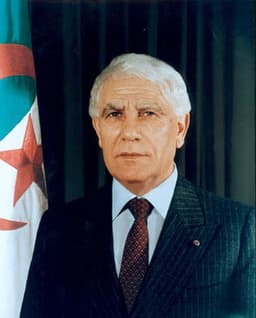
Chadli Bendjedid
Politician · Modern
50.3Total

Jusuf Kalla
Politician · Modern
49.1Total
Basic Information
Born
1929
1942
Died
—
—
Era
Modern
Modern
Nationality
Algeria
Indonesia
Occupation
Politician
Politician
Civilization
Middle Eastern
Eastern
Score Comparison
Military (10%)
41.3
13.9
Political (20%)
68.0
53.8
Influence (20%)
52.5
55.7
Legacy (20%)
41.7
45.8
Leadership (15%)
53.2
72.0
Strategy (15%)
44.3
35.1
TOTAL
50.3
49.1
Chadli Bendjedid — Complete Timeline
1979 AD
Elected President of AlgeriaPolitical Action◆ Major
Bendjedid was elected president after the death of Houari Boumediene. His election marked a shift from the revolutionary era to a period of political and economic liberalization in Algeria.
Algerian PoliticsSuccessionLiberalization
Impact: national
1988 AD
Introduced Political and Economic ReformsReform◆ Major
After the October 1988 riots, Bendjedid introduced a new constitution that ended the one-party system and allowed for multiparty elections. He also implemented economic liberalization measures, moving away from state socialism.
Constitutional ReformMultiparty SystemEconomic Liberalization
Impact: nationalprogressive
1992 AD
Resigned Under Military Pressure Amid Civil WarPolitical Action
Facing a likely victory by the Islamic Salvation Front (FIS) in the second round of parliamentary elections, Bendjedid resigned under pressure from the military. His resignation triggered the Algerian Civil War, a decade-long conflict between the government and Islamist insurgents.
Algerian Civil WarMilitary InterventionIslamist Conflict
Impact: nationaltragic
Jusuf Kalla — Complete Timeline
2004 AD
Elected Vice President of Indonesia (First Term)Political Action◆ Major
Jusuf Kalla was elected Vice President alongside President Susilo Bambang Yudhoyono. He played a key role in economic policy and infrastructure development, and was instrumental in negotiating the Helsinki peace deal for Aceh.
Vice PresidentSBYAceh Peace
Impact: nationalconstructive
2005 AD
Negotiated the Helsinki Peace Agreement for AcehPolitical Action
Kalla played a key role in brokering the Helsinki peace agreement between the Indonesian government and the Free Aceh Movement (GAM). The agreement ended a decades-long insurgency and granted Aceh special autonomy.
AcehPeaceHelsinki
Impact: regionalconstructive
2014 AD
Elected Vice President of Indonesia (Second Term)Political Action◆ Major
Kalla was elected Vice President for a second term, this time alongside President Joko Widodo. He brought experience in economic development and infrastructure, and helped manage the transition of power.
Vice PresidentJokowiSecond Term
Impact: nationalconstructive
This comparison has not been analyzed yet.
One-time AI generation (~1 minute). Scores and timeline are already available below.
Rankings
🥇
Chadli BendjedidLeader
Mil: 41.3Pol: 68.0Inf: 52.5
50.3
🥈
Jusuf Kalla
Mil: 13.9Pol: 53.8Inf: 55.7
49.1
+1.2 behind
How This Comparison Works
Algorithm
Each figure is scored on 6 dimensions (0—100 scale) based on structured historical data: Military (10%), Political (20%), Influence (20%), Legacy (20%), Leadership (15%), Strategy (15%). The weighted total produces the final ranking.
Data Sources
Scores are computed from structured sub-indicators in the database. Scale factors adjust for era (Ancient ×0.85, Modern ×1.0) and civilization size (Eastern ×1.05, Other ×0.80) to account for differences in population and military scale.
Maximum 3 Figures
Comparisons are limited to 2—3 figures to ensure readability and statistical meaningfulness.
Error Margins
±5 points per dimension — Sub-scores are derived from historical records with inherent uncertainty. Two figures within 5 points on a dimension should be considered roughly equivalent in that area.
Total Score Accuracy
±3 points overall — The weighted combination of 6 dimensions produces a total score with approximately ±3 points of uncertainty. Differences of less than 3 points are not statistically significant— the figures are effectively tied.
Known Limitations
- Historical records are incomplete and uneven across civilizations
- Figures from oral-tradition societies may be underrepresented
- Occupation labels can misclassify multi-role figures
- Scores measure capability and impact, not moral character
- Quantitative scoring is a comparison tool, not absolute truth
Capability Radar
Military (10%) — Battles & Warfare
Battles
20
13
Win Rate
24
18
Expansion
29
20
Political (20%) — Governance & Reform
Reform
55
55
Diplomacy
50
60
Economy
40
60
Influence (20%) — Cultural & Global Reach
Cultural
30
40
Global
25
35
Legacy (20%) — Historical Impact
Historical
30
45
Longevity
20
30
Leadership (15%) — Power & Stability
Tenure
65
65
Stability
35
55
Strategy (15%) — Tactics & Innovation
Strategy
30
24
Tactics
31
28
Reform
37
26
Similar Comparisons
Comments & Discussion
No comments yet. Be the first to share your thoughts!