Loading...
This comparison has not been analyzed yet.
One-time AI generation (~1 minute). Scores and timeline are already available below.
Chadli Bendjedid vs Mohamed Bazoum
Chadli Bendjedid leads by 8.4 pts · 2 figures compared
…
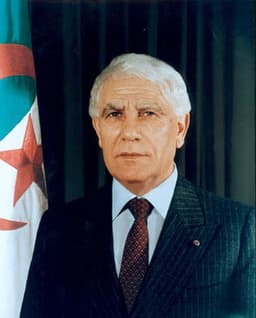
Chadli Bendjedid
Politician · Modern
50.3Total

Mohamed Bazoum
Politician · Modern
41.9Total
Basic Information
Born
1929
1960
Died
—
—
Era
Modern
Modern
Nationality
Algeria
Niger
Occupation
Politician
Politician
Civilization
Middle Eastern
Other
Score Comparison
Military (10%)
41.3
47.1
Political (20%)
68.0
39.4
Influence (20%)
52.5
47.9
Legacy (20%)
41.7
35.0
Leadership (15%)
53.2
41.5
Strategy (15%)
44.3
43.7
TOTAL
50.3
41.9
Chadli Bendjedid — Complete Timeline
1979 AD
Elected President of AlgeriaPolitical Action◆ Major
Bendjedid was elected president after the death of Houari Boumediene. His election marked a shift from the revolutionary era to a period of political and economic liberalization in Algeria.
Algerian PoliticsSuccessionLiberalization
Impact: national
1988 AD
Introduced Political and Economic ReformsReform◆ Major
After the October 1988 riots, Bendjedid introduced a new constitution that ended the one-party system and allowed for multiparty elections. He also implemented economic liberalization measures, moving away from state socialism.
Constitutional ReformMultiparty SystemEconomic Liberalization
Impact: nationalprogressive
1992 AD
Resigned Under Military Pressure Amid Civil WarPolitical Action
Facing a likely victory by the Islamic Salvation Front (FIS) in the second round of parliamentary elections, Bendjedid resigned under pressure from the military. His resignation triggered the Algerian Civil War, a decade-long conflict between the government and Islamist insurgents.
Algerian Civil WarMilitary InterventionIslamist Conflict
Impact: nationaltragic
Mohamed Bazoum — Complete Timeline
2021 AD
Elected President of NigerPolitical Action◆ Major
Mohamed Bazoum was elected president of Niger in a peaceful transfer of power, succeeding Mahamadou Issoufou. His election was seen as a milestone for democracy in a region plagued by coups.
ElectionDemocratic TransitionPeaceful Transfer
Impact: nationalconstructive
2023 AD
Deposed in Coup d'ÉtatPolitical Action
President Mohamed Bazoum was deposed by members of his own presidential guard on July 26, 2023. The coup was led by General Abdourahamane Tchiani, who cited insecurity and economic challenges as justifications.
CoupEnd of DemocracyPolitical Crisis
Impact: nationaldestructive
Detained by Coup LeadersOther◆ Major
Following the coup, Mohamed Bazoum was detained in his presidential palace along with his family. International calls for his release, including from ECOWAS and the UN, were ignored by the new military junta.
DetentionHuman RightsInternational Crisis
Impact: nationaltragic
This comparison has not been analyzed yet.
One-time AI generation (~1 minute). Scores and timeline are already available below.
Rankings
🥇
Chadli BendjedidLeader
Mil: 41.3Pol: 68.0Inf: 52.5
50.3
🥈
Mohamed Bazoum
Mil: 47.1Pol: 39.4Inf: 47.9
41.9
+8.4 behind
How This Comparison Works
Algorithm
Each figure is scored on 6 dimensions (0—100 scale) based on structured historical data: Military (10%), Political (20%), Influence (20%), Legacy (20%), Leadership (15%), Strategy (15%). The weighted total produces the final ranking.
Data Sources
Scores are computed from structured sub-indicators in the database. Scale factors adjust for era (Ancient ×0.85, Modern ×1.0) and civilization size (Eastern ×1.05, Other ×0.80) to account for differences in population and military scale.
Maximum 3 Figures
Comparisons are limited to 2—3 figures to ensure readability and statistical meaningfulness.
Error Margins
±5 points per dimension — Sub-scores are derived from historical records with inherent uncertainty. Two figures within 5 points on a dimension should be considered roughly equivalent in that area.
Total Score Accuracy
±3 points overall — The weighted combination of 6 dimensions produces a total score with approximately ±3 points of uncertainty. Differences of less than 3 points are not statistically significant— the figures are effectively tied.
Known Limitations
- Historical records are incomplete and uneven across civilizations
- Figures from oral-tradition societies may be underrepresented
- Occupation labels can misclassify multi-role figures
- Scores measure capability and impact, not moral character
- Quantitative scoring is a comparison tool, not absolute truth
Capability Radar
Military (10%) — Battles & Warfare
Battles
20
19
Win Rate
24
27
Expansion
29
28
Political (20%) — Governance & Reform
Reform
55
30
Diplomacy
50
35
Economy
40
25
Influence (20%) — Cultural & Global Reach
Cultural
30
10
Global
25
15
Legacy (20%) — Historical Impact
Historical
30
15
Longevity
20
5
Leadership (15%) — Power & Stability
Tenure
65
20
Stability
35
10
Strategy (15%) — Tactics & Innovation
Strategy
30
32
Tactics
31
31
Reform
37
34
Similar Comparisons
Comments & Discussion
No comments yet. Be the first to share your thoughts!