Loading...
Charles of Anjou vs Zhao Kuangyin
Zhao Kuangyin leads by 12.0 pts · 2 figures compared
…
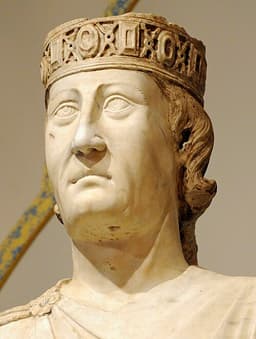
Charles of Anjou
Emperor · Medieval
59.5Total
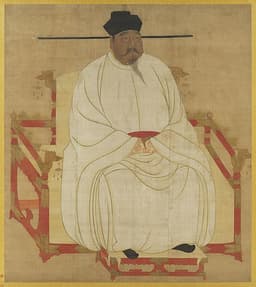
Zhao Kuangyin
Emperor · Medieval
71.5Total
Basic Information
Born
1227
927
Died
1285
976
Era
Medieval
Medieval
Nationality
France
China
Occupation
Emperor
Emperor
Civilization
Western
Eastern
Score Comparison
Military (10%)
82.0
78.0
Political (20%)
48.5
84.0
Influence (20%)
56.7
68.0
Legacy (20%)
52.0
65.0
Leadership (15%)
68.0
74.0
Strategy (15%)
66.3
68.0
TOTAL
59.5
71.5
Charles of Anjou — Complete Timeline
1266 AD
Battle of BeneventoWar◆ Major
Charles of Anjou defeated Manfred of Hohenstaufen at Benevento. Manfred was killed in the battle, allowing Charles to take control of the Kingdom of Sicily. This victory established the Angevin dynasty in southern Italy.
Angevin ConquestHohenstaufenItaly
Impact: regional
1268 AD
Battle of TagliacozzoWar◆ Major
Charles of Anjou defeated Conradin, the last Hohenstaufen claimant, at Tagliacozzo. Conradin was captured and later executed in Naples. This victory secured Charles's control over Sicily and ended Hohenstaufen claims.
HohenstaufenExecutionItaly
Impact: regionaldestructive
1282 AD
Sicilian VespersWar
A rebellion broke out in Palermo against Angevin rule, leading to the massacre of French officials and soldiers. The revolt spread across Sicily, resulting in the loss of the island to Peter III of Aragon. This event ended Charles's control of Sicily.
RevoltAragonSicily
Impact: regionaldestructive
1284 AD
Crusade against AragonWar
Pope Martin IV declared a crusade against Peter III of Aragon, and Charles of Anjou led the campaign. The French invasion of Aragon failed, and Charles's fleet was defeated. This crusade drained Angevin resources and weakened his position.
CrusadeAragonFailure
Impact: regionaldestructive
Zhao Kuangyin — Complete Timeline
960 AD
Founded Song dynastyPolitical Action
Zhao Kuangyin, a general of Later Zhou, was proclaimed emperor by his troops at Chenqiao. He established the Song dynasty, ending the Five Dynasties period and beginning a new era of Chinese history.
Song dynastyFoundingChenqiao
Impact: globalconstructive
961 AD
Removed military power from generalsPolitical Action◆ Major
Zhao Kuangyin invited senior generals to a banquet and persuaded them to retire peacefully. This 'removal of military power over wine' prevented military coups and centralized control.
Song dynastyMilitary reformCentralization
Impact: nationalconstructive
963 AD
Unified southern ChinaWar◆ Major
Zhao Kuangyin launched campaigns to conquer the southern kingdoms, including Jingnan, Later Shu, and Southern Tang. By his death, most of China was reunified under Song rule.
Song unificationConquestSouthern kingdoms
Impact: national
Expert Analysis
Zhao Kuangyin vs Charles of Anjou
# The Conqueror and the Unifier: Charles of Anjou and Zhao Kuangyin
On a spring morning in 1266, Charles of Anjou rode through the bloody fields of Benevento, where the body of his rival Manfred lay twisted among the dead. Less than three centuries earlier and half a world away, another commander, Zhao Kuangyin, stood before his troops at Chenqiao, accepting a yellow robe thrust upon him by soldiers who refused to serve another. One man built his throne on the bones of his enemies; the other built his on a cup of wine shared with friends. Both were medieval emperors. Both shaped the destiny of civilizations. Yet their paths could not have diverged more dramatically—and the reasons for that divergence lie not in fate, but in the very different worlds that made them.
Origins
Charles of Anjou was born into the fierce, competitive world of 13th-century French royalty. The youngest son of King Louis VIII, he inherited nothing but ambition. France in his time was a patchwork of feudal loyalties, where a prince could carve a kingdom from the ruins of others—if he was ruthless enough. The Mediterranean was aflame with the struggle between popes and emperors, and the papacy desperately needed a champion against the Hohenstaufen dynasty that threatened to encircle Rome.
Zhao Kuangyin came from a China fractured by the Five Dynasties and Ten Kingdoms period, an era of constant warfare where generals deposed emperors as easily as changing clothes. Born into a military family in 927, he grew up watching warlords rise and fall. The chaos was not abstract—it was the air he breathed. But unlike Charles, Zhao was shaped by a civilization that valued order above conquest, where the Confucian ideal of a stable, unified realm was the highest political good.
Rise to Power
Charles’s ascent was a gamble orchestrated by the papacy. In 1263, Pope Urban IV offered him the Kingdom of Sicily, then held by the Hohenstaufen Manfred. Charles accepted, raised an army with French and papal money, and marched south. At Benevento in 1266, he crushed Manfred’s forces—Manfred died in the battle. Two years later, when Conradin, the sixteen-year-old last Hohenstaufen heir, tried to reclaim his inheritance, Charles met him at Tagliacozzo. Outnumbered and nearly defeated, Charles won through a clever ambush. Then he captured Conradin and, in a move that shocked Christendom, executed the boy in the marketplace of Naples.
Zhao Kuangyin’s rise was almost the opposite—a reluctant usurpation. In 960, as a general of the Later Zhou dynasty, he was ordered north to repel a Khitan invasion. But his troops stopped at Chenqiao and proclaimed him emperor. Zhao accepted, but only after extracting promises that the capital would not be looted and the former emperor’s family would be spared. Where Charles seized power through blood, Zhao inherited it through a carefully managed coup.
Leadership & Governance
As ruler, Charles of Anjou revealed himself as a brilliant administrator and a terrifying tyrant. He centralized the Sicilian kingdom, built a powerful navy, and turned Naples into a Mediterranean trading hub. His leadership score of 85.1 reflects his ability to command loyalty and fear. But his rule was harsh: he imposed heavy taxes, replaced local nobles with French officials, and treated Sicily as a conquered province. His strategy score of 63.0 hints at a deeper flaw—he could win battles but could not win hearts.
Zhao Kuangyin governed with a different philosophy. His political score of 75.9 and military score of 74.6 both exceed Charles’s in raw terms, but the real difference lies in wisdom. In 961, Zhao invited his most powerful generals to a banquet. As wine flowed, he spoke of his sleepless nights, worrying that one day their own soldiers might force them to rebel. The generals understood. The next morning, they resigned their commands and retired to comfortable estates. This “removal of military power over wine” ended a century of warlordism without a single death. Zhao then unified southern China through campaigns against Jingnan, Later Shu, and Southern Tang, but he always offered surrender terms. He conquered kingdoms; Charles crushed enemies.
Triumph & Tragedy
Charles’s greatest triumph was the conquest of Sicily. His greatest tragedy was the Sicilian Vespers of 1282. On Easter Monday in Palermo, a French soldier harassed a Sicilian woman; the church bells rang for vespers, and the people rose up. In hours, thousands of French officials and soldiers were slaughtered. The rebellion spread, and Peter III of Aragon seized the island. Charles spent his remaining years trying to reclaim Sicily, even launching a crusade against Aragon in 1284, but he failed. His empire crumbled as it had been built—through violence.
Zhao Kuangyin’s triumph was the reunification of China after decades of division. His tragedy was that he did not live to complete it. He died in 976 at age 49, possibly from illness, leaving his brother to finish the conquest of the last southern kingdom. But his true tragedy was subtler: his policy of weakening military power to prevent rebellion left the Song dynasty vulnerable to northern invaders. The same banquet that secured domestic peace also sowed the seeds of future defeat.
Character & Destiny
Charles was driven by an unyielding will. A contemporary described him as “a man of iron”—pious, cold, and relentless. His personality demanded total victory, and that demand destroyed him. When the Sicilians rebelled, he could not compromise; he could only retaliate, spending his final years in a fruitless war.
Zhao was driven by a different vision: stability. He was known for his generosity, his humility, and his strategic patience. He once said, “I do not want to be a hero; I only want to be a good emperor.” Where Charles saw enemies, Zhao saw potential subjects. Where Charles ruled through fear, Zhao ruled through persuasion. Their scores reflect this: Charles’s leadership (85.1) is high, but his legacy (65.7) is lower than Zhao’s (75.1). The iron man built an empire that lasted a generation; the unifier built a dynasty that endured three centuries.
Legacy
Charles of Anjou is remembered as a brilliant failure. His Angevin dynasty ruled Naples for a time, but Sicily was lost, and his name became a byword for foreign tyranny. The Sicilian Vespers remains a symbol of resistance against oppression.
Zhao Kuangyin is remembered as one of China’s greatest emperors. The Song dynasty he founded saw an explosion of art, commerce, and technology—printing, gunpowder, and paper money all flourished under his successors. His “removal of military power over wine” is still taught as a masterpiece of political wisdom.
Conclusion
Standing at the crossroads of their respective civilizations, Charles and Zhao reveal how character meets circumstance. Both faced the same fundamental challenge: how to seize power and keep it. Charles chose the sword; Zhao chose the cup. One left a trail of blood; the other left a dynasty. In the end, the difference between them is not merely one of skill or luck—it is a difference in what they believed power was for. For Charles, power was a weapon to be wielded. For Zhao, power was a trust to be preserved. History, in its quiet judgment, has remembered which one understood the art of ruling best.
Rankings
🥇
Zhao KuangyinLeader
Mil: 78.0Pol: 84.0Inf: 68.0
71.5
🥈
Charles of Anjou
Mil: 82.0Pol: 48.5Inf: 56.7
59.5
+12.0 behind
How This Comparison Works
Algorithm
Each figure is scored on 6 dimensions (0—100 scale) based on structured historical data: Military (10%), Political (20%), Influence (20%), Legacy (20%), Leadership (15%), Strategy (15%). The weighted total produces the final ranking.
Data Sources
Scores are computed from structured sub-indicators in the database. Scale factors adjust for era (Ancient ×0.85, Modern ×1.0) and civilization size (Eastern ×1.05, Other ×0.80) to account for differences in population and military scale.
Maximum 3 Figures
Comparisons are limited to 2—3 figures to ensure readability and statistical meaningfulness.
Error Margins
±5 points per dimension — Sub-scores are derived from historical records with inherent uncertainty. Two figures within 5 points on a dimension should be considered roughly equivalent in that area.
Total Score Accuracy
±3 points overall — The weighted combination of 6 dimensions produces a total score with approximately ±3 points of uncertainty. Differences of less than 3 points are not statistically significant— the figures are effectively tied.
Known Limitations
- Historical records are incomplete and uneven across civilizations
- Figures from oral-tradition societies may be underrepresented
- Occupation labels can misclassify multi-role figures
- Scores measure capability and impact, not moral character
- Quantitative scoring is a comparison tool, not absolute truth
Capability Radar
Military (10%) — Battles & Warfare
Battles
75
75
Win Rate
70
85
Expansion
80
75
Political (20%) — Governance & Reform
Reform
60
90
Diplomacy
68
85
Economy
65
80
Influence (20%) — Cultural & Global Reach
Cultural
50
70
Global
45
60
Legacy (20%) — Historical Impact
Historical
60
80
Longevity
55
75
Leadership (15%) — Power & Stability
Tenure
70
65
Stability
55
85
Strategy (15%) — Tactics & Innovation
Strategy
78
80
Tactics
72
70
Reform
65
90
Similar Comparisons
Comments & Discussion
历史硬核控6/16/2026
说穿了,查理是教皇的雇佣兵,靠暴力强取豪夺;赵匡胤是精明的政治玩家。宋朝建立后,他杯酒释兵权,用经济奖励替代军阀威胁——这操作比查理的屠杀高明太多。数据上:查理统治西西里引发1282年晚祷起义,死了4000人;赵匡胤结束五代乱世,人口从1000万飙升到5000万。格局决定结局。
HelmetScholar6/16/2026
As a military historian, I see raw contrast: Charles of Anjou won at Benevento through sheer tactical aggression, but his arrogance led to the Sicilian Vespers. Zhao Kuangyin, by contrast, unified China by neutralizing warlords with diplomacy, not war. His Northern Song army was more cohesive because he prioritized logistics over ambition. Charles’s crusading mindset was his downfall—Zhao’s pragmatism built an empire.
纸上谈兵客6/16/2026
别跟我扯什么“仁义”,赵匡胤一样是政变起家,陈桥兵变就是高级兵谏。但他聪明在懂得收买精英集团,用科举起文官压制武将——这套宋制直接管了300年。查理的失败在于只懂贵族联姻和教皇背书,结果西西里人反他。比较起来,赵匡胤的根基是制度设计,查理只是个人秀场。
Historian6656/16/2026
Charles of Anjou was a conqueror; Zhao Kuangyin was a unifier. Benevento proved Charles could win battles, but his brutality alienated Sicily. Zhao’s “cup of wine” strategy dissolved military power without bloodshed—pure genius. One created rebellions; the other built stability for 300 years. Facts speak: Zhao’s Song Dynasty outlasted Charles’s Angevin kingdom by centuries.