Loading...
Che Guevara vs Zhang Xianzhong
Che Guevara leads by 0.4 pts · 2 figures compared
…
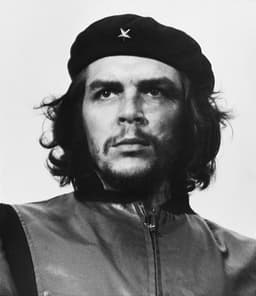
Che Guevara
Revolutionary · Modern
41.5Total

Zhang Xianzhong
Revolutionary · Modern
41.1Total
Basic Information
Born
1928
1606
Died
—
1647
Era
Modern
Modern
Nationality
Argentina
China
Occupation
Revolutionary
Revolutionary
Civilization
Western
Eastern
Score Comparison
Military (10%)
35.0
55.0
Political (20%)
25.0
35.0
Influence (20%)
55.0
44.8
Legacy (20%)
50.0
40.0
Leadership (15%)
30.0
35.4
Strategy (15%)
35.0
38.3
TOTAL
41.5
41.1
Che Guevara — Complete Timeline
1956 AD
Participation in the Cuban RevolutionWar
Guevara joined Fidel Castro's 26th of July Movement, landing in Cuba aboard the Granma. He became a key guerrilla commander, leading troops in the Battle of Santa Clara, which helped overthrow Fulgencio Batista's regime.
Cuban RevolutionGuerrilla WarfareCastro
Impact: regional
1961 AD
Appointment as Minister of IndustriesPolitical Action◆ Major
Guevara was appointed Minister of Industries in Cuba, where he implemented radical economic policies, including nationalization and central planning. His efforts to diversify the economy and reduce dependence on sugar largely failed.
Economic PolicyNationalizationCuba
Impact: national
1965 AD
Guerrilla Campaign in the CongoWar◆ Major
Guevara led a small Cuban force to support the Simba rebellion in the Democratic Republic of the Congo. The campaign was unsuccessful due to poor logistics, lack of local support, and superior opposition forces, leading to his withdrawal.
CongoGuerrillaFailed Revolution
Impact: regionaldestructive
1967 AD
Capture and Execution in BoliviaPolitical Action
Guevara was captured by Bolivian forces, trained and advised by the CIA, while leading a guerrilla insurgency. He was executed the next day in La Higuera. His death turned him into a global icon of revolutionary struggle.
ExecutionBoliviaMartyrdom
Impact: globaltragic
Zhang Xianzhong — Complete Timeline
1630 AD
Launched Rebellion in ShaanxiWar◆ Major
Zhang Xianzhong joined a peasant rebellion in Shaanxi province during the late Ming dynasty. He quickly rose to become a major rebel leader, gathering a large army and establishing a base of operations in the region.
Ming DynastyRebellionShaanxi
Impact: regionaldestructive
1644 AD
Captured and Sacked ChengduWar◆ Major
Zhang Xianzhong captured the city of Chengdu, the capital of Sichuan province. He then proclaimed the Daxi dynasty and made Chengdu his capital. The capture was accompanied by widespread destruction and massacres of the local population.
Ming-Qing TransitionSichuanMassacre
Impact: regionaldestructive
Proclaimed the Daxi DynastyPolitical Action◆ Major
Zhang Xianzhong proclaimed the Daxi (Great Western) dynasty in Sichuan. He established a government and minted his own coinage. His rule was characterized by extreme violence, including the systematic killing of scholars, officials, and civilians.
Daxi DynastyProclamationSichuan
Impact: regionaldestructive
1647 AD
Killed in Battle Against Qing ForcesWar◆ Major
Zhang Xianzhong was killed in battle against Qing forces in Xichong, Sichuan. His death led to the collapse of the Daxi dynasty. The Qing conquest of Sichuan was completed shortly after, but the province had been devastated by years of warfare.
Qing DynastyBattleDeath
Impact: regionaltragic
Expert Analysis
Origins
**Che Guevara:** Born Ernesto Guevara on June 14, 1928, in Rosario, Argentina, into a middle-class family of Spanish and Irish descent. His father, Ernesto Guevara Lynch, was a civil engineer, and his mother, Celia de la Serna, was a political activist. Guevara studied medicine at the University of Buenos Aires, graduating in 1953. His travels through Latin America exposed him to widespread poverty and imperialism, shaping his Marxist ideology.
**Zhang Xianzhong:** Born in 1606 in Yan’an, Shaanxi province, China, into a poor peasant family. He worked as a shepherd and later as a soldier in the Ming army. The harsh conditions of the late Ming dynasty, including famine and corruption, drove him to join a peasant rebellion in 1630. His early life was marked by hardship and a desire for survival and revenge against the ruling class.
Rise to Power
**Che Guevara:** Guevara’s rise began when he joined Fidel Castro’s 26th of July Movement in Mexico in 1955. He landed in Cuba aboard the Granma in December 1956, surviving an ambush. As a guerrilla commander, he led the column that captured Santa Clara in December 1958, a turning point that forced Batista to flee. His military score of 35.0 reflects his tactical role but limited scale.
**Zhang Xianzhong:** Zhang rose amid the Ming dynasty’s collapse. In 1630, he joined a rebellion and quickly became a leader, commanding tens of thousands. In 1644, he captured Chengdu, Sichuan, and proclaimed the Daxi dynasty. His military score of 55.0 indicates his success in large-scale warfare, but his political score of 35.0 shows his failure to consolidate power.
Leadership & Governance
**Che Guevara:** As Cuba’s Minister of Industries from 1961, Guevara implemented radical central planning and nationalization, aiming for rapid industrialization. His policies led to inefficiencies and economic decline, scoring 25.0 in political leadership. He emphasized guerrilla warfare as a model for global revolution, but his rigid ideology often ignored local realities.
**Zhang Xianzhong:** Zhang’s governance in Sichuan was brutal. He executed large numbers of officials and civilians, reportedly killing millions. He minted coins but failed to establish stable institutions. His leadership score of 35.4 reflects his authoritarian style but lack of sustainable governance. Both leaders prioritized revolutionary goals over practical administration.
Triumph & Tragedy
**Che Guevara:** His greatest success was his role in the Cuban Revolution, overthrowing Batista in 1959. He also inspired revolutionary movements worldwide. His greatest failure was the disastrous guerrilla campaign in Bolivia in 1967, where he was captured and executed. His influence score of 55.0 reflects his iconic status, but his military (35.0) and strategy (35.0) scores show limitations.
**Zhang Xianzhong:** Zhang’s triumph was conquering Sichuan and establishing the Daxi dynasty in 1644. His tragedy was his brutal rule, leading to massive depopulation of Sichuan. He was killed in 1647 by Qing forces, and his dynasty collapsed. His legacy score of 40.0 is overshadowed by his reputation as a mass murderer.
Character & Destiny
**Che Guevara:** Guevara was idealistic, disciplined, and willing to die for his beliefs. His decision to leave Cuba and fight in the Congo and Bolivia showed his commitment to global revolution but also his recklessness. His personality made him a martyr but also led to his death at age 39.
**Zhang Xianzhong:** Zhang was ruthless and pragmatic, driven by survival and ambition. His violent methods alienated potential allies and ensured his downfall. His character led to a short-lived dynasty and a legacy of terror.
Legacy
**Che Guevara:** Guevara’s image became a global symbol of rebellion and anti-imperialism, despite his mixed record. His writings on guerrilla warfare influenced movements in Africa and Latin America. His legacy score of 50.0 reflects his enduring cultural impact, but his practical achievements were limited.
**Zhang Xianzhong:** Zhang is remembered in Chinese history as a brutal rebel who depopulated Sichuan. His legacy is negative, with few positive contributions. His influence score of 44.8 is due to his role in the Ming-Qing transition, but he is not celebrated.
Conclusion
Che Guevara scores 41.5 total, slightly higher than Zhang Xianzhong’s 41.1, but the gap is narrow. Guevara’s global influence and symbolic legacy outweigh Zhang’s localized but larger-scale military campaigns. However, neither achieved lasting political success. Guevara’s impact on revolutionary ideology and culture makes him more significant historically, despite his failures. Zhang’s brutality and lack of constructive legacy relegate him to a footnote. Therefore, Che Guevara had greater impact.
Rankings
🥇
Che GuevaraLeader
Mil: 35.0Pol: 25.0Inf: 55.0
41.5
🥈
Zhang Xianzhong
Mil: 55.0Pol: 35.0Inf: 44.8
41.1
+0.4 behind
How This Comparison Works
Algorithm
Each figure is scored on 6 dimensions (0—100 scale) based on structured historical data: Military (10%), Political (20%), Influence (20%), Legacy (20%), Leadership (15%), Strategy (15%). The weighted total produces the final ranking.
Data Sources
Scores are computed from structured sub-indicators in the database. Scale factors adjust for era (Ancient ×0.85, Modern ×1.0) and civilization size (Eastern ×1.05, Other ×0.80) to account for differences in population and military scale.
Maximum 3 Figures
Comparisons are limited to 2—3 figures to ensure readability and statistical meaningfulness.
Error Margins
±5 points per dimension — Sub-scores are derived from historical records with inherent uncertainty. Two figures within 5 points on a dimension should be considered roughly equivalent in that area.
Total Score Accuracy
±3 points overall — The weighted combination of 6 dimensions produces a total score with approximately ±3 points of uncertainty. Differences of less than 3 points are not statistically significant— the figures are effectively tied.
Known Limitations
- Historical records are incomplete and uneven across civilizations
- Figures from oral-tradition societies may be underrepresented
- Occupation labels can misclassify multi-role figures
- Scores measure capability and impact, not moral character
- Quantitative scoring is a comparison tool, not absolute truth
Capability Radar
Military (10%) — Battles & Warfare
Battles
35
55
Win Rate
40
50
Expansion
25
60
Political (20%) — Governance & Reform
Reform
35
5
Diplomacy
20
10
Economy
15
5
Influence (20%) — Cultural & Global Reach
Cultural
75
20
Global
70
15
Legacy (20%) — Historical Impact
Historical
70
35
Longevity
65
25
Leadership (15%) — Power & Stability
Tenure
30
30
Stability
10
5
Strategy (15%) — Tactics & Innovation
Strategy
45
40
Tactics
55
45
Reform
30
10
Similar Comparisons
Comments & Discussion
No comments yet. Be the first to share your thoughts!