Loading...
This comparison has not been analyzed yet.
One-time AI generation (~1 minute). Scores and timeline are already available below.
Chris Hipkins vs Peter Christian
Peter Christian leads by 7.9 pts · 2 figures compared
…
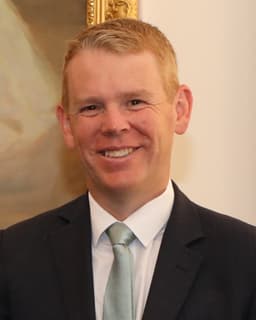
Chris Hipkins
Politician · Modern
37.2Total

Peter Christian
Politician · Modern
45.1Total
Basic Information
Born
1978
1947
Died
—
—
Era
Modern
Modern
Nationality
New Zealand
Micronesia
Occupation
Politician
Politician
Civilization
Western
Other
Score Comparison
Military (10%)
11.3
45.2
Political (20%)
32.2
40.8
Influence (20%)
47.1
48.6
Legacy (20%)
34.2
37.5
Leadership (15%)
48.4
58.8
Strategy (15%)
36.9
41.1
TOTAL
37.2
45.1
Chris Hipkins — Complete Timeline
2023 AD
2023 Appointment as Prime MinisterPolitical Action◆ Major
Hipkins succeeded Jacinda Ardern as Prime Minister after her resignation. He became the 41st Prime Minister of New Zealand, leading the Labour Party into the 2023 general election.
LeadershipLabour PartyGovernment Change
Impact: national
2023 General Election DefeatPolitical Action◆ Major
Hipkins led Labour to a decisive defeat in the general election, winning only 34 seats to National's 48. He resigned as Labour leader following the loss, ending his brief tenure as Prime Minister.
Election DefeatLabour LossGovernment Change
Impact: national
2023 COVID-19 Response ContinuationPolitical Action
As Prime Minister, Hipkins oversaw the final stages of New Zealand's COVID-19 response, including the end of mandatory isolation requirements and the transition to living with the virus.
COVID-19Public HealthPandemic Response
Impact: national
2023 Cyclone Gabrielle ResponsePolitical Action
Hipkins' government coordinated the national response to Cyclone Gabrielle, which caused widespread flooding and damage in the North Island. The government declared a national state of emergency and allocated recovery funding.
Natural DisasterCycloneRecovery
Impact: nationalconstructive
Peter Christian — Complete Timeline
2011 AD
Election as President of the Federated States of MicronesiaPolitical Action◆ Major
Peter Christian was elected as the eighth President of the Federated States of Micronesia, representing the state of Pohnpei. He served from 2011 to 2015, focusing on climate change issues affecting the Pacific islands.
PresidencyMicronesiaClimate Change
Impact: national
2013 AD
Advocacy for Climate Change ActionPolitical Action◆ Major
Christian actively advocated for international action on climate change, highlighting the existential threat to low-lying Pacific island nations. He spoke at United Nations forums and regional meetings, pushing for emissions reductions and adaptation funding.
Climate ChangeAdvocacyPacific Islands
Impact: regionalconstructive
2015 AD
End of PresidencyPolitical Action
Christian's term ended in 2015 after serving one term. He was succeeded by David Panuelo. His presidency was noted for its emphasis on environmental issues.
PresidencyTransitionMicronesia
Impact: national
This comparison has not been analyzed yet.
One-time AI generation (~1 minute). Scores and timeline are already available below.
Rankings
🥇
Peter ChristianLeader
Mil: 45.2Pol: 40.8Inf: 48.6
45.1
🥈
Chris Hipkins
Mil: 11.3Pol: 32.2Inf: 47.1
37.2
+7.9 behind
How This Comparison Works
Algorithm
Each figure is scored on 6 dimensions (0—100 scale) based on structured historical data: Military (10%), Political (20%), Influence (20%), Legacy (20%), Leadership (15%), Strategy (15%). The weighted total produces the final ranking.
Data Sources
Scores are computed from structured sub-indicators in the database. Scale factors adjust for era (Ancient ×0.85, Modern ×1.0) and civilization size (Eastern ×1.05, Other ×0.80) to account for differences in population and military scale.
Maximum 3 Figures
Comparisons are limited to 2—3 figures to ensure readability and statistical meaningfulness.
Error Margins
±5 points per dimension — Sub-scores are derived from historical records with inherent uncertainty. Two figures within 5 points on a dimension should be considered roughly equivalent in that area.
Total Score Accuracy
±3 points overall — The weighted combination of 6 dimensions produces a total score with approximately ±3 points of uncertainty. Differences of less than 3 points are not statistically significant— the figures are effectively tied.
Known Limitations
- Historical records are incomplete and uneven across civilizations
- Figures from oral-tradition societies may be underrepresented
- Occupation labels can misclassify multi-role figures
- Scores measure capability and impact, not moral character
- Quantitative scoring is a comparison tool, not absolute truth
Capability Radar
Military (10%) — Battles & Warfare
Battles
22
23
Win Rate
23
22
Expansion
29
29
Political (20%) — Governance & Reform
Reform
20
40
Diplomacy
25
35
Economy
20
20
Influence (20%) — Cultural & Global Reach
Cultural
10
10
Global
10
20
Legacy (20%) — Historical Impact
Historical
10
15
Longevity
5
10
Leadership (15%) — Power & Stability
Tenure
15
30
Stability
25
25
Strategy (15%) — Tactics & Innovation
Strategy
32
33
Tactics
36
34
Reform
38
36
Similar Comparisons
Comments & Discussion
No comments yet. Be the first to share your thoughts!