Loading...
Decius vs Pushyamitra Shunga
Pushyamitra Shunga leads by 13.7 pts · 2 figures compared
…
Decius
Emperor · Ancient
43.1Total
Pushyamitra Shunga
Emperor · Ancient
56.8Total
Basic Information
Born
201
-195
Died
251
-149
Era
Ancient
Ancient
Nationality
Roman Empire
India
Occupation
Emperor
Emperor
Civilization
Western
Indian
Score Comparison
Military (10%)
38.3
47.5
Political (20%)
37.9
68.0
Influence (20%)
46.3
54.9
Legacy (20%)
39.2
47.5
Leadership (15%)
41.5
68.0
Strategy (15%)
60.0
60.0
TOTAL
43.1
56.8
Decius — Complete Timeline
249 AD
Proclamation as Emperor and Defeat of Philip the ArabPolitical Action◆ Major
Decius, a Roman senator and general, was proclaimed emperor by the Danubian legions. He marched into Italy and defeated Philip the Arab at the Battle of Verona, where Philip was killed, securing Decius's position as sole emperor.
Imperial AccessionCivil WarBattle of Verona
Impact: global
250 AD
Campaign against the GothsWar
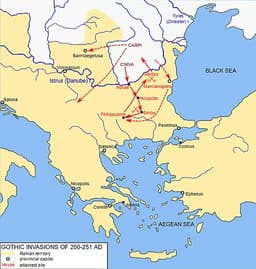
Decius led a military campaign against the Goths who had invaded the Danubian provinces. He initially achieved some successes, driving the Goths back, but the campaign was hampered by logistical issues and the plague.
Gothic WarDanube FrontierCampaign
Impact: regional
Edict of Decius (Decian Persecution)Political Action◆ Major
Decius issued an edict requiring all Roman citizens to perform a sacrifice to the Roman gods and obtain a certificate (libellus) proving compliance. This triggered the first empire-wide persecution of Christians, who refused to sacrifice, leading to widespread arrests, torture, and executions.
Christian PersecutionEdictReligious Policy
Impact: globaldestructive
251 AD
Death at the Battle of AbritusWar◆ Major
Decius and his son Herennius Etruscus were killed in battle against the Goths at Abritus (modern Bulgaria). They were ambushed in a swamp by the Gothic king Cniva, making Decius the first Roman emperor to die in battle against a foreign enemy.
Battle of AbritusGothic WarImperial Death
Impact: globaltragic
Pushyamitra Shunga — Complete Timeline
185 BC
Overthrew the Maurya DynastyPolitical Action
Pushyamitra Shunga, a Mauryan general, assassinated the last Maurya emperor Brihadratha during a military parade and established the Shunga dynasty. This coup ended the Maurya Empire and marked a return to Brahmanical rule after Buddhist patronage.
CoupDynasty Change
Impact: regional
180 BC
Fought the Battle of the IndusWar◆ Major
Pushyamitra Shunga repelled an invasion by the Indo-Greek king Menander I (Milinda) near the Indus River. The Shunga victory preserved the kingdom's independence and prevented Greek expansion into the Gangetic plain.
BattleIndo-Greek War
Impact: regional
Patronized Brahmanical RevivalCultural
Pushyamitra Shunga supported the restoration of Brahmanical Hinduism, building temples and sponsoring Vedic scholars. This shift from Mauryan Buddhist patronage influenced Indian religious and cultural development for centuries.
ReligionCultural Revival
Impact: regionalconstructive
175 BC
Performed the Ashvamedha YajnaCultural◆ Major
Pushyamitra Shunga performed the Vedic horse sacrifice (Ashvamedha) to assert his sovereignty and legitimacy. The ritual involved releasing a horse to roam for a year, followed by a grand ceremony, reaffirming Brahmanical traditions after Mauryan Buddhist influence.
RitualBrahmanism
Impact: nationalconstructive
Expert Analysis
Origins
Decius (c. 201–251 AD) was born into a senatorial family near Sirmium (modern Sremska Mitrovica, Serbia). His early career included service as a senator and governor under Emperor Philip the Arab. Pushyamitra Shunga (c. 220–190 BC) was a Brahmin general in the Mauryan Empire, serving under the last Mauryan emperor Brihadratha. His exact birth details are uncertain, but he rose through the military ranks.
Rise to Power
Decius rose to prominence when the Danubian legions proclaimed him emperor in 249 AD, challenging Philip the Arab. He defeated Philip at the Battle of Verona, becoming emperor. Pushyamitra Shunga seized power by assassinating Brihadratha during a military parade in 185 BC, establishing the Shunga dynasty. This coup ended the Mauryan rule.
Leadership & Governance
Decius focused on restoring traditional Roman religious practices. In 250 AD, he issued the Edict of Decius, requiring all Roman citizens to sacrifice to the Roman gods and obtain a libellus (certificate). This persecution targeted Christians, leading to many martyrdoms. His governance was centralized but short-lived. Pushyamitra Shunga revived Brahmanical Hinduism, patronizing Vedic scholars and performing the Ashvamedha Yajna (horse sacrifice) to assert sovereignty. He built temples and supported Sanskrit literature, reversing the Mauryan patronage of Buddhism.
Triumph & Tragedy
Decius's greatest success was becoming emperor and initially repelling Gothic invasions. However, his tragedy was his death at the Battle of Abritus in 251 AD, where he and his son were ambushed and killed by Goths in a swamp. This was the first time a Roman emperor died in battle against a foreign enemy. Pushyamitra Shunga's triumph was founding a dynasty that lasted about 112 years. He also repelled an Indo-Greek invasion by Menander I at the Battle of the Indus. His tragedy was the loss of northwestern territories to the Indo-Greeks and internal rebellions.
Character & Destiny
Decius is often seen as a traditionalist who sought to restore Roman values. His persecution of Christians demonstrated a rigid adherence to pagan orthodoxy, but his military incompetence led to his downfall. Pushyamitra Shunga was a decisive and ambitious general. His Brahmin background shaped his policies, but his overthrow of the Mauryas was a violent act that set a precedent for military coups.
Legacy
Decius is remembered primarily for his persecution of Christians, which intensified the conflict between the Roman state and Christianity. His death marked a turning point in Roman military decline. Pushyamitra Shunga is credited with reviving Hinduism and Sanskrit culture, influencing later Indian dynasties. The Shunga period saw the construction of the Great Stupa at Sanchi (though originally Mauryan, it was expanded). His military score is 47.5 vs Decius's 38.3, political 68.0 vs 37.9, influence 54.9 vs 46.3, legacy 47.5 vs 39.2, leadership 68.0 vs 41.5, strategy 60.0 vs 60.0. Total score: Pushyamitra Shunga 56.8 vs Decius 43.1.
Conclusion
Pushyamitra Shunga had a greater impact due to founding a dynasty that shaped Indian culture for centuries, while Decius's short reign and death in battle limited his influence. Pushyamitra's higher political and leadership scores reflect his successful consolidation of power and cultural revival. Decius's legacy is largely negative due to his persecution and military failure.
Rankings
🥇
Pushyamitra ShungaLeader
Mil: 47.5Pol: 68.0Inf: 54.9
56.8
🥈
Decius
Mil: 38.3Pol: 37.9Inf: 46.3
43.1
+13.7 behind
How This Comparison Works
Algorithm
Each figure is scored on 6 dimensions (0—100 scale) based on structured historical data: Military (10%), Political (20%), Influence (20%), Legacy (20%), Leadership (15%), Strategy (15%). The weighted total produces the final ranking.
Data Sources
Scores are computed from structured sub-indicators in the database. Scale factors adjust for era (Ancient ×0.85, Modern ×1.0) and civilization size (Eastern ×1.05, Other ×0.80) to account for differences in population and military scale.
Maximum 3 Figures
Comparisons are limited to 2—3 figures to ensure readability and statistical meaningfulness.
Error Margins
±5 points per dimension — Sub-scores are derived from historical records with inherent uncertainty. Two figures within 5 points on a dimension should be considered roughly equivalent in that area.
Total Score Accuracy
±3 points overall — The weighted combination of 6 dimensions produces a total score with approximately ±3 points of uncertainty. Differences of less than 3 points are not statistically significant— the figures are effectively tied.
Known Limitations
- Historical records are incomplete and uneven across civilizations
- Figures from oral-tradition societies may be underrepresented
- Occupation labels can misclassify multi-role figures
- Scores measure capability and impact, not moral character
- Quantitative scoring is a comparison tool, not absolute truth
Capability Radar
Military (10%) — Battles & Warfare
Battles
40
55
Win Rate
30
50
Expansion
20
40
Political (20%) — Governance & Reform
Reform
45
50
Diplomacy
30
45
Economy
25
40
Influence (20%) — Cultural & Global Reach
Cultural
20
40
Global
15
30
Legacy (20%) — Historical Impact
Historical
35
50
Longevity
20
45
Leadership (15%) — Power & Stability
Tenure
30
60
Stability
20
45
Strategy (15%) — Tactics & Innovation
Strategy
40
45
Tactics
35
40
Reform
50
35
Similar Comparisons
Comments & Discussion
No comments yet. Be the first to share your thoughts!