Loading...
This comparison has not been analyzed yet.
One-time AI generation (~1 minute). Scores and timeline are already available below.
Denis Sassou-Nguesso vs Joachim Yhombi-Opango
Denis Sassou-Nguesso leads by 10.8 pts · 2 figures compared
…
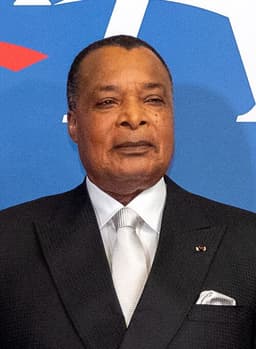
Denis Sassou-Nguesso
General · Modern
49.4Total

Joachim Yhombi-Opango
General · Modern
38.6Total
Basic Information
Born
1943
1939
Died
—
—
Era
Modern
Modern
Nationality
Congo Republic
Congo-Brazzaville
Occupation
General
General
Civilization
Other
Other
Score Comparison
Military (10%)
10.2
10.2
Political (20%)
68.0
35.1
Influence (20%)
51.8
48.6
Legacy (20%)
46.7
37.5
Leadership (15%)
62.0
43.8
Strategy (15%)
42.3
42.3
TOTAL
49.4
38.6
Denis Sassou-Nguesso — Complete Timeline
1979 AD
Seized Power in CoupPolitical Action
Denis Sassou-Nguesso, a military officer, became President of the People's Republic of the Congo after a coup that ousted President Joachim Yhombi-Opango. He led the Congolese Party of Labour (PCT).
Coup d'étatCongoMilitary Rule
Impact: national
1990 AD
Transition to Multi-Party PoliticsReform◆ Major
Under pressure, Sassou-Nguesso's government introduced multi-party politics, ending the one-party Marxist-Leninist system. A national conference was held in 1991, leading to a transition to civilian rule.
Political ReformDemocracyCongo
Impact: national
1992 AD
Lost Presidential ElectionPolitical Action◆ Major
Sassou-Nguesso lost the 1992 presidential election to Pascal Lissouba. This was the first multi-party election in the country since independence, and Sassou-Nguesso peacefully handed over power.
ElectionDemocracyCongo
Impact: national
1997 AD
Returned to Power via Civil WarWar
Sassou-Nguesso's militia, backed by Angolan troops, captured Brazzaville, overthrowing President Pascal Lissouba. This ended a four-month civil war and returned Sassou-Nguesso to the presidency.
Civil WarCongoPower Struggle
Impact: nationaldestructive
2002 AD
Won Controversial Re-electionsPolitical Action◆ Major
Sassou-Nguesso won the 2002 presidential election with over 89% of the vote. The election was boycotted by major opposition candidates and criticized as neither free nor fair.
ElectionCongoControversy
Impact: national
2015 AD
Constitutional Referendum to Extend TermPolitical Action◆ Major
Sassou-Nguesso's government held a constitutional referendum that removed the age limit and two-term limit for the presidency. The change allowed him to run for re-election in 2016 and potentially remain in power.
Constitutional ReformCongoPower Consolidation
Impact: national
Joachim Yhombi-Opango — Complete Timeline
1977 AD
Became President of Congo-BrazzavillePolitical Action◆ Major
Yhombi-Opango succeeded Marien Ngouabi as president after Ngouabi's assassination. He led the Congolese Party of Labour and ruled until 1979.
PresidencyCongo-BrazzavilleSuccession
Impact: national
1979 AD
Ousted from PowerPolitical Action◆ Major
Yhombi-Opango was forced to resign by the Central Committee of the Congolese Party of Labour, which accused him of mismanagement and corruption. He was succeeded by Denis Sassou-Nguesso.
CoupPolitical CrisisCongo-Brazzaville
Impact: nationaldestructive
1993 AD
Returned to Politics as Prime MinisterPolitical Action
Yhombi-Opango was appointed Prime Minister by President Pascal Lissouba during the civil war. His tenure was marked by conflict and instability.
AppointmentCivil WarCongo-Brazzaville
Impact: nationaldestructive
This comparison has not been analyzed yet.
One-time AI generation (~1 minute). Scores and timeline are already available below.
Rankings
🥇
Denis Sassou-NguessoLeader
Mil: 10.2Pol: 68.0Inf: 51.8
49.4
🥈
Joachim Yhombi-Opango
Mil: 10.2Pol: 35.1Inf: 48.6
38.6
+10.8 behind
How This Comparison Works
Algorithm
Each figure is scored on 6 dimensions (0—100 scale) based on structured historical data: Military (10%), Political (20%), Influence (20%), Legacy (20%), Leadership (15%), Strategy (15%). The weighted total produces the final ranking.
Data Sources
Scores are computed from structured sub-indicators in the database. Scale factors adjust for era (Ancient ×0.85, Modern ×1.0) and civilization size (Eastern ×1.05, Other ×0.80) to account for differences in population and military scale.
Maximum 3 Figures
Comparisons are limited to 2—3 figures to ensure readability and statistical meaningfulness.
Error Margins
±5 points per dimension — Sub-scores are derived from historical records with inherent uncertainty. Two figures within 5 points on a dimension should be considered roughly equivalent in that area.
Total Score Accuracy
±3 points overall — The weighted combination of 6 dimensions produces a total score with approximately ±3 points of uncertainty. Differences of less than 3 points are not statistically significant— the figures are effectively tied.
Known Limitations
- Historical records are incomplete and uneven across civilizations
- Figures from oral-tradition societies may be underrepresented
- Occupation labels can misclassify multi-role figures
- Scores measure capability and impact, not moral character
- Quantitative scoring is a comparison tool, not absolute truth
Capability Radar
Military (10%) — Battles & Warfare
Battles
5
5
Win Rate
5
5
Expansion
5
5
Political (20%) — Governance & Reform
Reform
30
20
Diplomacy
50
25
Economy
30
15
Influence (20%) — Cultural & Global Reach
Cultural
20
10
Global
20
10
Legacy (20%) — Historical Impact
Historical
30
15
Longevity
40
10
Leadership (15%) — Power & Stability
Tenure
70
30
Stability
20
10
Strategy (15%) — Tactics & Innovation
Strategy
5
5
Tactics
5
5
Reform
10
10
Similar Comparisons
Comments & Discussion
No comments yet. Be the first to share your thoughts!