Loading...
Denis Sassou-Nguesso vs Napoleon Bonaparte
Napoleon Bonaparte leads by 21.5 pts · 2 figures compared
…
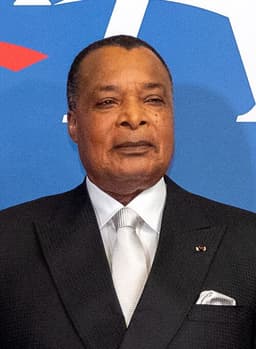
Denis Sassou-Nguesso
General · Modern
49.4Total

Napoleon Bonaparte
General · Modern
70.9Total
Basic Information
Born
1943
1769
Died
—
1821
Era
Modern
Modern
Nationality
Congo Republic
France
Occupation
General
General
Civilization
Other
Western
Score Comparison
Military (10%)
10.2
94.0
Political (20%)
68.0
72.0
Influence (20%)
51.8
40.0
Legacy (20%)
46.7
80.0
Leadership (15%)
62.0
78.0
Strategy (15%)
42.3
90.0
TOTAL
49.4
70.9
Denis Sassou-Nguesso — Complete Timeline
1979 AD
Seized Power in CoupPolitical Action
Denis Sassou-Nguesso, a military officer, became President of the People's Republic of the Congo after a coup that ousted President Joachim Yhombi-Opango. He led the Congolese Party of Labour (PCT).
Coup d'étatCongoMilitary Rule
Impact: national
1990 AD
Transition to Multi-Party PoliticsReform◆ Major
Under pressure, Sassou-Nguesso's government introduced multi-party politics, ending the one-party Marxist-Leninist system. A national conference was held in 1991, leading to a transition to civilian rule.
Political ReformDemocracyCongo
Impact: national
1992 AD
Lost Presidential ElectionPolitical Action◆ Major
Sassou-Nguesso lost the 1992 presidential election to Pascal Lissouba. This was the first multi-party election in the country since independence, and Sassou-Nguesso peacefully handed over power.
ElectionDemocracyCongo
Impact: national
1997 AD
Returned to Power via Civil WarWar
Sassou-Nguesso's militia, backed by Angolan troops, captured Brazzaville, overthrowing President Pascal Lissouba. This ended a four-month civil war and returned Sassou-Nguesso to the presidency.
Civil WarCongoPower Struggle
Impact: nationaldestructive
2002 AD
Won Controversial Re-electionsPolitical Action◆ Major
Sassou-Nguesso won the 2002 presidential election with over 89% of the vote. The election was boycotted by major opposition candidates and criticized as neither free nor fair.
ElectionCongoControversy
Impact: national
2015 AD
Constitutional Referendum to Extend TermPolitical Action◆ Major
Sassou-Nguesso's government held a constitutional referendum that removed the age limit and two-term limit for the presidency. The change allowed him to run for re-election in 2016 and potentially remain in power.
Constitutional ReformCongoPower Consolidation
Impact: national
Napoleon Bonaparte — Complete Timeline
1799 AD
Coup of 18 BrumaireOther◆ Major
Napoleon Bonaparte, with support from his brother Lucien and key political figures, overthrew the Directory in a bloodless coup. He established the Consulate with himself as First Consul, effectively becoming the ruler of France. This event ended the French Revolution's most unstable period.
French RevolutionCoupRise to Power
Impact: regional
1804 AD
Promulgation of the Napoleonic CodeOther◆ Major
Napoleon enacted the Civil Code of the French, known as the Napoleonic Code, a comprehensive set of laws that replaced the fragmented feudal legal systems. The code established legal equality, protected property rights, and secularized law. It became the basis for legal systems in many European and world countries.
Legal ReformNapoleonic CodeCivil Law
Impact: globalconstructive
1805 AD
Battle of AusterlitzWar◆ Major
Napoleon's Grande Arm
Napoleonic WarsBattleDecisive Victory
Impact: global
1812 AD
Invasion of RussiaWar◆ Major
Napoleon led the Grande Arm
Napoleonic WarsInvasionDisaster
Impact: globaldestructive
1815 AD
Battle of WaterlooWar◆ Major
Napoleon's French army was defeated by the combined forces of the Duke of Wellington's Anglo-Allied army and Gebhard Leberecht von Bl
Napoleonic WarsBattleFinal Defeat
Impact: globaldestructive
Expert Analysis
denis-sassou-nguesso-vs-napoleon-bonaparte
# The General and the Strongman
On a June morning in 1815, Napoleon Bonaparte watched his Imperial Guard march into the maw of British and Prussian cannons at Waterloo. He had staked everything on a single, desperate gamble—and lost. Nearly two centuries later, in 1997, a different kind of general, Denis Sassou-Nguesso, watched his militia roll into Brazzaville backed by Angolan tanks. He had lost an election, then won a war. Napoleon ended his days in exile on a remote Atlantic island, a prisoner of history. Sassou-Nguesso ended his year back in the presidential palace, where he remains to this day. Both men were generals who seized power. But the paths they took, and the worlds they left behind, could not be more different. Why?
Origins
Napoleon was born in 1769 on Corsica, an island that had only recently become French. His family was minor nobility, poor enough to be ambitious but connected enough to send him to French military academies. There, a short, intense boy with a thick accent endured the mockery of aristocrats. The French Revolution, erupting when he was twenty, shattered the old order and created a vacuum that talent could fill. Napoleon was a child of revolution, his mind forged in the chaos of a world remaking itself.
Denis Sassou-Nguesso was born in 1943 in the French Congo, a colony that would become the Republic of Congo. His family belonged to the Mbochi ethnic group, a minority in a country dominated by the larger Kongo and Teke peoples. He joined the French colonial army, then the Congolese army after independence in 1960. He was a product of the Cold War, a time when African strongmen could play superpowers against each other. The world that shaped him was one of coups, ideologies, and patronage networks—not revolutions that promised to remake humanity.
Rise to Power
Napoleon’s rise was meteoric, a story of raw talent meeting opportunity. In 1793, at age twenty-four, he drove the British out of Toulon. In 1795, he saved the revolutionary government from a royalist mob with a “whiff of grapeshot.” By 1796, he was commanding the Army of Italy, where his lightning campaigns stunned Europe. He was not yet thirty. His path was built on victories—dozens of them, each one a stepping stone.
Sassou-Nguesso’s rise was quieter, more bureaucratic. He joined the ruling Marxist-Leninist party, climbed the military hierarchy, and in 1979, after a series of coups and counter-coups, seized power. There was no Austerlitz, no Rivoli. There was simply a moment when the man with the most loyal soldiers took the palace. His score of 19.9 in military genius, compared to Napoleon’s 94.0, tells the story: one man conquered continents, the other conquered a committee.
Leadership & Governance
Napoleon governed with a vision that extended far beyond the battlefield. He reformed French law with the Napoleonic Code, a system that enshrined equality before the law, property rights, and secular administration. He centralized education, built roads and canals, and reorganized the banking system. His political score of 75.0 reflects a ruler who understood that conquest required institutions. Yet his ambition consumed him. He placed his brothers on thrones, waged endless wars, and bled France white for glory.
Sassou-Nguesso governed with a different calculus. He abandoned Marxist-Leninist economics in the 1980s, introduced multi-party politics in 1990 under pressure, and when he lost the 1992 election, he waited. He did not accept defeat gracefully—he rebuilt his militia, allied with Angola, and in 1997, after a four-month civil war, returned to power. Since then, he has won elections with 89% of the vote, boycotted by opponents, and in 2015 held a referendum to remove term limits. His political score of 61.2 is lower than Napoleon’s, but his leadership score of 72.0 suggests a different kind of skill: the survival instinct of a man who knows that in African politics, losing power can mean losing life.
Triumph & Tragedy
Napoleon’s greatest triumph was Austerlitz in 1805, where he destroyed a combined Russian and Austrian army, ending the Holy Roman Empire. His greatest tragedy was the invasion of Russia in 1812. He marched 600,000 men into the frozen vastness; fewer than 100,000 returned. The Grande Armée was shattered, and with it, his aura of invincibility.
Sassou-Nguesso’s triumph was his return to power in 1997, a stunning reversal of fortune. His tragedy is the country he has left behind: Congo-Brazzaville, rich in oil, remains one of the poorest nations on earth. His legacy score of 61.2 reflects a man who has built no lasting institutions, no code of laws, no nation that can survive without him.
Character & Destiny
Napoleon was driven by an insatiable hunger for glory. “I am not a man,” he once said, “but a thing.” He saw himself as an instrument of fate, a force of nature. This made him brilliant—and doomed. He could not stop. He could not compromise. He could not share power.
Sassou-Nguesso is driven by survival. He has no grand vision, no Napoleonic Code, no ambition to remake the world. He wants to stay in power. This makes him cautious, pragmatic, and ruthless in small ways. He does not conquer Europe; he manipulates his neighbors. He does not write constitutions; he rewrites them.
Legacy
Napoleon’s legacy is global. The Napoleonic Code influenced legal systems from Latin America to the Middle East. His wars reshaped nationalism in Germany and Italy. He is remembered as a genius and a tyrant, a liberator and a conqueror. His legacy score of 78.0 places him among the most consequential figures in history.
Sassou-Nguesso’s legacy is local. He is remembered as a survivor, a man who has outlasted the Cold War, the wave of democratization, and every rival. But what has he built? In 2023, he is still president, still holding elections, still ruling a country that has seen little progress. His legacy score of 61.2 is a question mark.
Conclusion
Napoleon and Sassou-Nguesso are both generals who became rulers. But Napoleon was a revolutionary who remade the world; Sassou-Nguesso is a strongman who preserved himself. One chased glory and fell; the other chased survival and endured. Their stories remind us that the same ambition can produce vastly different outcomes, shaped by era, opportunity, and character. Napoleon’s tragedy was that he could not stop reaching for the stars. Sassou-Nguesso’s tragedy may be that he never tried.
Rankings
🥇
Napoleon BonaparteLeader
Mil: 94.0Pol: 72.0Inf: 40.0
70.9
🥈
Denis Sassou-Nguesso
Mil: 10.2Pol: 68.0Inf: 51.8
49.4
+21.5 behind
How This Comparison Works
Algorithm
Each figure is scored on 6 dimensions (0—100 scale) based on structured historical data: Military (10%), Political (20%), Influence (20%), Legacy (20%), Leadership (15%), Strategy (15%). The weighted total produces the final ranking.
Data Sources
Scores are computed from structured sub-indicators in the database. Scale factors adjust for era (Ancient ×0.85, Modern ×1.0) and civilization size (Eastern ×1.05, Other ×0.80) to account for differences in population and military scale.
Maximum 3 Figures
Comparisons are limited to 2—3 figures to ensure readability and statistical meaningfulness.
Error Margins
±5 points per dimension — Sub-scores are derived from historical records with inherent uncertainty. Two figures within 5 points on a dimension should be considered roughly equivalent in that area.
Total Score Accuracy
±3 points overall — The weighted combination of 6 dimensions produces a total score with approximately ±3 points of uncertainty. Differences of less than 3 points are not statistically significant— the figures are effectively tied.
Known Limitations
- Historical records are incomplete and uneven across civilizations
- Figures from oral-tradition societies may be underrepresented
- Occupation labels can misclassify multi-role figures
- Scores measure capability and impact, not moral character
- Quantitative scoring is a comparison tool, not absolute truth
Capability Radar
Military (10%) — Battles & Warfare
Battles
5
95
Win Rate
5
90
Expansion
5
95
Political (20%) — Governance & Reform
Reform
30
95
Diplomacy
50
80
Economy
30
85
Influence (20%) — Cultural & Global Reach
Cultural
20
85
Global
20
90
Legacy (20%) — Historical Impact
Historical
30
95
Longevity
40
90
Leadership (15%) — Power & Stability
Tenure
70
85
Stability
20
70
Strategy (15%) — Tactics & Innovation
Strategy
5
95
Tactics
5
98
Reform
10
92
Similar Comparisons
Comments & Discussion
CARNAGE COMPARER6/17/2026
Waterloo was a battle between two empires; Sassou’s coup was a neighborhood brawl with Angolan mercenaries. Napoleon’s final defeat involved 72,000 troops on a European battlefield, while Sassou just paid off a few militia commanders and rolled his tanks into Brazzaville. One reshaped continents, the other grabbed a gas-rich backwater. Comparing them is like putting a lion next to a hyena—both predators, but one eats kings.
史诗碰瓷家6/17/2026
拿破仑好歹是真刀真枪打了十几场会战才爬上帝位;萨苏-恩格索不过是1997年搞了场雇佣兵政变。拿破仑在奥斯特里茨以少胜多,击溃俄奥联军,萨苏只会抓反对派关进监狱。拿这两个人比,就像拿拿破仑的宝剑比萨苏的AK-47——武器差了一百年,脑子差了两百年。
RATIO RADICAL6/17/2026
Scale matters. Napoleon commanded armies of 500,000, fought from Madrid to Moscow, and left a legal code still used today. Sassou’s “empire” is a 342,000 km² petro-state where he’s been president for 39 of the last 45 years. The power is similar—authoritarian control—but Napoleon’s footprint is a continent, Sassou’s is a single city’s worth of oil pipelines. Don't inflate a thug to a titan.
逻辑拆弹专家6/17/2026
拿破仑的军事失败有明确可查的战役记录——滑铁卢伤亡25,000人,退位有正式文件。萨苏的“胜利”呢?1997年内战死亡人数至今是笔糊涂账,联合国也没派调查团。用模糊数字比精密历史?要么是你数据太烂,要么是你存心想吹非洲独裁者。立场先行的历史最恶心。
CLASSICS CRITIC6/17/2026
Napoleon studied Caesar, wore a laurel crown, and tried to build a European empire on the Roman model. Sassou-Nguesso studied the manual of the Congolese Labour Party and built a kleptocracy on oil revenues. One thought in terms of civilization and glory; the other thinks in terms of barrel exports and palace renovations. You can’t compare a man who dreamed of Augustus with one who dreams of Swiss bank accounts.
油腻长辈史观6/17/2026
拿破仑最后被反法联盟围殴,在圣赫勒拿岛孤老而死;萨苏呢?输了选举就发动战争,现在还在总统府里喝茶。一个敢承担失败,一个只敢绑架国家。拿破仑至少战败后没杀俘虏,萨苏1997年平定布拉柴维尔时,可没少让对手“失踪”。讲历史不讲人性,就是在骗自己。