Loading...
Deodoro da Fonseca vs Hyder Ali
Hyder Ali leads by 20.6 pts · 2 figures compared
…
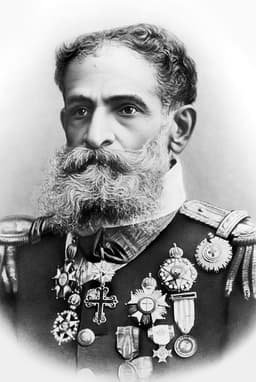
Deodoro da Fonseca
General · Modern
48.8Total
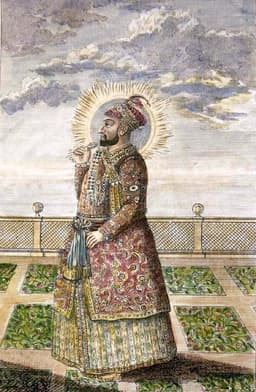
Hyder Ali
General · Modern
69.4Total
Basic Information
Born
1827
1720
Died
1892
1782
Era
Modern
Modern
Nationality
Brazil
India
Occupation
General
General
Civilization
Western
Indian
Score Comparison
Military (10%)
50.0
80.0
Political (20%)
45.1
65.7
Influence (20%)
54.1
82.0
Legacy (20%)
44.2
56.0
Leadership (15%)
57.6
68.0
Strategy (15%)
38.6
68.0
TOTAL
48.8
69.4
Deodoro da Fonseca — Complete Timeline
1889 AD
Proclamation of the Brazilian RepublicPolitical Action
Deodoro da Fonseca led a military coup that overthrew Emperor Pedro II on November 15, 1889. He proclaimed the Republic of the United States of Brazil, ending 67 years of imperial rule.
CoupRepublic
Impact: globalprogressive
1891 AD
Election as First President of BrazilPolitical Action◆ Major
Deodoro da Fonseca was elected the first President of Brazil by the Constituent Congress on February 25, 1891. He took office under the new republican constitution, but his rule was brief and authoritarian.
ElectionPresidency
Impact: national
Dissolution of the National CongressPolitical Action◆ Major
Facing political opposition, Deodoro da Fonseca dissolved the National Congress on November 3, 1891, and declared a state of siege. This authoritarian act triggered a naval revolt and his eventual resignation.
AuthoritarianismPolitical Crisis
Impact: nationaldestructive
Resignation from the PresidencyPolitical Action◆ Major
Deodoro da Fonseca resigned the presidency on November 23, 1891, after a naval rebellion threatened his government. He handed power to Vice President Floriano Peixoto, ending his 9-month rule.
ResignationPolitical Crisis
Impact: nationaltragic
Hyder Ali — Complete Timeline
1757 AD
Battle of PlasseyWar◆ Major
Hyder Ali, as a commander under the Wodeyar dynasty, participated in the Battle of Plassey indirectly by supporting the French against the British. However, his major role came later. This battle marked the beginning of British dominance in Bengal, which Hyder Ali would later challenge in the Carnatic Wars.
Carnatic WarsBritish East India CompanyMysore
Impact: regional
1761 AD
Capture of the throne of MysorePolitical Action◆ Major
Hyder Ali, a military commander, overthrew the Wodeyar ruler Krishnaraja Wodeyar II and established himself as the de facto ruler of Mysore. He imprisoned the maharaja and assumed full control, transforming Mysore into a powerful state through military reforms and expansion.
CoupMysore KingdomWodeyar Dynasty
Impact: regionaldestructive
1767 AD
First Anglo-Mysore WarWar◆ Major
Hyder Ali led Mysore against the British East India Company in the First Anglo-Mysore War. He formed alliances with the Nizam of Hyderabad and the Marathas. The war ended with the Treaty of Madras in 1769, which restored conquered territories and established a defensive alliance between Mysore and the British.
Anglo-Mysore WarsTreaty of MadrasBritish India
Impact: regional
1780 AD
Second Anglo-Mysore WarWar◆ Major
Hyder Ali launched the Second Anglo-Mysore War, attacking British territories in the Carnatic. He captured Arcot and defeated British forces at Pollilur. The war continued after his death in 1782, with his son Tipu Sultan taking command. The conflict ended with the Treaty of Mangalore in 1784.
Anglo-Mysore WarsBattle of PollilurTipu Sultan
Impact: regional
Expert Analysis
Deodoro da Fonseca vs Hyder Ali
### The General Who Became Sultan and the General Who Became President
On a sweltering November morning in 1889, Marshal Deodoro da Fonseca, a gruff, aging soldier, stood at the head of a column of troops in Rio de Janeiro. With a single, reluctant command, he ended a half-century of imperial rule in Brazil. Just over a century earlier, on the other side of the world, Hyder Ali, a former mercenary, seized the throne of Mysore from a puppet king and declared himself the de facto ruler of a kingdom that would soon become the British Empire’s most formidable Indian enemy. Both were generals who stepped into the political void, yet their paths could not have diverged more sharply. Why did one forge a dynasty and the other a fragile republic? The answer lies not in the clash of civilizations, but in the collision of ambition, opportunity, and the very different worlds they sought to command.
### Origins
Hyder Ali was born in 1720 into a world of crumbling empires and rising European power. His father was a military commander in the service of the Wodeyar kings of Mysore, a small but prosperous state in southern India. Hyder grew up in the chaos of the Carnatic Wars, where the British and French East India Companies fought for commercial supremacy by manipulating local rulers. He learned war as a craft, not a calling—rising through the ranks by sheer competence, not birth. By 1757, the year of the Battle of Plassey—where Robert Clive secured Bengal for the British—Hyder was already a seasoned commander, watching from afar as the British methodically dismantled Indian sovereignty.
Deodoro da Fonseca, born in 1827 in Alagoas, Brazil, came from a military family in a nation that was itself a product of European upheaval. Brazil had been an independent empire since 1822, ruled by the House of Braganza. Deodoro was a product of the Brazilian Army, a force that saw itself as the guardian of national order, not a tool of foreign conquest. He fought in the Paraguayan War (1864–1870), a brutal conflict that forged a generation of officers who believed the military had a duty to reshape the nation. Where Hyder’s world was one of shifting alliances and existential threats, Deodoro’s was one of institutional stability—and growing frustration with a monarchy that seemed out of touch.
### Rise to Power
Hyder Ali’s rise was a masterclass in opportunism. In 1761, he overthrew the young Wodeyar ruler Krishnaraja Wodeyar II, not with a grand coup but by quietly assuming control as the kingdom’s real power. He kept the puppet king on the throne for legitimacy, but all decisions flowed from Hyder. His military genius was proven on the battlefield: in the First Anglo-Mysore War (1767–1769), he forced the British East India Company to sign a humiliating treaty, with his army camped at the gates of Madras. Hyder understood that the British were not invincible—they were vulnerable to swift, decisive action and to alliances with their Indian rivals.
Deodoro’s rise was slower and more reluctant. He was no revolutionary. For years, he resisted calls from younger officers to overthrow Emperor Pedro II. But the monarchy’s stubbornness—especially its refusal to reform the military or address the abolition of slavery—pushed him to act. On November 15, 1889, Deodoro led a bloodless coup. He later claimed he had only meant to force the emperor to change his cabinet, not to abolish the monarchy. But events overtook him. The republic was proclaimed, and Deodoro, almost against his will, became its first head of state. His rise was not a conquest but a collapse—a system that broke under its own weight.
### Leadership & Governance
As ruler, Hyder Ali was a reformer and a warrior. He modernized Mysore’s army, introducing European drills, artillery, and rocket technology—the famous Mysorean rockets that would later inspire British innovations. He built a centralized state, curbing the power of feudal lords, and fostered trade with the French, the Dutch, and the Ottomans. His military score of 87.4 reflects his battlefield brilliance: he could outmaneuver the British, as in the 1780 capture of Arcot during the Second Anglo-Mysore War. But his political score of 66.2 reveals the limits of his rule. He was a conqueror, not a builder of institutions. His kingdom depended on his personal authority, and his alliances were fragile.
Deodoro, by contrast, was a political general thrust into a role he never wanted. His military score of 35.9 is low, but his political score of 77.9 is telling. He was not a strategist; he was a figurehead. His presidency (1891) lasted only nine months. He dissolved the National Congress in November 1891, triggering a naval rebellion. He resigned, exhausted and ill, less than three weeks later. Deodoro tried to govern like a soldier—by command—but a republic requires compromise. He lacked the patience for politics and the vision for reform. His greatest achievement was ending the empire; his greatest failure was not knowing what to put in its place.
### Triumph & Tragedy
Hyder Ali’s triumph was the Second Anglo-Mysore War. In 1780, he swept through the Carnatic, capturing Arcot and threatening Madras itself. He forged a grand alliance with the Marathas and the Nizam of Hyderabad, uniting Indian powers against the British. But his tragedy was also this war. He died in 1782, before its conclusion, his body ravaged by cancer. He left his son, Tipu Sultan, a kingdom at war and a legacy of resistance—but also a target for British vengeance. Hyder’s life was a single, relentless campaign; he never knew peace.
Deodoro’s triumph was the Proclamation of the Republic itself. On that November day, he stood at the head of history. His tragedy was the republic he could not stabilize. His dissolution of Congress turned allies into enemies. The naval revolt forced him to resign, and he died in 1892, a year later, a broken man. Unlike Hyder, who died in command, Deodoro died in defeat—a general who had won the war but lost the peace.
### Character & Destiny
Hyder Ali was a pragmatist. He was ruthless but not cruel, ambitious but not reckless. He knew when to fight and when to negotiate. His personality shaped a kingdom that survived on his will alone. Deodoro was a reluctant revolutionary. He was honest, gruff, and loyal—but indecisive. He let events push him into a role he never wanted. Their destinies were written by their worlds: Hyder’s India was a place where a strong man could carve a kingdom; Deodoro’s Brazil was a place where a strong man could only break a system, not build one.
### Legacy
Hyder Ali’s legacy is that of a founder. He created the military and political foundation for Tipu Sultan’s later resistance. He is remembered as the “Sultan of Mysore,” a symbol of Indian defiance. His score of 68.1 in legacy reflects a figure who is respected but overshadowed by his son. Deodoro’s legacy is more ambiguous. He is the first president of Brazil, but his tenure was a failure. His score of 60.6 places him as a historical footnote—a necessary but flawed transition figure. Brazil remembers him with a statue in Rio, but few celebrate his presidency.
### Conclusion
One general seized a throne and built a dynasty that fought the British to a standstill. Another general seized a republic and watched it crumble in his hands. Hyder Ali and Deodoro da Fonseca were both men of their time, but their times were not the same. Hyder’s world was one of empires in collision, where a single warrior could reshape history through force and guile. Deodoro’s world was one of institutions in transition, where a single general could only topple what he could not build. In the end, the difference between them is not military genius or political skill—it is the nature of the stage on which they played. Hyder died a king; Deodoro died a president without a country. Both were generals; only one understood that the hardest war is the one you fight after you win.
Rankings
🥇
Hyder AliLeader
Mil: 80.0Pol: 65.7Inf: 82.0
69.4
🥈
Deodoro da Fonseca
Mil: 50.0Pol: 45.1Inf: 54.1
48.8
+20.6 behind
How This Comparison Works
Algorithm
Each figure is scored on 6 dimensions (0—100 scale) based on structured historical data: Military (10%), Political (20%), Influence (20%), Legacy (20%), Leadership (15%), Strategy (15%). The weighted total produces the final ranking.
Data Sources
Scores are computed from structured sub-indicators in the database. Scale factors adjust for era (Ancient ×0.85, Modern ×1.0) and civilization size (Eastern ×1.05, Other ×0.80) to account for differences in population and military scale.
Maximum 3 Figures
Comparisons are limited to 2—3 figures to ensure readability and statistical meaningfulness.
Error Margins
±5 points per dimension — Sub-scores are derived from historical records with inherent uncertainty. Two figures within 5 points on a dimension should be considered roughly equivalent in that area.
Total Score Accuracy
±3 points overall — The weighted combination of 6 dimensions produces a total score with approximately ±3 points of uncertainty. Differences of less than 3 points are not statistically significant— the figures are effectively tied.
Known Limitations
- Historical records are incomplete and uneven across civilizations
- Figures from oral-tradition societies may be underrepresented
- Occupation labels can misclassify multi-role figures
- Scores measure capability and impact, not moral character
- Quantitative scoring is a comparison tool, not absolute truth
Capability Radar
Military (10%) — Battles & Warfare
Battles
20
78
Win Rate
25
72
Expansion
10
70
Political (20%) — Governance & Reform
Reform
40
70
Diplomacy
25
68
Economy
15
60
Influence (20%) — Cultural & Global Reach
Cultural
20
50
Global
15
50
Legacy (20%) — Historical Impact
Historical
35
55
Longevity
20
45
Leadership (15%) — Power & Stability
Tenure
30
65
Stability
10
55
Strategy (15%) — Tactics & Innovation
Strategy
25
80
Tactics
20
85
Reform
15
75
Similar Comparisons
Comments & Discussion
Marshall's Last March6/16/2026
Deodoro's coup was less a military masterstroke than a desperate gamble by a sick old man who'd rather topple a throne than face retirement. His "reluctant" republic survived purely because Brazil's coffee barons needed a figurehead, not a fighter. Meanwhile, Hyder Ali actually *built* something—a modern army that taught the British real fear at Pollilur. Deodoro gave Brazil a flag; Hyder gave Tipu a war machine.
老兵的叹息6/16/2026
说德奥多罗是军人,不如说他是帝国最后的门卫——推翻了佩德罗二世,却把共和国建在咖啡和奴隶制的泥潭里。而海德尔·阿里才是真正的铁腕:他用法国军事顾问训练出南印最精锐的火箭部队,1780年波利卢尔之战几乎全歼英军。一个枪口对着皇帝的后背,一个枪口对准殖民者的心脏。高下立判。
Data Skeptic Steve6/16/2026
Show me one metric where Deodoro outperforms Hyder. GDP? Hyder's Mysore was booming from silk and spice trade when Brazil was still a Portuguese plantation. Military innovation? Hyder fielded iron-cased rockets decades before Congreve copied them. Deodoro's greatest "victory" was a bloodless coup—talented amateur hour compared to fighting the British Empire to a standstill for two decades.
铁腕与纸冠6/16/2026
别被"共和国之父"的帽子骗了。德奥多罗在佛洛里亚诺的政变里连枪都没开,就灰溜溜辞职了。海德尔·阿里从一个小军官爬到苏丹之位,靠的是在坦焦尔战役里用骑兵撕碎东印度公司的方阵。一个统治不到两年就被赶下台,一个临死前还在规划征服马拉塔。你说谁是真正的将军?
Classics Corner Lily6/16/2026
Deodoro's story reads like a cautionary tale from Plutarch—a general who wins the state but loses command of himself. His fragile republic mirrored his fragile health: both dissolved within years. Hyder Ali, by contrast, belongs to Livy's annals: a self-made king who turned a tributary kingdom into a hegemon. One founded a newspaper (O Federalista); the other founded a dynasty that made the British rewrite their entire Indian strategy.
泥潭与王座6/16/2026
历史总把"开国者"神化,但德奥多罗最多算个意外总统——他自己都承认治国不如骑马。海德尔·阿里才是系统性的革命者:他重组了迈索尔的税收、建立了国有军工复合体,让英军在1782年之前不敢南下。一个靠枪杆子推翻了皇冠,另一个用枪杆子铸造了一顶更坚固的新皇冠。谁更有远见?答案在