Loading...
Deodoro da Fonseca vs Jung Bahadur Rana
Jung Bahadur Rana leads by 12.6 pts · 2 figures compared
…
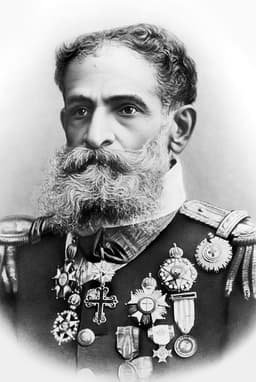
Deodoro da Fonseca
General · Modern
48.8Total
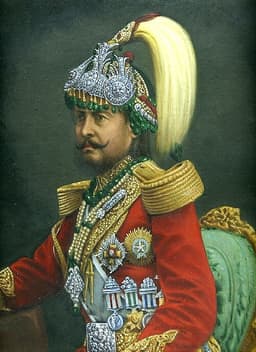
Jung Bahadur Rana
General · Modern
61.4Total
Basic Information
Born
1827
1817
Died
1892
1877
Era
Modern
Modern
Nationality
Brazil
Nepal
Occupation
General
General
Civilization
Western
Indian
Score Comparison
Military (10%)
50.0
55.0
Political (20%)
45.1
72.0
Influence (20%)
54.1
56.7
Legacy (20%)
44.2
55.0
Leadership (15%)
57.6
78.0
Strategy (15%)
38.6
55.0
TOTAL
48.8
61.4
Deodoro da Fonseca — Complete Timeline
1889 AD
Proclamation of the Brazilian RepublicPolitical Action
Deodoro da Fonseca led a military coup that overthrew Emperor Pedro II on November 15, 1889. He proclaimed the Republic of the United States of Brazil, ending 67 years of imperial rule.
CoupRepublic
Impact: globalprogressive
1891 AD
Election as First President of BrazilPolitical Action◆ Major
Deodoro da Fonseca was elected the first President of Brazil by the Constituent Congress on February 25, 1891. He took office under the new republican constitution, but his rule was brief and authoritarian.
ElectionPresidency
Impact: national
Dissolution of the National CongressPolitical Action◆ Major
Facing political opposition, Deodoro da Fonseca dissolved the National Congress on November 3, 1891, and declared a state of siege. This authoritarian act triggered a naval revolt and his eventual resignation.
AuthoritarianismPolitical Crisis
Impact: nationaldestructive
Resignation from the PresidencyPolitical Action◆ Major
Deodoro da Fonseca resigned the presidency on November 23, 1891, after a naval rebellion threatened his government. He handed power to Vice President Floriano Peixoto, ending his 9-month rule.
ResignationPolitical Crisis
Impact: nationaltragic
Jung Bahadur Rana — Complete Timeline
1846 AD
Kot MassacrePolitical Action
Jung Bahadur Runa orchestrated the Kot Massacre in Kathmandu, where dozens of nobles and courtiers were killed. This event eliminated his political rivals and allowed him to seize effective control of the Nepalese government, establishing the hereditary Rana prime ministership.
CoupMassacreRana Dynasty
Impact: nationaldestructive
Establishment of Rana DynastyPolitical Action◆ Major
Following the Kot Massacre, Jung Bahadur Rana appointed himself prime minister and commander-in-chief. He made the position hereditary, founding the Rana dynasty that ruled Nepal for over a century, reducing the Shah monarchs to figureheads.
DynastyGovernmentNepal
Impact: national
1850 AD
Visit to EuropeCultural
Jung Bahadur Rana traveled to Britain and France, becoming the first South Asian ruler to visit Europe. He observed Western military and industrial technology, which influenced his modernization efforts in Nepal, including army reforms.
DiplomacyModernizationTravel
Impact: nationalconstructive
1856 AD
Nepal-Tibet War and Treaty of ThapathaliWar◆ Major
Jung Bahadur Rana led a Nepalese military campaign into Tibet. The conflict ended with the Treaty of Thapathali, which secured Nepalese territorial claims and established a tributary relationship with Tibet, enhancing Nepal's regional influence.
WarTreatyTibet
Impact: regional
Expert Analysis
Deodoro da Fonseca vs Jung Bahadur Rana
# The General Who Became a Dynasty, and the General Who Became a Republic
On a November morning in 1891, two men on opposite sides of the world faced the wreckage of their ambitions. In Rio de Janeiro, Marshal Deodoro da Fonseca, the first president of Brazil, scrawled his resignation after just nine months in power, his dream of a stable republic shattered by a naval rebellion. Half a century earlier, in the blood-soaked courtyard of the Kathmandu palace, Jung Bahadur Rana had watched the bodies of dozens of nobles pile up—and from that carnage, he built a dynasty that would rule Nepal for 104 years. Both men were generals. Both seized power in moments of national crisis. But one founded a family empire, while the other could not even hold a presidency. Why?
Origins
Jung Bahadur Rana was born in 1817 into a minor noble family in Kathmandu, a kingdom where power flowed through palace intrigue and the whims of a young, weak king. Nepal was a landlocked fortress of mountains, recently humiliated in a war with British India, and its court was a snake pit of feuding factions. Jung Bahadur learned early that survival meant reading men's intentions, striking first, and never hesitating. His world was one of absolute loyalty and absolute betrayal, where a single misstep meant death.
Deodoro da Fonseca, born ten years later in 1827, came from a military family in Alagoas, a province of the Brazilian Empire. Brazil in the 19th century was a vast, slaveholding monarchy, stable under Emperor Pedro II, a respected constitutional ruler. Deodoro grew up in an army that prided itself on order and professionalism, fighting in the Paraguayan War and rising through the ranks by competence, not conspiracy. His world was one of institutions, not vendettas. The difference in their origins—a precarious mountain court versus a functioning imperial state—shaped everything that followed.
Rise to Power
Jung Bahadur's ascent was a masterpiece of cold-blooded calculation. On September 14, 1846, he orchestrated the Kot Massacre, luring his rivals into the palace armory and having them slaughtered. In a single night, he eliminated the old nobility. Within weeks, he named himself prime minister and commander-in-chief, making both positions hereditary. He did not abolish the monarchy—he kept the king as a figurehead, a puppet whose strings he pulled. His rise was not a revolution but a coup d'état disguised as a restoration of order.
Deodoro da Fonseca's path was entirely different. He did not plot for years; he was drafted by republican conspirators who needed a famous general to lead their coup. On November 15, 1889, Deodoro, suffering from poor health and deep ambivalence, reluctantly marched his troops through Rio de Janeiro and arrested the prime minister. Emperor Pedro II, unwilling to spill blood, abdicated. Deodoro did not seize power for himself; he proclaimed a republic and handed authority to a provisional government. His rise was not a calculated grab but a reluctant response to a movement he barely controlled.
Leadership & Governance
Jung Bahadur ruled Nepal with an iron pragmatism. He modernized the army, reformed taxation, and abolished *sati* (widow burning), but he never touched the social order that kept him in power. His military strategy was shrewd: in 1856, he led a campaign into Tibet, securing the Treaty of Thapathali that guaranteed Nepal's northern border and extracted tribute. He also made a historic visit to Britain and France in 1850, the first South Asian ruler to do so, studying Western technology and diplomacy. He brought back guns, railways, and a deep understanding of British power—which he used to keep Nepal independent while the rest of the subcontinent fell under colonial rule.
Deodoro governed Brazil for just over two years, and it was a disaster. Elected president by the Constituent Congress in February 1891, he faced a parliament that resented his authoritarian instincts. His military background made him see opposition as insubordination. In November 1891, he dissolved the National Congress and declared a state of siege, hoping to rule by decree. But Brazil was not Nepal—there were newspapers, a professional navy, and a public that would not tolerate a dictatorship. Within three weeks, a naval rebellion forced him to resign. His political wisdom, unlike Jung Bahadur's, was almost nonexistent.
Triumph & Tragedy
Jung Bahadur's greatest triumph was the Kot Massacre itself—a moment of such ruthless clarity that it ended centuries of court chaos. His tragedy was that his dynasty, for all its stability, became a parasitic elite that drained Nepal of progress for generations. He saved the country from British conquest but condemned it to stagnation.
Deodoro's triumph was the proclamation of the republic itself—a bloodless transition that ended the monarchy without civil war. His tragedy was his own incompetence. A man who could lead an army could not lead a democracy. He died in 1892, just months after his resignation, a broken figure remembered as the man who could not finish what he started.
Character & Destiny
Jung Bahadur was a predator in a world of prey. He trusted no one, planned everything, and understood that power was a zero-sum game. His personality—cold, patient, and utterly without sentiment—allowed him to build a structure that outlasted him. Deodoro was a reluctant revolutionary, a man of honor in a game that required cunning. He was loyal to his friends, hesitant to act, and easily swayed by flattery. In the cutthroat politics of a new republic, such virtues became fatal weaknesses.
Legacy
Jung Bahadur Rana is remembered as the founder of a dynasty that ruled Nepal until 1951. His legacy score of 80.0 reflects a man who shaped a nation's destiny for over a century—for better and worse. He is a figure of awe and ambivalence, a national unifier and a tyrant.
Deodoro da Fonseca is a footnote in Brazilian history, a transitional figure whose legacy score of 60.6 captures his failure to institutionalize the republic he created. He is honored as the first president but studied as a warning: that military men who make revolutions rarely know how to govern the peace.
Conclusion
What drove these two generals to such different fates? It was not talent—Jung Bahadur was a political genius, Deodoro a political amateur. It was the soil in which they grew. One was shaped by a court where survival meant slaughter; the other by an empire where order was assumed. Jung Bahadur built a dynasty because his world demanded it; Deodoro failed to build a republic because his world expected it. In the end, their stories remind us that leaders are not just makers of history—they are also its creatures, born into cages they can never fully escape.
Rankings
🥇
Jung Bahadur RanaLeader
Mil: 55.0Pol: 72.0Inf: 56.7
61.4
🥈
Deodoro da Fonseca
Mil: 50.0Pol: 45.1Inf: 54.1
48.8
+12.6 behind
How This Comparison Works
Algorithm
Each figure is scored on 6 dimensions (0—100 scale) based on structured historical data: Military (10%), Political (20%), Influence (20%), Legacy (20%), Leadership (15%), Strategy (15%). The weighted total produces the final ranking.
Data Sources
Scores are computed from structured sub-indicators in the database. Scale factors adjust for era (Ancient ×0.85, Modern ×1.0) and civilization size (Eastern ×1.05, Other ×0.80) to account for differences in population and military scale.
Maximum 3 Figures
Comparisons are limited to 2—3 figures to ensure readability and statistical meaningfulness.
Error Margins
±5 points per dimension — Sub-scores are derived from historical records with inherent uncertainty. Two figures within 5 points on a dimension should be considered roughly equivalent in that area.
Total Score Accuracy
±3 points overall — The weighted combination of 6 dimensions produces a total score with approximately ±3 points of uncertainty. Differences of less than 3 points are not statistically significant— the figures are effectively tied.
Known Limitations
- Historical records are incomplete and uneven across civilizations
- Figures from oral-tradition societies may be underrepresented
- Occupation labels can misclassify multi-role figures
- Scores measure capability and impact, not moral character
- Quantitative scoring is a comparison tool, not absolute truth
Capability Radar
Military (10%) — Battles & Warfare
Battles
20
45
Win Rate
25
50
Expansion
10
40
Political (20%) — Governance & Reform
Reform
40
75
Diplomacy
25
70
Economy
15
65
Influence (20%) — Cultural & Global Reach
Cultural
20
55
Global
15
40
Legacy (20%) — Historical Impact
Historical
35
65
Longevity
20
60
Leadership (15%) — Power & Stability
Tenure
30
80
Stability
10
60
Strategy (15%) — Tactics & Innovation
Strategy
25
60
Tactics
20
55
Reform
15
70
Similar Comparisons
Comments & Discussion
铁腕筑巢6/16/2026
Jung Bahadur才是真懂权力的人——他从一场宫廷血案中活下来并建立百年王朝,这比Deodoro的共和梦务实多了。历史读的是生存率,不是理想主义。
SkepticalSgt6/16/2026
You're romanticizing Rana's "dynasty" — it was a hereditary dictatorship propped up by British guns. Deodoro at least attempted a constitutional framework. Let's not confuse longevity with legitimacy.
老书虫6/16/2026
细读历史:Rana在1850年访英后,带回的不仅是军事改革,更是现代官僚体系的种子。而Deodoro的失败,根在巴西帝国的奴隶制遗产——他镇压海军起义只用炮舰,却不懂土地改革。两者根本不在同一维度的政治棋局上。
SlaveStateSniper6/16/2026
Don't gloss over the fact that Deodoro was a slaver general who literally issued a decree promising to protect property rights of plantation owners. His "republic" was a white elite coup dressed in positivist drag. Rana's Nepal was feudal garbage too, but at least he modernized Nepal's army and kept British India at bay.
王座密码6/16/2026
结论很清楚了:Rana是政变里的艺术家,Deodoro是泥潭里的莽夫。前者用一百年证明权力可以传承,后者连九个月都撑不住。军队要的是家族忠诚,不是宪法陈词。