Loading...
Deodoro da Fonseca vs Ranoji Scindia
Ranoji Scindia leads by 8.2 pts · 2 figures compared
…
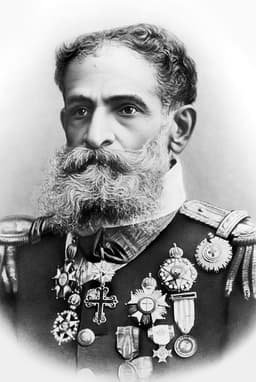
Deodoro da Fonseca
General · Modern
48.8Total
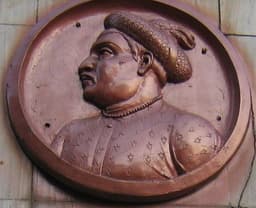
Ranoji Scindia
General · Modern
57.0Total
Basic Information
Born
1827
1700
Died
1892
1745
Era
Modern
Modern
Nationality
Brazil
India
Occupation
General
General
Civilization
Western
Indian
Score Comparison
Military (10%)
50.0
50.0
Political (20%)
45.1
54.7
Influence (20%)
54.1
58.0
Legacy (20%)
44.2
54.0
Leadership (15%)
57.6
65.0
Strategy (15%)
38.6
60.0
TOTAL
48.8
57.0
Deodoro da Fonseca — Complete Timeline
1889 AD
Proclamation of the Brazilian RepublicPolitical Action
Deodoro da Fonseca led a military coup that overthrew Emperor Pedro II on November 15, 1889. He proclaimed the Republic of the United States of Brazil, ending 67 years of imperial rule.
CoupRepublic
Impact: globalprogressive
1891 AD
Election as First President of BrazilPolitical Action◆ Major
Deodoro da Fonseca was elected the first President of Brazil by the Constituent Congress on February 25, 1891. He took office under the new republican constitution, but his rule was brief and authoritarian.
ElectionPresidency
Impact: national
Dissolution of the National CongressPolitical Action◆ Major
Facing political opposition, Deodoro da Fonseca dissolved the National Congress on November 3, 1891, and declared a state of siege. This authoritarian act triggered a naval revolt and his eventual resignation.
AuthoritarianismPolitical Crisis
Impact: nationaldestructive
Resignation from the PresidencyPolitical Action◆ Major
Deodoro da Fonseca resigned the presidency on November 23, 1891, after a naval rebellion threatened his government. He handed power to Vice President Floriano Peixoto, ending his 9-month rule.
ResignationPolitical Crisis
Impact: nationaltragic
Ranoji Scindia — Complete Timeline
1726 AD
Appointed Subedar of MalwaPolitical Action◆ Major
Ranoji Scindia was appointed as the Maratha subedar of Malwa by Peshwa Baji Rao I. This gave him control over a large territory and laid the foundation for the Scindia dynasty of Gwalior.
Maratha EmpireMalwaScindia Dynasty
Impact: regionalconstructive
1737 AD
Battle of DelhiWar◆ Major
Ranoji Scindia participated in the Maratha raid on Delhi under Baji Rao I. The attack on the Mughal capital demonstrated Maratha power and led to the extraction of tribute.
Maratha-Mughal WarsDelhiRaid
Impact: national
1739 AD
Battle of VasaiWar
Ranoji Scindia fought alongside Malhar Rao Holkar in the siege of Vasai against the Portuguese. The victory ended Portuguese control in the Konkan region.
Maratha-Portuguese WarsSiegeKonkan
Impact: regional
1740 AD
Founded Gwalior as CapitalPolitical Action◆ Major
Ranoji Scindia established his capital at Gwalior, fortifying the Gwalior Fort and building a palace. This city became the center of Scindia power for over a century.
FoundingGwaliorScindia Dynasty
Impact: regionalconstructive
1745 AD
Death in BattleWar
Ranoji Scindia was killed in a battle against the Nizam of Hyderabad's forces near the Narmada River. His death occurred during a Maratha campaign to expand into the Deccan.
DeathBattleMaratha-Nizam Wars
Impact: regionaltragic
Expert Analysis
Deodoro da Fonseca vs Ranoji Scindia
### The General Who Built a Kingdom and the General Who Built a Republic
In the stark, sun-baked courtyard of the Gwalior Fort, a Maratha warrior named Ranoji Scindia once laid the foundation of a dynasty that would rule central India for two centuries. Half a world away and a century later, a Brazilian marshal named Deodoro da Fonseca stood on the balcony of the Imperial Palace in Rio de Janeiro, watching the last emperor of Brazil sail into exile. Both men were generals. Both men stepped onto the stage of history at moments of profound transition. Yet one died in battle, his body lost in the waters of the Narmada, while the other resigned in disgrace, his republic teetering on the brink of collapse. What separates a founder from a failure? The answer lies not in their swords, but in the worlds they sought to command.
### Origins: The Forge of Two Empires
Ranoji Scindia was born in 1700 into a humble family of hill farmers in the Deccan. The Maratha Empire, under the visionary Peshwa Baji Rao I, was then a whirlwind of ambition, sweeping across the crumbling Mughal Empire. Ranoji’s rise was not through bloodline but through sheer competence. He joined Baji Rao’s cavalry as a young man, learning war in the saddle, where speed and audacity were the only laws. The Maratha world was one of fluid loyalties and endless campaigns—a brutal school where a general’s worth was measured in plundered treasure and conquered forts.
Deodoro da Fonseca, born in 1827 in Alagoas, Brazil, came from a military family in a nation that had been an empire since 1822. Unlike Ranoji, he was educated in formal military academies, reading European texts on strategy and governance. Brazil in the late 19th century was a paradox: a vast, slave-dependent monarchy in a hemisphere of republics. The emperor, Pedro II, was beloved but aging, and the army—humiliated by the long, costly War of the Triple Alliance—was restless. Deodoro was a product of this tension: a soldier who revered order but chafed under imperial authority.
### Rise to Power: The Path of the Sword and the Coup
Ranoji Scindia’s rise was a steady climb through the ranks of the Maratha confederacy. In 1726, Peshwa Baji Rao I appointed him Subedar of Malwa, a vast province wrested from Mughal control. It was a political action of immense significance, giving Ranoji not just an army but a territory to tax, govern, and defend. He proved his mettle in the 1737 Battle of Delhi, where Maratha cavalry raided the Mughal capital, and in the 1739 Siege of Vasai, where he fought alongside Malhar Rao Holkar to expel the Portuguese from the Konkan coast. Each victory was a brick in the foundation of his power.
Deodoro da Fonseca’s path was different. He did not conquer provinces; he seized a state. On November 15, 1889, he led a bloodless military coup that deposed Emperor Pedro II. The monarchy fell not because of a great battle, but because of a whispered conspiracy among officers who feared a succession crisis and the rise of a republican heir. Deodoro, a hesitant and reluctant revolutionary, was pushed to the front by younger, more radical officers. He became the head of a provisional government almost by accident, his authority resting not on a dynasty he built, but on a throne he had dismantled.
### Leadership & Governance: The Builder and the Bureaucrat
As a leader, Ranoji Scindia was a master of consolidation. In 1740, he established his capital at Gwalior, fortifying its ancient hill fort and building a palace that would become the heart of his dynasty. He did not seek to destroy the Mughal Empire; he sought to carve a stable domain within its ruins. His political wisdom lay in balancing tribute to the Peshwa with autonomy for himself, creating a semi-independent state that could survive his death. His military genius was tactical, not strategic—he was a superb field commander who could hold a line and lead a charge, but his overall score of 55.7 in military reflects that he was a lieutenant, not a supreme commander.
Deodoro da Fonseca, by contrast, was a political general thrust into a civilian role. His leadership score of 70.0 suggests a man of presence and resolve, but his political score of 77.9 hides a fatal flaw: he had no patience for the messy, slow work of democracy. Elected the first president of Brazil on February 25, 1891, he faced a hostile Congress and a collapsing economy. His response was not compromise but force. On November 3, 1891, he dissolved the National Congress and declared a state of siege. It was a general’s solution to a politician’s problem—and it failed.
### Triumph & Tragedy: The Battlefield and the Ballot Box
Ranoji Scindia’s greatest moment was the founding of Gwalior. He transformed a remote fort into a capital that would rival Delhi in splendor, a city that still bears his dynasty’s name. His tragedy came in 1745, when he was killed in a skirmish against the Nizam of Hyderabad’s forces near the Narmada River. He died as he had lived: in the saddle, sword in hand. His body was never recovered, a fitting end for a man whose life was a campaign.
Deodoro da Fonseca’s triumph was the Proclamation of the Republic itself—a historic act that ended 67 years of monarchy in Brazil. But his tragedy followed swiftly. The naval rebellion of November 1891, led by officers loyal to the old empire, forced his resignation on November 23, just months after he had seized dictatorial power. He left the presidency a broken man, dying the following year. His republic survived, but he did not.
### Character & Destiny: The Warrior and the Reluctant Revolutionary
Ranoji Scindia’s character was forged in the crucible of constant war. He was a man of action, not reflection, whose decisions were driven by the immediate needs of survival and expansion. He understood that power in 18th-century India was built on loyalty, plunder, and the sword. His destiny was to be a founder because he never aspired to be anything else.
Deodoro da Fonseca was a man caught between two worlds. He believed in order, hierarchy, and military discipline, yet he destroyed the very monarchy that embodied those values. He was a republican by circumstance, not conviction. His character—proud, stubborn, and politically naive—led him to overreach. He dissolved Congress not out of strategic genius but out of frustration. His destiny was to be a symbol, not a ruler.
### Legacy: The Dynasty and the Date
Ranoji Scindia’s legacy is tangible. The Scindia dynasty ruled Gwalior until Indian independence, and the city remains a monument to his ambition. His influence score of 73.6 reflects a man who created a political lineage that outlasted the Maratha Empire itself. He is remembered as a builder, a fighter, and a founder.
Deodoro da Fonseca’s legacy is more abstract. He is the first president of Brazil, a name on a page in history books. His legacy score of 60.6 is modest because his republic was shaped more by his successors than by him. He is honored as a founding father, but his failures are glossed over. His true monument is the date November 15, celebrated as Republic Day in Brazil.
### Conclusion: The General’s Choice
Ranoji Scindia and Deodoro da Fonseca stand at opposite ends of the spectrum of military leadership. One built a kingdom from the saddle; the other tried to build a republic from a coup. The difference between them is not talent or courage—both had plenty—but context and vision. Ranoji lived in a world where power was personal, where a general could carve a state from a battlefield. Deodoro lived in a world of institutions, constitutions, and popular will, where a general’s sword could topple a throne but could not govern a nation. Their stories remind us that the same qualities that make a great warrior can destroy a great leader. In the end, the general who knows his limits is the one who leaves a dynasty. The one who forgets them leaves only a date.
Rankings
🥇
Ranoji ScindiaLeader
Mil: 50.0Pol: 54.7Inf: 58.0
57.0
🥈
Deodoro da Fonseca
Mil: 50.0Pol: 45.1Inf: 54.1
48.8
+8.2 behind
How This Comparison Works
Algorithm
Each figure is scored on 6 dimensions (0—100 scale) based on structured historical data: Military (10%), Political (20%), Influence (20%), Legacy (20%), Leadership (15%), Strategy (15%). The weighted total produces the final ranking.
Data Sources
Scores are computed from structured sub-indicators in the database. Scale factors adjust for era (Ancient ×0.85, Modern ×1.0) and civilization size (Eastern ×1.05, Other ×0.80) to account for differences in population and military scale.
Maximum 3 Figures
Comparisons are limited to 2—3 figures to ensure readability and statistical meaningfulness.
Error Margins
±5 points per dimension — Sub-scores are derived from historical records with inherent uncertainty. Two figures within 5 points on a dimension should be considered roughly equivalent in that area.
Total Score Accuracy
±3 points overall — The weighted combination of 6 dimensions produces a total score with approximately ±3 points of uncertainty. Differences of less than 3 points are not statistically significant— the figures are effectively tied.
Known Limitations
- Historical records are incomplete and uneven across civilizations
- Figures from oral-tradition societies may be underrepresented
- Occupation labels can misclassify multi-role figures
- Scores measure capability and impact, not moral character
- Quantitative scoring is a comparison tool, not absolute truth
Capability Radar
Military (10%) — Battles & Warfare
Battles
20
45
Win Rate
25
50
Expansion
10
55
Political (20%) — Governance & Reform
Reform
40
30
Diplomacy
25
45
Economy
15
35
Influence (20%) — Cultural & Global Reach
Cultural
20
30
Global
15
30
Legacy (20%) — Historical Impact
Historical
35
50
Longevity
20
55
Leadership (15%) — Power & Stability
Tenure
30
40
Stability
10
40
Strategy (15%) — Tactics & Innovation
Strategy
25
45
Tactics
20
40
Reform
15
35
Similar Comparisons
Comments & Discussion
No comments yet. Be the first to share your thoughts!