Loading...
Djemal Pasha vs Sun Chuanfang
Djemal Pasha leads by 1.9 pts · 2 figures compared
…
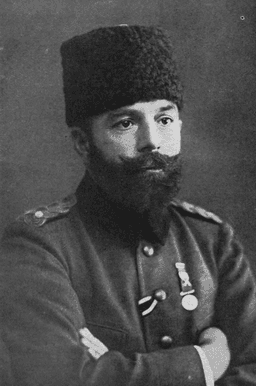
Djemal Pasha
General · Modern
56.3Total

Sun Chuanfang
General · Modern
54.4Total
Basic Information
Born
1872
1885
Died
1922
1935
Era
Modern
Modern
Nationality
Ottoman Empire
China
Occupation
General
General
Civilization
Middle Eastern
Eastern
Score Comparison
Military (10%)
50.0
67.5
Political (20%)
68.0
54.7
Influence (20%)
54.9
52.5
Legacy (20%)
46.7
43.3
Leadership (15%)
65.0
65.0
Strategy (15%)
60.0
57.5
TOTAL
56.3
54.4
Djemal Pasha — Complete Timeline
1914 AD
Appointment as Minister of Public WorksPolitical Action
Djemal Pasha was appointed Minister of Public Works in 1914 as part of the Committee of Union and Progress government. He later became Minister of the Navy and was given command of the Fourth Army in Syria.
Ottoman GovernmentMinisterCUP
Impact: national
1915 AD
Command of the Fourth Army in SyriaWar◆ Major
Djemal Pasha commanded the Ottoman Fourth Army in Syria and Palestine from 1915 to 1917. He launched an unsuccessful attack on the Suez Canal in February 1915 and later faced the Arab Revolt. His harsh rule in Syria included executions of Arab nationalists.
World War ISyria CampaignArab Revolt
Impact: regionaldestructive
1922 AD
Assassination in TbilisiOther◆ Major
Djemal Pasha was assassinated on July 21, 1922, in Tbilisi, Georgia, by Armenian agents as part of Operation Nemesis. He was killed in retaliation for his role in the Armenian Genocide while traveling to negotiate with Soviet authorities.
AssassinationOperation NemesisArmenian Genocide
Impact: globaltragic
Sun Chuanfang — Complete Timeline
1923 AD
Control of the Lower YangtzePolitical Action◆ Major
Sun Chuanfang established control over the wealthy Lower Yangtze region, including Jiangsu, Zhejiang, Anhui, Fujian, and Jiangxi provinces. He became one of the most powerful warlords in southern China, commanding substantial revenues and military forces.
Warlord EraTerritorial ControlPower
Impact: regional
1924 AD
Formation of the Five Provinces AlliancePolitical Action
Sun Chuanfang formed the Five Provinces Alliance with other warlords to resist the expansion of the Fengtian clique. This alliance temporarily stabilized his position in the Lower Yangtze region.
Warlord EraAlliancePolitics
Impact: regional
1927 AD
Defeat by the National Revolutionary ArmyWar◆ Major
Sun Chuanfang's forces were decisively defeated by the National Revolutionary Army during the Northern Expedition. He lost control of the Lower Yangtze provinces and fled, ending his warlord rule.
Northern ExpeditionWarDefeat
Impact: nationaltragic
1935 AD
AssassinationPolitical Action
Sun Chuanfang was assassinated in Tianjin by a woman named Shi Jianqiao, who claimed revenge for her father's death during the warlord conflicts. His death marked the end of his influence in Chinese politics.
AssassinationWarlord EraDeath
tragic
Expert Analysis
Origins
**Djemal Pasha** was born in 1872 on the island of Midilli (now Lesbos, Greece), into a middle-class Ottoman family. He attended the Ottoman Military Academy, graduating as a staff officer. His early career included postings in the Balkans, where he became involved with the Committee of Union and Progress (CUP), a secret revolutionary society. Djemal was a committed reformer, influenced by the Young Turk movement that sought to modernize the Ottoman Empire.
**Sun Chuanfang** was born in 1885 in Licheng, Shandong Province, China, into a scholarly family. He studied at the Baoding Military Academy, graduating in 1908. He served in the Beiyang Army under Yuan Shikai, rising through the ranks. After the fall of the Qing dynasty, Sun became a protégé of the Zhili clique warlord Cao Kun, eventually carving out his own domain in the wealthy Lower Yangtze region.
Rise to Power
Djemal Pasha rose to prominence after the 1908 Young Turk Revolution. He became a key figure in the CUP, serving as military governor of Constantinople and later Minister of Public Works in 1914. His real breakthrough came during World War I, when he was appointed commander of the Fourth Army in Syria and Palestine (1915-1917). He also held the position of Minister of the Navy, consolidating his power within the triumvirate alongside Enver Pasha and Talaat Pasha.
Sun Chuanfang rose to power after the death of Yuan Shikai in 1916, when China fragmented into warlord fiefdoms. He initially served under the Zhili clique and gained control of Fujian province in 1923. By 1925, he expanded his territory to include Jiangsu, Zhejiang, Anhui, and Jiangxi, forming the Five Provinces Alliance. He became the dominant warlord in the Lower Yangtze, one of China's richest regions.
Leadership & Governance
Djemal Pasha was an authoritarian modernizer. As governor of Syria, he enforced strict policies, suppressed Arab nationalist movements, and executed suspected dissidents. He also implemented infrastructure projects, including roads and railways, but his heavy-handed rule alienated the local population. His military score of 50.0 reflects his mixed performance; his attack on the Suez Canal in February 1915 failed, and he struggled against the British-led Arab Revolt.
Sun Chuanfang governed the Lower Yangtze with a mix of coercion and pragmatism. He maintained order, collected taxes, and built up his military. However, his rule was extractive, and he faced resistance from local elites. His political score of 54.7 indicates moderate political skill, but he failed to build lasting institutions. He relied on personal loyalty and force, typical of warlord rule.
Triumph & Tragedy
Djemal Pasha's greatest triumph was his role in the Ottoman Empire's wartime governance, but his military failures in Palestine and the Armenian genocide (in which he was complicit) overshadow his achievements. He scored 54.9 in influence, but his legacy is tarnished. His assassination in Tbilisi on July 21, 1922, by Armenian agents (Operation Nemesis) marked a tragic end.
Sun Chuanfang's greatest success was controlling the Lower Yangtze, a region of immense wealth. He scored 67.5 in military, higher than Djemal, due to his effective warlord army. However, his defeat by the National Revolutionary Army during the Northern Expedition in 1927 was a crushing blow. He was assassinated in Tianjin in 1935 by a woman avenging her father, a victim of his earlier campaigns.
Character & Destiny
Djemal Pasha was idealistic but ruthless. He believed in a centralized, modern Ottoman state but was willing to use extreme violence. His character—ambitious, disciplined, and uncompromising—led him to support the CUP's radical policies. His destiny was sealed by the Ottoman defeat and the vengeful survivors of the Armenian genocide.
Sun Chuanfang was pragmatic and opportunistic. He was a capable military commander but lacked strategic vision. His reliance on personal networks and short-term gains ultimately failed against the organized National Revolutionary Army. His character—cautious yet ambitious—led him to overreach without building a sustainable power base.
Legacy
Djemal Pasha's legacy is complex. He is remembered as one of the Three Pashas who led the Ottoman Empire during World War I and as a perpetrator of the Armenian genocide. His influence score of 54.9 reflects his role in shaping the post-Ottoman Middle East, but his legacy is overwhelmingly negative. He scored 46.7 in legacy, indicating limited positive impact.
Sun Chuanfang's legacy is more localized. He is remembered as a typical Chinese warlord of the Republican era, whose rule contributed to the fragmentation that the Nationalists and Communists eventually overcame. His legacy score of 43.3 is low, as his impact was temporary and overshadowed by later events.
Conclusion
Djemal Pasha and Sun Chuanfang both represent the militaristic ambitions of their respective eras, but Djemal Pasha's impact was broader due to the Ottoman Empire's global role. With a total score of 56.3 to Sun's 54.4, Djemal edges ahead, but neither achieved lasting greatness. Djemal's involvement in the Armenian genocide makes his legacy profoundly negative, while Sun's warlordism was a dead end. In terms of historical significance, Djemal Pasha had greater influence on world events, even if that influence was destructive.
Rankings
🥇
Djemal PashaLeader
Mil: 50.0Pol: 68.0Inf: 54.9
56.3
🥈
Sun Chuanfang
Mil: 67.5Pol: 54.7Inf: 52.5
54.4
+1.9 behind
How This Comparison Works
Algorithm
Each figure is scored on 6 dimensions (0—100 scale) based on structured historical data: Military (10%), Political (20%), Influence (20%), Legacy (20%), Leadership (15%), Strategy (15%). The weighted total produces the final ranking.
Data Sources
Scores are computed from structured sub-indicators in the database. Scale factors adjust for era (Ancient ×0.85, Modern ×1.0) and civilization size (Eastern ×1.05, Other ×0.80) to account for differences in population and military scale.
Maximum 3 Figures
Comparisons are limited to 2—3 figures to ensure readability and statistical meaningfulness.
Error Margins
±5 points per dimension — Sub-scores are derived from historical records with inherent uncertainty. Two figures within 5 points on a dimension should be considered roughly equivalent in that area.
Total Score Accuracy
±3 points overall — The weighted combination of 6 dimensions produces a total score with approximately ±3 points of uncertainty. Differences of less than 3 points are not statistically significant— the figures are effectively tied.
Known Limitations
- Historical records are incomplete and uneven across civilizations
- Figures from oral-tradition societies may be underrepresented
- Occupation labels can misclassify multi-role figures
- Scores measure capability and impact, not moral character
- Quantitative scoring is a comparison tool, not absolute truth
Capability Radar
Military (10%) — Battles & Warfare
Battles
55
65
Win Rate
40
55
Expansion
35
60
Political (20%) — Governance & Reform
Reform
55
25
Diplomacy
40
45
Economy
30
40
Influence (20%) — Cultural & Global Reach
Cultural
30
20
Global
30
15
Legacy (20%) — Historical Impact
Historical
45
30
Longevity
25
20
Leadership (15%) — Power & Stability
Tenure
60
50
Stability
20
30
Strategy (15%) — Tactics & Innovation
Strategy
50
55
Tactics
45
60
Reform
30
30
Similar Comparisons
Comments & Discussion
No comments yet. Be the first to share your thoughts!