Loading...
This comparison has not been analyzed yet.
One-time AI generation (~1 minute). Scores and timeline are already available below.
Dmitry Peskov vs Zlatko Lagumdzija
Zlatko Lagumdzija leads by 3.4 pts · 2 figures compared
…
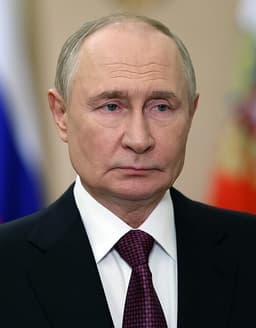
Dmitry Peskov
Politician · Modern
44.9Total

Zlatko Lagumdzija
Politician · Modern
48.3Total
Basic Information
Born
1967
1955
Died
—
—
Era
Modern
Modern
Nationality
Russia
Bosnia
Occupation
Politician
Politician
Civilization
Western
Western
Score Comparison
Military (10%)
50.0
48.2
Political (20%)
35.1
45.1
Influence (20%)
51.8
50.2
Legacy (20%)
38.3
40.8
Leadership (15%)
53.2
65.7
Strategy (15%)
41.0
41.4
TOTAL
44.9
48.3
Dmitry Peskov — Complete Timeline
1999 AD
Appointed Deputy Press Secretary of the PresidentPolitical Action
Peskov was appointed Deputy Press Secretary for President Boris Yeltsin in 1999, later serving under Putin. He worked under Press Secretary Alexei Gromov before taking over the role.
Presidential AdministrationMedia
Impact: national
2000 AD
Appointed Press Secretary of the President of RussiaPolitical Action◆ Major
Dmitry Peskov was appointed Press Secretary for President Vladimir Putin in 2000, serving as the official spokesperson. He has been the primary conduit for Kremlin communications, handling media relations and public statements.
Presidential AdministrationMedia
Impact: national
2012 AD
Served as Deputy Chief of the Presidential AdministrationPolitical Action◆ Major
Peskov was appointed Deputy Chief of the Presidential Administration in 2012, while retaining his role as Press Secretary. He gained broader responsibilities in managing Kremlin communications and policy coordination.
Presidential AdministrationLeadership
Impact: national
2014 AD
Managed communication during the annexation of CrimeaPolitical Action◆ Major
Peskov was the Kremlin's chief spokesperson during the annexation of Crimea in 2014, presenting the Russian government's narrative. He denied Russian military involvement initially, later acknowledging it, and defended the annexation as a legitimate act.
CrimeaMedia
Impact: global
Zlatko Lagumdzija — Complete Timeline
1997 AD
Leadership of the Social Democratic PartyPolitical Action◆ Major
Lagumdzija became the leader of the Social Democratic Party (SDP) in 1997, transforming it into a major multi-ethnic party in Bosnia. He advocated for social democracy, EU integration, and anti-nationalist policies.
Party leadershipSDPSocial democracy
Impact: nationalconstructive
2001 AD
Appointment as Foreign MinisterPolitical Action◆ Major
Lagumdzija served as Foreign Minister of Bosnia and Herzegovina from 2001 to 2003, focusing on EU integration and regional cooperation. He worked to improve Bosnia's international image and relations with neighboring countries.
Foreign MinisterEU integrationDiplomacy
Impact: nationalconstructive
2012 AD
Second term as Foreign MinisterPolitical Action◆ Major
Lagumdzija served again as Foreign Minister from 2012 to 2015, continuing his work on EU accession. He faced challenges from ethnic divisions and slow reform progress, but maintained Bosnia's EU candidacy status.
Foreign MinisterEU accessionReform
Impact: national
This comparison has not been analyzed yet.
One-time AI generation (~1 minute). Scores and timeline are already available below.
Rankings
🥇
Zlatko LagumdzijaLeader
Mil: 48.2Pol: 45.1Inf: 50.2
48.3
🥈
Dmitry Peskov
Mil: 50.0Pol: 35.1Inf: 51.8
44.9
+3.4 behind
How This Comparison Works
Algorithm
Each figure is scored on 6 dimensions (0—100 scale) based on structured historical data: Military (10%), Political (20%), Influence (20%), Legacy (20%), Leadership (15%), Strategy (15%). The weighted total produces the final ranking.
Data Sources
Scores are computed from structured sub-indicators in the database. Scale factors adjust for era (Ancient ×0.85, Modern ×1.0) and civilization size (Eastern ×1.05, Other ×0.80) to account for differences in population and military scale.
Maximum 3 Figures
Comparisons are limited to 2—3 figures to ensure readability and statistical meaningfulness.
Error Margins
±5 points per dimension — Sub-scores are derived from historical records with inherent uncertainty. Two figures within 5 points on a dimension should be considered roughly equivalent in that area.
Total Score Accuracy
±3 points overall — The weighted combination of 6 dimensions produces a total score with approximately ±3 points of uncertainty. Differences of less than 3 points are not statistically significant— the figures are effectively tied.
Known Limitations
- Historical records are incomplete and uneven across civilizations
- Figures from oral-tradition societies may be underrepresented
- Occupation labels can misclassify multi-role figures
- Scores measure capability and impact, not moral character
- Quantitative scoring is a comparison tool, not absolute truth
Capability Radar
Military (10%) — Battles & Warfare
Battles
27
31
Win Rate
33
32
Expansion
34
35
Political (20%) — Governance & Reform
Reform
10
35
Diplomacy
55
45
Economy
10
30
Influence (20%) — Cultural & Global Reach
Cultural
10
20
Global
40
20
Legacy (20%) — Historical Impact
Historical
20
25
Longevity
10
20
Leadership (15%) — Power & Stability
Tenure
70
40
Stability
30
25
Strategy (15%) — Tactics & Innovation
Strategy
37
39
Tactics
40
40
Reform
42
41
Similar Comparisons
Comments & Discussion
No comments yet. Be the first to share your thoughts!