Loading...
This comparison has not been analyzed yet.
One-time AI generation (~1 minute). Scores and timeline are already available below.
Douglas Haig vs Jozef Pilsudski
Jozef Pilsudski leads by 7.7 pts · 2 figures compared
…

Douglas Haig
General · Modern
58.0Total
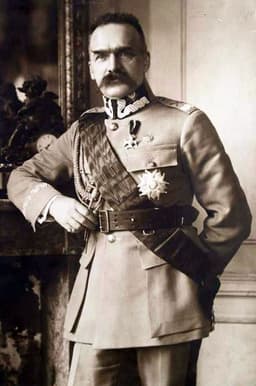
Jozef Pilsudski
General · Modern
65.7Total
Basic Information
Born
1861
1867
Died
1928
1935
Era
Modern
Modern
Nationality
Great Britain
Poland
Occupation
General
General
Civilization
Western
Western
Score Comparison
Military (10%)
65.0
61.7
Political (20%)
68.0
72.0
Influence (20%)
56.7
72.0
Legacy (20%)
55.0
55.0
Leadership (15%)
48.8
68.0
Strategy (15%)
60.7
68.0
TOTAL
58.0
65.7
Douglas Haig — Complete Timeline
1915 AD
Battle of Neuve ChapelleWar
Haig commanded the First Army at the Battle of Neuve Chapelle. This was the first major British offensive of 1915. The attack achieved a limited breakthrough but failed to exploit it due to communication and supply problems, foreshadowing later trench warfare difficulties.
World War IWestern FrontOffensive
Impact: regional
1916 AD
Battle of the SommeWar
Haig commanded the British Expeditionary Force during the Battle of the Somme. The offensive resulted in over 400,000 British casualties for minimal territorial gains. The first day, 1 July 1916, saw 57,470 British casualties, the bloodiest day in British military history.
World War IWestern FrontAttrition
Impact: nationaltragic
1917 AD
Third Battle of Ypres (Passchendaele)War◆ Major
Haig launched the Third Battle of Ypres in Flanders. The offensive aimed to break through German lines and capture the Belgian coast. After months of fighting in mud, the Allies gained about five miles at a cost of over 300,000 casualties, with no strategic breakthrough achieved.
World War IWestern FrontAttrition
Impact: regionaltragic
1918 AD
Hundred Days OffensiveWar
Haig commanded the British forces during the final Allied offensive that broke the German army. Beginning with the Battle of Amiens on 8 August 1918, the offensive pushed the Germans back continuously until the Armistice on 11 November 1918, ending World War I.
World War IVictoryAllied Offensive
Impact: globalconstructive
Jozef Pilsudski — Complete Timeline
1914 AD
Founded the Polish LegionsOther◆ Major
At the outbreak of World War I, Pilsudski formed the Polish Legions, volunteer military units fighting alongside Austria-Hungary against Russia. The Legions aimed to create a core for a future Polish army and advance the cause of Polish independence from partitioning powers.
Polish IndependenceWorld War IMilitary Formation
Impact: national
1918 AD
Proclaimed Independence of PolandOther◆ Major
On November 11, 1918, Pilsudski was released from German internment and returned to Warsaw. He assumed command of Polish forces and proclaimed the independence of the Second Polish Republic, becoming the nation's first Chief of State after 123 years of partition.
Polish IndependenceStatehoodNational Founding
Impact: nationalconstructive
1920 AD
Led the Battle of Warsaw (Miracle on the Vistula)War◆ Major
During the Polish-Soviet War, Pilsudski personally planned and commanded the counteroffensive at the Battle of Warsaw in August 1920. Polish forces repelled the advancing Red Army, securing Polish independence and halting the spread of Bolshevism into Central Europe.
Polish-Soviet WarMilitary VictoryNational Survival
Impact: regionalconstructive
1926 AD
Executed the May Coup d'ÉtatPolitical Action◆ Major
In May 1926, Pilsudski led a military coup against the Polish government, marching loyal troops into Warsaw. After three days of fighting, President Wojciechowski resigned and Pilsudski assumed de facto dictatorial power, establishing the Sanacja regime that ruled Poland until 1939.
Coup d'ÉtatAuthoritarianismPolish Politics
Impact: nationaldestructive
1932 AD
Signed the Polish-Soviet Non-Aggression PactOther◆ Major
Pilsudski's government signed a non-aggression pact with the Soviet Union on July 25, 1932. The treaty normalized relations between the two countries for ten years, though it was later broken by the Soviet invasion of Poland in 1939.
DiplomacySoviet-Polish RelationsTreaty
Impact: regional
This comparison has not been analyzed yet.
One-time AI generation (~1 minute). Scores and timeline are already available below.
Rankings
🥇
Jozef PilsudskiLeader
Mil: 61.7Pol: 72.0Inf: 72.0
65.7
🥈
Douglas Haig
Mil: 65.0Pol: 68.0Inf: 56.7
58.0
+7.7 behind
How This Comparison Works
Algorithm
Each figure is scored on 6 dimensions (0—100 scale) based on structured historical data: Military (10%), Political (20%), Influence (20%), Legacy (20%), Leadership (15%), Strategy (15%). The weighted total produces the final ranking.
Data Sources
Scores are computed from structured sub-indicators in the database. Scale factors adjust for era (Ancient ×0.85, Modern ×1.0) and civilization size (Eastern ×1.05, Other ×0.80) to account for differences in population and military scale.
Maximum 3 Figures
Comparisons are limited to 2—3 figures to ensure readability and statistical meaningfulness.
Error Margins
±5 points per dimension — Sub-scores are derived from historical records with inherent uncertainty. Two figures within 5 points on a dimension should be considered roughly equivalent in that area.
Total Score Accuracy
±3 points overall — The weighted combination of 6 dimensions produces a total score with approximately ±3 points of uncertainty. Differences of less than 3 points are not statistically significant— the figures are effectively tied.
Known Limitations
- Historical records are incomplete and uneven across civilizations
- Figures from oral-tradition societies may be underrepresented
- Occupation labels can misclassify multi-role figures
- Scores measure capability and impact, not moral character
- Quantitative scoring is a comparison tool, not absolute truth
Capability Radar
Military (10%) — Battles & Warfare
Battles
75
70
Win Rate
60
65
Expansion
50
60
Political (20%) — Governance & Reform
Reform
55
75
Diplomacy
50
80
Economy
40
55
Influence (20%) — Cultural & Global Reach
Cultural
55
65
Global
60
60
Legacy (20%) — Historical Impact
Historical
70
75
Longevity
65
60
Leadership (15%) — Power & Stability
Tenure
60
70
Stability
45
50
Strategy (15%) — Tactics & Innovation
Strategy
70
80
Tactics
45
75
Reform
65
85
Similar Comparisons
Comments & Discussion
No comments yet. Be the first to share your thoughts!