Loading...
This comparison has not been analyzed yet.
One-time AI generation (~1 minute). Scores and timeline are already available below.
Duan Qirui vs Floriano Peixoto
Duan Qirui leads by 3.3 pts · 2 figures compared
…
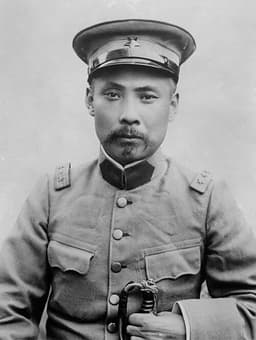
Duan Qirui
General · Modern
53.1Total

Floriano Peixoto
General · Modern
49.8Total
Basic Information
Born
1865
1839
Died
1936
1895
Era
Modern
Modern
Nationality
China
Brazil
Occupation
General
General
Civilization
Eastern
Western
Score Comparison
Military (10%)
47.5
46.7
Political (20%)
53.8
45.1
Influence (20%)
53.3
51.8
Legacy (20%)
47.5
44.2
Leadership (15%)
62.0
65.7
Strategy (15%)
58.0
45.0
TOTAL
53.1
49.8
Duan Qirui — Complete Timeline
1919 AD
Resignation as Premier after the May Fourth MovementPolitical Action◆ Major
Duan Qirui resigned as Premier of the Republic of China in 1919 following the May Fourth Movement. The movement protested the weak response of the Chinese government to the Treaty of Versailles. Duan's government was blamed for failing to protect Chinese interests, leading to his resignation.
ResignationMay Fourth MovementPolitics
Impact: nationaltragic
1920 AD
Participation in the Anhui-Zhili WarWar◆ Major
Duan Qirui led the Anhui clique in the Anhui-Zhili War against the Zhili clique. The war was a major conflict in the Warlord Era. Duan's forces were defeated, leading to his resignation as Premier and the decline of the Anhui clique's power.
Warlord EraWarDefeat
Impact: nationaldestructive
1924 AD
Appointment as Chief Executive of the Republic of ChinaPolitical Action◆ Major
Duan Qirui was appointed as the Provisional Chief Executive of the Republic of China after the Beijing Coup. He headed a provisional government that attempted to unify the country but faced opposition from various warlords. His tenure was marked by political instability and military conflicts.
Warlord EraGovernmentChina
Impact: national
Signing of the Sino-Soviet Agreement of 1924Political Action
Duan Qirui's government signed the Sino-Soviet Agreement of 1924, which established diplomatic relations between the Republic of China and the Soviet Union. The agreement recognized Outer Mongolia as part of China but allowed Soviet influence. It was controversial and criticized by some Chinese nationalists.
DiplomacySoviet UnionTreaty
Impact: national
Floriano Peixoto — Complete Timeline
1891 AD
Assumption of the PresidencyPolitical Action◆ Major
Floriano Peixoto became President of Brazil on November 23, 1891, after Deodoro da Fonseca's resignation. As Vice President, he assumed office under the constitution, but his rule was marked by authoritarianism.
PresidencySuccession
Impact: national
1893 AD
Suppression of the Naval RevoltWar◆ Major
Peixoto crushed a naval revolt led by Admiral Cust
Civil WarRebellion
Impact: nationaldestructive
Federalist RevolutionWar◆ Major
Peixoto faced the Federalist Revolution in Rio Grande do Sul, a civil war between federalists and republicans. The conflict lasted until 1895, with Peixoto's forces ultimately victorious, but at high cost.
Civil WarRebellion
Impact: regionaldestructive
1894 AD
End of Presidential TermPolitical Action◆ Major
Floriano Peixoto completed his term as president on November 15, 1894, handing power to Prudente de Morais. He was the first Brazilian president to serve a full term, despite governing under a state of siege.
PresidencyTransition
Impact: national
This comparison has not been analyzed yet.
One-time AI generation (~1 minute). Scores and timeline are already available below.
Rankings
🥇
Duan QiruiLeader
Mil: 47.5Pol: 53.8Inf: 53.3
53.1
🥈
Floriano Peixoto
Mil: 46.7Pol: 45.1Inf: 51.8
49.8
+3.3 behind
How This Comparison Works
Algorithm
Each figure is scored on 6 dimensions (0—100 scale) based on structured historical data: Military (10%), Political (20%), Influence (20%), Legacy (20%), Leadership (15%), Strategy (15%). The weighted total produces the final ranking.
Data Sources
Scores are computed from structured sub-indicators in the database. Scale factors adjust for era (Ancient ×0.85, Modern ×1.0) and civilization size (Eastern ×1.05, Other ×0.80) to account for differences in population and military scale.
Maximum 3 Figures
Comparisons are limited to 2—3 figures to ensure readability and statistical meaningfulness.
Error Margins
±5 points per dimension — Sub-scores are derived from historical records with inherent uncertainty. Two figures within 5 points on a dimension should be considered roughly equivalent in that area.
Total Score Accuracy
±3 points overall — The weighted combination of 6 dimensions produces a total score with approximately ±3 points of uncertainty. Differences of less than 3 points are not statistically significant— the figures are effectively tied.
Known Limitations
- Historical records are incomplete and uneven across civilizations
- Figures from oral-tradition societies may be underrepresented
- Occupation labels can misclassify multi-role figures
- Scores measure capability and impact, not moral character
- Quantitative scoring is a comparison tool, not absolute truth
Capability Radar
Military (10%) — Battles & Warfare
Battles
55
35
Win Rate
50
40
Expansion
40
10
Political (20%) — Governance & Reform
Reform
55
40
Diplomacy
50
30
Economy
40
25
Influence (20%) — Cultural & Global Reach
Cultural
30
25
Global
20
15
Legacy (20%) — Historical Impact
Historical
45
35
Longevity
30
20
Leadership (15%) — Power & Stability
Tenure
60
45
Stability
30
20
Strategy (15%) — Tactics & Innovation
Strategy
65
35
Tactics
60
30
Reform
70
20
Similar Comparisons
Comments & Discussion
No comments yet. Be the first to share your thoughts!