Loading...
Edgar the Peaceful vs Stefan Dusan
Stefan Dusan leads by 10.4 pts · 2 figures compared
…
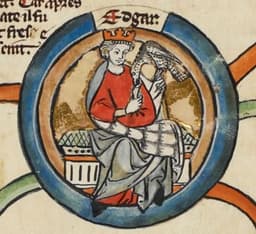
Edgar the Peaceful
Emperor · Medieval
53.5Total
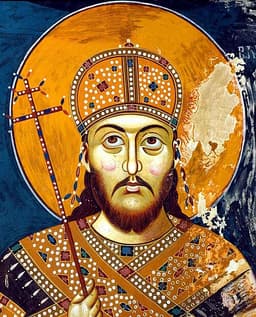
Stefan Dusan
Emperor · Medieval
63.9Total
Basic Information
Born
943
1308
Died
975
1355
Era
Medieval
Medieval
Nationality
England
Serbia
Occupation
Emperor
Emperor
Civilization
Western
Western
Score Comparison
Military (10%)
21.2
85.0
Political (20%)
65.0
70.0
Influence (20%)
56.4
56.7
Legacy (20%)
49.2
52.0
Leadership (15%)
78.0
72.0
Strategy (15%)
35.7
69.1
TOTAL
53.5
63.9
Edgar the Peaceful — Complete Timeline
959 AD
Coronation as King of EnglandPolitical Action◆ Major
Edgar succeeded his brother Eadwig as King of England. His reign was marked by stability and the consolidation of monastic reform under Dunstan.
Impact: nationalconstructive
970 AD
Naval defense reformsReform
Edgar organized a standing navy and divided England into naval districts to defend against Viking raids. This created a period of peace and security along the coasts.
Impact: nationalconstructive
Council of WinchesterCultural◆ Major
Edgar convened the Council of Winchester, which established the Regularis Concordia, a code for monastic life. This standardized Benedictine practices across England.
Impact: nationalconstructive
Stefan Dusan — Complete Timeline
1346 AD
Coronation as Emperor of the Serbs and GreeksPolitical Action◆ Major
Stefan Dušan was crowned Emperor of the Serbs and Greeks in Skopje by the Serbian Patriarch, elevating the Serbian Kingdom to an Empire. This act asserted Serbian dominance in the Balkans and challenged Byzantine authority.
CoronationEmpireByzantine
Impact: regionalconstructive
1348 AD
Conquest of Macedonia and EpirusWar◆ Major
Dušan's forces captured key Byzantine territories including Serres, Thessaloniki (though not the city itself), and much of Epirus. These conquests expanded the Serbian Empire to its greatest territorial extent, controlling most of the Balkan Peninsula.
ConquestByzantineBalkans
Impact: regional
1349 AD
Promulgation of Dušan's CodeReform◆ Major
Dušan issued a comprehensive legal code, the Zakonik, at a state council in Skopje. The code standardized laws across the Serbian Empire, covering criminal, civil, and ecclesiastical matters, and reinforced the authority of the monarchy.
Legal CodeReformSerbia
Impact: nationalconstructive
1350 AD
Campaign against BosniaWar
Dušan launched a military campaign into Bosnia, aiming to expand Serbian influence westward. The campaign achieved limited success, failing to conquer significant territory, and was abandoned due to threats from Hungary.
CampaignBosniaHungary
Impact: regional
Expert Analysis
Origins
Edgar the Peaceful (c. 943–975) was the younger son of King Edmund I of England. After his father's death in 946, his uncle Eadred ruled, followed by his older brother Eadwig in 955. Edgar was raised in the household of Æthelstan Half-King, a powerful ealdorman of East Anglia, and received education from monastic reformers like Dunstan. His early exposure to Benedictine ideals shaped his later policies.
Stefan Dušan (c. 1308–1355) was the son of King Stefan Uroš III of Serbia and Theodora of Bulgaria. He grew up in a court torn by dynastic struggles. His father was blinded and exiled by his grandfather, Stefan Milutin, but later regained power. Dušan received military training from a young age and participated in campaigns against the Byzantine Empire. His upbringing in a warrior culture contrasted sharply with Edgar's monastic environment.
Rise to Power
Edgar became King of England in 959 after Eadwig's death, but his rise was not immediate. During Eadwig's unpopular reign, Edgar had already been recognized as king in Mercia and Northumbria (957). With the support of Dunstan, whom Eadwig had exiled, Edgar consolidated power. His coronation at Bath in 973 was a carefully staged event, emphasizing his divine right and unity with the Church. He was hailed as 'Edgar the Peaceful' for the stability he brought.
Stefan Dušan overthrew his father in 1331 with the help of the nobility, who were dissatisfied with Uroš III's concessions to Byzantium. Dušan was crowned king in September 1331. He then launched a series of campaigns against the Byzantine Empire, exploiting its internal divisions. By 1345, he had captured Serres and much of Macedonia. On April 16, 1346, he was crowned Emperor of the Serbs and Greeks in Skopje, with the newly created Serbian Patriarch elevating his status. His rise was military-driven, unlike Edgar's peaceful succession.
Leadership & Governance
Edgar's leadership style was administrative and ecclesiastical. He convened the Council of Winchester (c. 970) which produced the Regularis Concordia, a code standardizing Benedictine monastic practices across England. He also reformed the coinage, introducing a unified silver penny that boosted trade. His naval reforms divided England into districts responsible for ship maintenance, creating a standing fleet that deterred Viking raids. Edgar scored 78.0 in Leadership but only 21.2 in Military, reflecting his preference for governance over conquest.
Stefan Dušan's leadership was expansionist and legalistic. He codified Serbian law with the Zakonik (Dušan's Code) in 1349, amended in 1354. This code covered criminal, civil, and ecclesiastical matters, standardizing justice across his multi-ethnic empire. He also granted privileges to the Church and nobility to secure loyalty. His military score of 85.0 reflects his conquests, but his Strategy score of 69.1 indicates a methodical approach. However, his empire lacked administrative centralization, relying on local magnates.
Triumph & Tragedy
Edgar's greatest triumph was the peaceful unification of England under a strong monarchy and reformed Church. His reign saw no major wars, and the kingdom prospered. The Regularis Concordia became the foundation of English monasticism. His naval reforms created a 'peace of Edgar' that lasted decades. However, his failure was the lack of a clear succession plan. After his death in 975, his sons Edward and Æthelred fought over the throne, leading to renewed Viking attacks. His legacy score of 49.2 reflects this fragility.
Stefan Dušan's triumph was the creation of the Serbian Empire, the largest in the Balkans at the time, covering parts of modern Serbia, Kosovo, Macedonia, Albania, Greece, and Bulgaria. His legal code was a milestone in Serbian jurisprudence. His tragedy was the empire's collapse after his sudden death in 1355 (possibly from a stroke). Without a strong successor, the empire fragmented into feudal states, easily conquered by the Ottoman Empire within a few decades. His Influence score of 56.7 is hampered by this ephemeral legacy.
Character & Destiny
Edgar was a pious but pragmatic ruler, deeply influenced by Dunstan. He was known for his justice and love of peace, but also for a scandal involving the abduction of a nun (later resolved by penance). His character fostered stability but also dependence on advisors. His Political score of 65.0 shows competence, but his total score of 53.5 is lower than Dušan's.
Stefan Dušan was ambitious, ruthless, and charismatic. He deposed his father and blinded his brother to secure power. His military campaigns were bold but calculated. He styled himself as the heir of the Byzantine emperors, adopting their court rituals. His character drove expansion but also overreach; his empire was too diverse to hold together. His total score of 63.9 reflects a more impactful life, though cut short.
Legacy
Edgar's legacy is the stabilization of England and the promotion of Benedictine monasticism. The Regularis Concordia influenced English church history, and his coinage reforms set standards for centuries. He is remembered as a peacemaker, but his long-term impact is overshadowed by the Viking resurgence after his death. His legacy score of 49.2 is modest.
Stefan Dušan's legacy is the Serbian Empire and its legal code. The Zakonik remained a symbol of Serbian statehood and was used in later periods. His conquests expanded Serbian identity, but the empire's fall left a power vacuum that the Ottomans filled. He is a national hero in Serbia, but his influence beyond the Balkans is limited. His legacy score of 52.0 is slightly higher than Edgar's.
Conclusion
Stefan Dušan had a greater impact than Edgar the Peaceful, as reflected in his higher total score of 63.9 vs 53.5. While Edgar brought stability to England, his achievements were largely internal and temporary. Dušan created an empire and a legal code that shaped Serbian identity for centuries, despite its collapse. His military conquests and legal reforms had a more dramatic and lasting influence on the Balkans. Edgar's peaceful reign was important for England, but Dušan's dynamic expansion and codification of law left a deeper mark on history. Therefore, Stefan Dušan is the more significant figure.
Rankings
🥇
Stefan DusanLeader
Mil: 85.0Pol: 70.0Inf: 56.7
63.9
🥈
Edgar the Peaceful
Mil: 21.2Pol: 65.0Inf: 56.4
53.5
+10.4 behind
How This Comparison Works
Algorithm
Each figure is scored on 6 dimensions (0—100 scale) based on structured historical data: Military (10%), Political (20%), Influence (20%), Legacy (20%), Leadership (15%), Strategy (15%). The weighted total produces the final ranking.
Data Sources
Scores are computed from structured sub-indicators in the database. Scale factors adjust for era (Ancient ×0.85, Modern ×1.0) and civilization size (Eastern ×1.05, Other ×0.80) to account for differences in population and military scale.
Maximum 3 Figures
Comparisons are limited to 2—3 figures to ensure readability and statistical meaningfulness.
Error Margins
±5 points per dimension — Sub-scores are derived from historical records with inherent uncertainty. Two figures within 5 points on a dimension should be considered roughly equivalent in that area.
Total Score Accuracy
±3 points overall — The weighted combination of 6 dimensions produces a total score with approximately ±3 points of uncertainty. Differences of less than 3 points are not statistically significant— the figures are effectively tied.
Known Limitations
- Historical records are incomplete and uneven across civilizations
- Figures from oral-tradition societies may be underrepresented
- Occupation labels can misclassify multi-role figures
- Scores measure capability and impact, not moral character
- Quantitative scoring is a comparison tool, not absolute truth
Capability Radar
Military (10%) — Battles & Warfare
Battles
10
85
Win Rate
10
80
Expansion
10
90
Political (20%) — Governance & Reform
Reform
70
90
Diplomacy
70
75
Economy
65
70
Influence (20%) — Cultural & Global Reach
Cultural
40
70
Global
20
55
Legacy (20%) — Historical Impact
Historical
45
75
Longevity
40
60
Leadership (15%) — Power & Stability
Tenure
65
80
Stability
75
65
Strategy (15%) — Tactics & Innovation
Strategy
15
85
Tactics
10
75
Reform
20
70
Similar Comparisons
Comments & Discussion
No comments yet. Be the first to share your thoughts!