Loading...
This comparison has not been analyzed yet.
One-time AI generation (~1 minute). Scores and timeline are already available below.
Edward of Portugal vs Gao Wei
Edward of Portugal leads by 11.0 pts · 2 figures compared
…

Edward of Portugal
Emperor · Medieval
51.6Total
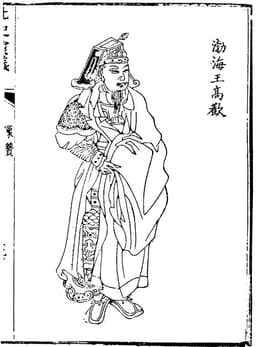
Gao Wei
Emperor · Medieval
40.6Total
Basic Information
Born
1391
557
Died
1438
577
Era
Medieval
Medieval
Nationality
Portugal
China
Occupation
Emperor
Emperor
Civilization
Western
Eastern
Score Comparison
Military (10%)
50.0
50.0
Political (20%)
45.1
26.4
Influence (20%)
54.1
45.5
Legacy (20%)
45.8
35.8
Leadership (15%)
65.7
49.9
Strategy (15%)
50.0
38.6
TOTAL
51.6
40.6
Edward of Portugal — Complete Timeline
1433 AD
Accession as King of PortugalPolitical Action◆ Major
Edward succeeded his father John I as King of Portugal. He inherited a prosperous kingdom but faced challenges including the ongoing exploration efforts sponsored by his brother Henry the Navigator and tensions with the nobility.
SuccessionPortugal
Impact: national
1437 AD
Expedition to TangierWar◆ Major
Edward authorized a disastrous expedition to capture Tangier in Morocco, led by his brother Henry the Navigator. The Portuguese forces were defeated, and Edward's younger brother Ferdinand was taken hostage, leading to a national crisis.
CrusadeMoroccoDefeat
Impact: nationaldestructive
1438 AD
Publication of the 'Leal Conselheiro'Cultural
Edward wrote the 'Leal Conselheiro' (Loyal Counselor), a philosophical and moral treatise for the nobility. This work reflects his humanist education and established him as a philosopher-king, influencing Portuguese literature and political thought.
LiteraturePhilosophyHumanism
Impact: nationalconstructive
Death from plagueOther◆ Major
Edward died of the plague at age 47, leaving his young son Afonso V as king. His death triggered a regency crisis, as his widow Eleanor of Aragon and his brother Pedro disputed control, leading to political instability in Portugal.
DeathPlagueRegency Crisis
Impact: nationaltragic
Gao Wei — Complete Timeline
565 AD
Accession as Emperor of Northern QiPolitical Action◆ Major
Gao Wei ascended the throne as emperor of Northern Qi at age eight, with his mother Empress Dowager Hu and officials serving as regents. His reign was marked by incompetence, corruption, and neglect of state affairs, leading to the dynasty's decline.
Northern QiSuccessionDecline
Impact: national
577 AD
Defeat and capture by Northern ZhouWar
Northern Zhou forces under Emperor Wu conquered Northern Qi. Gao Wei was captured and later executed, ending the Northern Qi dynasty. His incompetence, including favoring eunuchs and neglecting defense, was a major cause of the defeat.
Northern QiConquestExecution
Impact: regionaltragic
This comparison has not been analyzed yet.
One-time AI generation (~1 minute). Scores and timeline are already available below.
Rankings
🥇
Edward of PortugalLeader
Mil: 50.0Pol: 45.1Inf: 54.1
51.6
🥈
Gao Wei
Mil: 50.0Pol: 26.4Inf: 45.5
40.6
+11.0 behind
How This Comparison Works
Algorithm
Each figure is scored on 6 dimensions (0—100 scale) based on structured historical data: Military (10%), Political (20%), Influence (20%), Legacy (20%), Leadership (15%), Strategy (15%). The weighted total produces the final ranking.
Data Sources
Scores are computed from structured sub-indicators in the database. Scale factors adjust for era (Ancient ×0.85, Modern ×1.0) and civilization size (Eastern ×1.05, Other ×0.80) to account for differences in population and military scale.
Maximum 3 Figures
Comparisons are limited to 2—3 figures to ensure readability and statistical meaningfulness.
Error Margins
±5 points per dimension — Sub-scores are derived from historical records with inherent uncertainty. Two figures within 5 points on a dimension should be considered roughly equivalent in that area.
Total Score Accuracy
±3 points overall — The weighted combination of 6 dimensions produces a total score with approximately ±3 points of uncertainty. Differences of less than 3 points are not statistically significant— the figures are effectively tied.
Known Limitations
- Historical records are incomplete and uneven across civilizations
- Figures from oral-tradition societies may be underrepresented
- Occupation labels can misclassify multi-role figures
- Scores measure capability and impact, not moral character
- Quantitative scoring is a comparison tool, not absolute truth
Capability Radar
Military (10%) — Battles & Warfare
Battles
20
5
Win Rate
25
5
Expansion
10
0
Political (20%) — Governance & Reform
Reform
40
0
Diplomacy
50
5
Economy
35
5
Influence (20%) — Cultural & Global Reach
Cultural
45
5
Global
20
5
Legacy (20%) — Historical Impact
Historical
40
10
Longevity
35
5
Leadership (15%) — Power & Stability
Tenure
55
10
Stability
30
5
Strategy (15%) — Tactics & Innovation
Strategy
25
5
Tactics
30
5
Reform
15
0
Similar Comparisons
Comments & Discussion
No comments yet. Be the first to share your thoughts!