Loading...
This comparison has not been analyzed yet.
One-time AI generation (~1 minute). Scores and timeline are already available below.
Efrain Rios Montt vs Hambirrao Mohite
Hambirrao Mohite leads by 17.4 pts · 2 figures compared
…
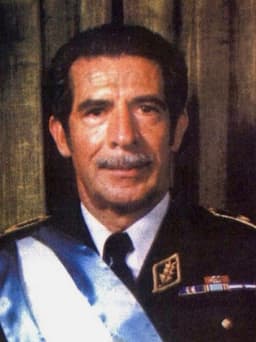
Efrain Rios Montt
General · Modern
38.0Total

Hambirrao Mohite
General · Modern
55.4Total
Basic Information
Born
1926
1620
Died
—
1687
Era
Modern
Modern
Nationality
Guatemala
India
Occupation
General
General
Civilization
Western
Indian
Score Comparison
Military (10%)
25.9
67.5
Political (20%)
25.0
48.0
Influence (20%)
47.9
54.9
Legacy (20%)
38.3
47.5
Leadership (15%)
47.3
71.0
Strategy (15%)
30.3
52.5
TOTAL
38.0
55.4
Efrain Rios Montt — Complete Timeline
1982 AD
Scorched earth campaign against Maya communitiesWar◆ Major
Under Ríos Montt's 'Beans and Bullets' policy, the Guatemalan army conducted a scorched earth campaign in the highlands, destroying hundreds of Maya villages, killing thousands, and displacing tens of thousands. The campaign aimed to eliminate support for leftist guerrillas.
Scorched EarthCounterinsurgencyMaya Genocide
Impact: nationaldestructive
Coup d'état and assumption of powerPolitical Action◆ Major
Ríos Montt led a military coup that overthrew President Fernando Romeo Lucas García. He assumed power as head of a military junta, suspending the constitution and dissolving Congress. His rule marked the bloodiest period of Guatemala's 36-year civil war.
CoupMilitary RuleCivil War
Impact: nationaldestructive
2013 AD
Conviction for genocide against Maya IxilPolitical Action
Ríos Montt was convicted of genocide and crimes against humanity for the massacre of over 1,700 Maya Ixil people during his 1982-83 rule. He was sentenced to 80 years in prison, but the conviction was later overturned on procedural grounds by the Constitutional Court.
GenocideHuman RightsMayaTrial
Impact: globaldestructive
Hambirrao Mohite — Complete Timeline
1680 AD
Appointed as Commander-in-Chief under SambhajiPolitical Action◆ Major
Hambirrao Mohite was appointed as the Senapati (commander-in-chief) of the Maratha army by Sambhaji after Shivaji's death. He led Maratha forces in campaigns against the Mughal Empire.
AppointmentMarathaMilitary
Impact: regionalconstructive
1681 AD
Battle of BurhanpurWar◆ Major
Hambirrao Mohite led a Maratha raid on the Mughal city of Burhanpur. The Marathas plundered the city and captured valuable treasure, weakening Mughal control in the region.
RaidMarathaMughal
Impact: regionalconstructive
1687 AD
Battle of WaiWar◆ Major
Hambirrao Mohite fought in the Battle of Wai against the Mughal army. He was killed in action during the battle, which resulted in a Maratha defeat.
BattleMarathaDeath
Impact: regionaltragic
This comparison has not been analyzed yet.
One-time AI generation (~1 minute). Scores and timeline are already available below.
Rankings
🥇
Hambirrao MohiteLeader
Mil: 67.5Pol: 48.0Inf: 54.9
55.4
🥈
Efrain Rios Montt
Mil: 25.9Pol: 25.0Inf: 47.9
38.0
+17.4 behind
How This Comparison Works
Algorithm
Each figure is scored on 6 dimensions (0—100 scale) based on structured historical data: Military (10%), Political (20%), Influence (20%), Legacy (20%), Leadership (15%), Strategy (15%). The weighted total produces the final ranking.
Data Sources
Scores are computed from structured sub-indicators in the database. Scale factors adjust for era (Ancient ×0.85, Modern ×1.0) and civilization size (Eastern ×1.05, Other ×0.80) to account for differences in population and military scale.
Maximum 3 Figures
Comparisons are limited to 2—3 figures to ensure readability and statistical meaningfulness.
Error Margins
±5 points per dimension — Sub-scores are derived from historical records with inherent uncertainty. Two figures within 5 points on a dimension should be considered roughly equivalent in that area.
Total Score Accuracy
±3 points overall — The weighted combination of 6 dimensions produces a total score with approximately ±3 points of uncertainty. Differences of less than 3 points are not statistically significant— the figures are effectively tied.
Known Limitations
- Historical records are incomplete and uneven across civilizations
- Figures from oral-tradition societies may be underrepresented
- Occupation labels can misclassify multi-role figures
- Scores measure capability and impact, not moral character
- Quantitative scoring is a comparison tool, not absolute truth
Capability Radar
Military (10%) — Battles & Warfare
Battles
15
65
Win Rate
10
60
Expansion
5
55
Political (20%) — Governance & Reform
Reform
5
30
Diplomacy
10
40
Economy
10
35
Influence (20%) — Cultural & Global Reach
Cultural
5
35
Global
20
25
Legacy (20%) — Historical Impact
Historical
30
45
Longevity
10
30
Leadership (15%) — Power & Stability
Tenure
40
45
Stability
5
45
Strategy (15%) — Tactics & Innovation
Strategy
15
60
Tactics
20
55
Reform
5
40
Similar Comparisons
Comments & Discussion
No comments yet. Be the first to share your thoughts!