Loading...
Emperor Pedro I of Brazil vs Fu Jian
Fu Jian leads by 8.9 pts · 2 figures compared
…
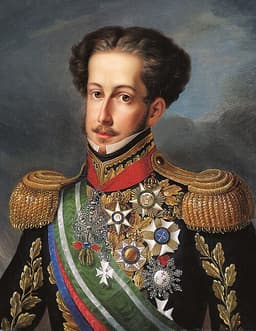
Emperor Pedro I of Brazil
Emperor · Modern
55.5Total
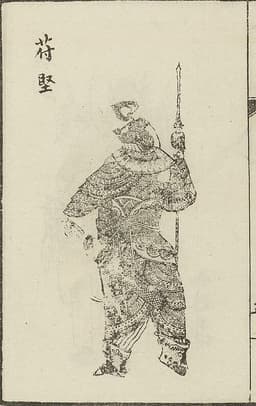
Fu Jian
Emperor · Ancient
64.4Total
Basic Information
Born
1798
338
Died
1834
385
Era
Modern
Ancient
Nationality
Brazil
China
Occupation
Emperor
Emperor
Civilization
Western
Eastern
Score Comparison
Military (10%)
55.0
78.0
Political (20%)
62.7
72.0
Influence (20%)
59.0
59.0
Legacy (20%)
50.0
50.0
Leadership (15%)
65.0
85.0
Strategy (15%)
35.7
58.0
TOTAL
55.5
64.4
Emperor Pedro I of Brazil — Complete Timeline
1822 AD
Declaration of Brazilian IndependencePolitical Action
Dom Pedro declared Brazil's independence from Portugal on September 7, 1822, at the Ipiranga River. He was acclaimed Emperor Pedro I of Brazil, establishing a constitutional monarchy separate from Portugal.
IndependenceFounding
Impact: globalprogressive
Coronation as Emperor of BrazilPolitical Action◆ Major
Pedro I was crowned Emperor of Brazil on December 1, 1822, in Rio de Janeiro. The coronation formalized his rule over the newly independent nation, with a constitution promulgated in 1824.
CoronationMonarchy
Impact: national
1825 AD
Cisplatine WarWar◆ Major
Brazil went to war with the United Provinces of the R
WarTerritorial Loss
Impact: regionaldestructive
1831 AD
Abdication of the Brazilian ThronePolitical Action
Facing political crisis and military unrest, Pedro I abdicated the Brazilian throne on April 7, 1831, in favor of his five-year-old son Pedro II. He then returned to Portugal to claim the Portuguese throne.
AbdicationPolitical Crisis
Impact: nationaltragic
Fu Jian — Complete Timeline
370 AD
Conquest of Former YanWar◆ Major
Fu Jian's Former Qin forces conquered the Former Yan state, annexing its territory in northern China. This victory significantly expanded Former Qin's power and territory, bringing Fu Jian closer to unifying the north.
ConquestExpansion
Impact: regionalconstructive
376 AD
Conquest of Former LiangWar◆ Major
Fu Jian's forces conquered the Former Liang state in the northwest, incorporating its territory into Former Qin. This further consolidated his control over northern China.
ConquestExpansion
Impact: regionalconstructive
Conquest of DaiWar
Fu Jian's army conquered the Dai state, a Xianbei confederation in the north. This eliminated a rival and extended Former Qin's influence into the steppe region.
ConquestExpansion
Impact: regionalconstructive
379 AD
Capture of XiangyangWar
Fu Jian's forces captured the strategic city of Xiangyang from the Eastern Jin dynasty. This victory gave Former Qin a foothold south of the Huai River, setting the stage for the invasion that led to the Battle of Fei River.
ConquestCampaign
Impact: regionalconstructive
383 AD
Battle of Fei RiverWar
Fu Jian led a massive Former Qin army against the Eastern Jin dynasty at the Fei River. The Jin forces defeated the Qin army, causing a catastrophic rout. This defeat shattered Fu Jian's unification efforts and led to the collapse of Former Qin.
BattleUnificationDefeat
Impact: regionaltragic
Expert Analysis
Emperor Pedro I of Brazil vs Fu Jian
### Two Emperors, One Dream: The Unification That Failed and the Independence That Succeeded
On a crisp autumn day in 383 AD, Fu Jian, the Emperor of Former Qin, stood atop a hill overlooking the Fei River. Before him stretched an army so vast that he believed his soldiers could dam the river by throwing their whips into it. Behind him lay a decade of conquests that had united nearly all of northern China. Across the river, a much smaller Eastern Jin force waited. Within hours, Fu Jian’s empire would shatter, and his dream of unifying China would die. Fifteen centuries later and half a world away, another emperor faced his own river. On September 7, 1822, Dom Pedro stood at the Ipiranga River in Brazil and shouted, “Independência ou Morte!” — Independence or Death. That cry launched a new nation, yet within nine years, Pedro would abandon his throne. What drove these two men, both founders of empires, to such different fates? The answer lies not in their ambitions, but in the worlds that shaped them.
### Origins
Fu Jian was born in 338 into the Di people, a semi-nomadic tribe on the fringes of Chinese civilization. His era was the Sixteen Kingdoms, a period of chaos following the fall of the Western Jin dynasty. China was fractured into warring states, and survival demanded ruthlessness. Fu Jian was raised by his uncle, a chieftain, and learned early that power was won by the sword. He was a boy of the steppe, hardened by constant warfare, yet he also absorbed Chinese Confucian ideals — a tension that would define his rule.
Pedro I entered the world in 1798, not on a battlefield but in the palace of Queluz, Portugal. He was the son of King John VI, and his childhood was a flight from Napoleon’s armies. In 1807, the entire Portuguese royal court fled to Brazil, transforming Rio de Janeiro into the capital of a transatlantic empire. Pedro grew up in a tropical court, surrounded by intrigue and decadence. He was educated by tutors, but his true teachers were the streets of Rio, where he learned to ride, fight, and charm. Where Fu Jian’s world was a brutal struggle for survival, Pedro’s was a gilded cage of European politics and colonial resentment.
### Rise to Power
Fu Jian’s path to power was forged in blood. He became emperor of Former Qin in 357 at age 19, after a coup that killed his cousin. He immediately set out to conquer the rival states of northern China. In 370, he crushed Former Yan, annexing its vast territories. In 376, he swallowed Former Liang and the Xianbei state of Dai. Each victory was a stepping stone, and by 379, his forces had captured the strategic city of Xiangyang from Eastern Jin. Fu Jian’s rise was a whirlwind of military genius, driven by a vision of a unified China under his rule.
Pedro’s ascent was different. He became prince regent of Brazil in 1821 when his father returned to Portugal, leaving him behind. The Portuguese parliament tried to reduce Brazil to a colony, stripping its autonomy. Pedro faced a choice: submit or rebel. He chose rebellion, but not as a conqueror — as a figurehead. On September 7, 1822, he declared independence, and by December, he was crowned Emperor of Brazil. His rise was a political maneuver, not a military conquest. He inherited a nation, he did not build it from scratch.
### Leadership & Governance
Fu Jian ruled like a Chinese emperor but thought like a steppe chieftain. He adopted Confucian rituals, built schools, and promoted agriculture, earning a Political score of 72.0. But his true strength was military strategy, with a score of 72.0, and leadership at 75.1. He was generous to conquered peoples, incorporating Xianbei and other tribes into his army. This inclusivity was his greatest asset — and his fatal flaw. He trusted his enemies too much.
Pedro’s leadership was erratic. His Political score of 60.2 reflects his struggles with governance. He wrote a constitution in 1824 that balanced liberal and conservative ideas, but he could not manage the factions that arose. His Military score was a low 32.8, for he was no general. He led Brazil into the Cisplatine War (1825–1828) against Argentina, a costly stalemate that drained the treasury. Where Fu Jian unified through conquest, Pedro tried to govern through compromise, but his autocratic temper alienated allies.
### Triumph & Tragedy
Fu Jian’s greatest triumph was the near-unification of northern China by 382. He controlled territory from the Gobi Desert to the Yangtze River. His tragedy came in 383 at the Battle of Fei River. He led an army of perhaps 300,000 men against Eastern Jin’s 80,000. But his troops were a patchwork of conquered peoples, and when the Jin feigned retreat, chaos erupted. Fu Jian’s army collapsed, and his empire disintegrated within years. His dream died on that riverbank.
Pedro’s triumph was Brazil’s independence — a peaceful transition compared to the bloodbaths of Latin America. His tragedy was his inability to rule. The Cisplatine War, economic crises, and his affair with the Marchioness of Santos scandalized the court. On April 7, 1831, facing revolt, he abdicated in favor of his five-year-old son, Pedro II. He sailed back to Portugal, a broken man, and died of tuberculosis in 1834 at age 35.
### Character & Destiny
Fu Jian was a visionary who believed in the power of inclusion. He once said, “I have conquered the world with virtue, not force.” But his virtue blinded him to the treachery of his subjects. He pardoned a Xianbei general who later led the rebellion that destroyed his empire. His flaw was trust in a world that rewarded suspicion.
Pedro was a romantic revolutionary, impulsive and passionate. He declared, “I will do everything for the people, but nothing by the people.” His charisma won Brazil’s independence, but his arrogance lost him the throne. He was a man of the 19th century, torn between Enlightenment ideals and monarchical absolutism. Where Fu Jian’s tragedy was external — the betrayal of his army — Pedro’s was internal: his own inability to govern.
### Legacy
Fu Jian is remembered as a cautionary tale. His Fei River defeat is a Chinese proverb: “throwing whips to dam the river” describes overconfidence. His Legacy score of 67.9 is modest, for his empire vanished, but his attempt at unification foreshadowed the Sui and Tang dynasties. He is a footnote in history, yet his story echoes in every overreaching conqueror.
Pedro I left a deeper mark. Brazil’s independence is his monument, and his son Pedro II ruled for 58 years, creating a stable empire. His Legacy score of 70.0 reflects this. But he is also a tragic figure — a king who abandoned his crown. In Brazil, he is “the Liberator”; in Portugal, “the Soldier King.” He straddled two worlds and satisfied neither.
### Conclusion
Fu Jian and Pedro I were both founders, but of very different kinds. Fu Jian tried to rebuild an ancient civilization through conquest; Pedro I broke an empire apart to create a new nation. One failed because he trusted his enemies; the other failed because he could not trust himself. Their stories remind us that leadership is not just about ambition or vision — it is about the world you inhabit. Fu Jian lived in an age of war, where unity came only through the sword. Pedro lived in an age of revolution, where freedom was a cry in the streets. Each was a product of his time, and each paid the price for it. In the end, the rivers they faced — the Fei and the Ipiranga — defined them not by their crossing, but by their choice of what lay on the other side.
Rankings
🥇
Fu JianLeader
Mil: 78.0Pol: 72.0Inf: 59.0
64.4
🥈
Emperor Pedro I of Brazil
Mil: 55.0Pol: 62.7Inf: 59.0
55.5
+8.9 behind
How This Comparison Works
Algorithm
Each figure is scored on 6 dimensions (0—100 scale) based on structured historical data: Military (10%), Political (20%), Influence (20%), Legacy (20%), Leadership (15%), Strategy (15%). The weighted total produces the final ranking.
Data Sources
Scores are computed from structured sub-indicators in the database. Scale factors adjust for era (Ancient ×0.85, Modern ×1.0) and civilization size (Eastern ×1.05, Other ×0.80) to account for differences in population and military scale.
Maximum 3 Figures
Comparisons are limited to 2—3 figures to ensure readability and statistical meaningfulness.
Error Margins
±5 points per dimension — Sub-scores are derived from historical records with inherent uncertainty. Two figures within 5 points on a dimension should be considered roughly equivalent in that area.
Total Score Accuracy
±3 points overall — The weighted combination of 6 dimensions produces a total score with approximately ±3 points of uncertainty. Differences of less than 3 points are not statistically significant— the figures are effectively tied.
Known Limitations
- Historical records are incomplete and uneven across civilizations
- Figures from oral-tradition societies may be underrepresented
- Occupation labels can misclassify multi-role figures
- Scores measure capability and impact, not moral character
- Quantitative scoring is a comparison tool, not absolute truth
Capability Radar
Military (10%) — Battles & Warfare
Battles
25
75
Win Rate
30
70
Expansion
35
80
Political (20%) — Governance & Reform
Reform
50
70
Diplomacy
45
60
Economy
30
65
Influence (20%) — Cultural & Global Reach
Cultural
45
50
Global
40
45
Legacy (20%) — Historical Impact
Historical
55
60
Longevity
50
40
Leadership (15%) — Power & Stability
Tenure
40
65
Stability
20
55
Strategy (15%) — Tactics & Innovation
Strategy
25
70
Tactics
20
65
Reform
15
60
Similar Comparisons
Comments & Discussion
IRON_SCIMITAR6/16/2026
Any serious military historian knows Fu Jian was doomed at Fei River not by bad luck but by sheer incompetence. Amassing 800,000 troops sounds impressive, but logistics? A nightmare. Ancient armies couldn't feed such numbers on the move. He should've used 100,000 elite cavalry to flank the Jin instead of parading raw conscripts. That's Strategy 101. Pedro I, by contrast, fought smart with smaller, motivated forces and seized the moment. Fu Jian's dream was always a mirage.
长江铁骑6/16/2026
我翻遍史书,发现氐人苻坚根本就是个被儒家史官捧上天的失败者。淝水之战前,他逼降了前燕慕容垂、羌人姚苌这些枭雄,却不斩草除根。慕容垂反叛时,苻坚竟还流泪说“卿何负我”——天真至此,怎能统一天下?反观佩德罗一世,他果断处决亲葡派大臣,毫不手软。帝王心术上,苻坚差得远。统一不是靠仁义,是靠铁血。