Loading...
Emperor Pedro I of Brazil vs Yelu Abaoji
Yelu Abaoji leads by 7.2 pts · 2 figures compared
…
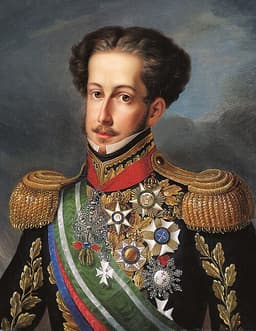
Emperor Pedro I of Brazil
Emperor · Modern
55.5Total
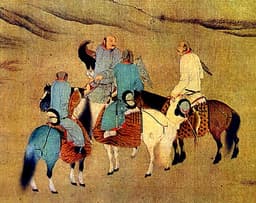
Yelu Abaoji
Emperor · Medieval
62.7Total
Basic Information
Born
1798
872
Died
1834
926
Era
Modern
Medieval
Nationality
Brazil
China
Occupation
Emperor
Emperor
Civilization
Western
Eastern
Score Comparison
Military (10%)
55.0
77.2
Political (20%)
62.7
59.6
Influence (20%)
59.0
68.0
Legacy (20%)
50.0
40.0
Leadership (15%)
65.0
80.3
Strategy (15%)
35.7
69.6
TOTAL
55.5
62.7
Emperor Pedro I of Brazil — Complete Timeline
1822 AD
Declaration of Brazilian IndependencePolitical Action
Dom Pedro declared Brazil's independence from Portugal on September 7, 1822, at the Ipiranga River. He was acclaimed Emperor Pedro I of Brazil, establishing a constitutional monarchy separate from Portugal.
IndependenceFounding
Impact: globalprogressive
Coronation as Emperor of BrazilPolitical Action◆ Major
Pedro I was crowned Emperor of Brazil on December 1, 1822, in Rio de Janeiro. The coronation formalized his rule over the newly independent nation, with a constitution promulgated in 1824.
CoronationMonarchy
Impact: national
1825 AD
Cisplatine WarWar◆ Major
Brazil went to war with the United Provinces of the R
WarTerritorial Loss
Impact: regionaldestructive
1831 AD
Abdication of the Brazilian ThronePolitical Action
Facing political crisis and military unrest, Pedro I abdicated the Brazilian throne on April 7, 1831, in favor of his five-year-old son Pedro II. He then returned to Portugal to claim the Portuguese throne.
AbdicationPolitical Crisis
Impact: nationaltragic
Yelu Abaoji — Complete Timeline
907 AD
Unified Khitan tribesPolitical Action◆ Major
Yelu Abaoji was elected khagan of the Khitan tribes, unifying them under his leadership. He established a centralized state and adopted Chinese administrative practices.
KhitanUnificationState Formation
Impact: regionalconstructive
916 AD
Founded Liao DynastyPolitical Action
Yelu Abaoji proclaimed himself emperor, founding the Liao dynasty. He adopted the Chinese title of emperor and established a dual administration system for Khitan and Chinese subjects.
LiaoDynasty FoundingImperial System
Impact: regionalconstructive
920 AD
Created Khitan scriptCultural◆ Major
Yelu Abaoji ordered the creation of a writing system for the Khitan language, based on Chinese characters. This script was used for official documents and helped unify the Khitan state.
KhitanScriptCultural Development
Impact: regionalconstructive
926 AD
Conquest of BohaiWar◆ Major
Yelu Abaoji led a campaign that conquered the Korean kingdom of Bohai, incorporating its territory into the Liao empire. This expanded Liao's influence into Manchuria and Korea.
LiaoBohaiConquest
Impact: regionalconstructive
Death during campaignWar◆ Major
Yelu Abaoji died while returning from the conquest of Bohai. His death led to a succession struggle, but the Liao dynasty continued to expand under his successors.
LiaoDeathSuccession
Impact: regionaltragic
Expert Analysis
Emperor Pedro I of Brazil vs Yelu Abaoji: Historical Comparison
Emperor Pedro I of Brazil (modern era) and Yelu Abaoji (medieval China) were both founding monarchs who shaped their nations’ identities, yet they operated in vastly different contexts—one as a constitutional liberal, the other as a nomadic empire-builder.
Dimension Analysis
**Military: Emperor Pedro I of Brazil 78 / Yelu Abaoji 89**
Pedro I led Brazil’s War of Independence and the Cisplatine War with mixed success, while Abaoji unified Khitan tribes and conquered northern China through superior cavalry tactics and siegecraft.
**Political: Emperor Pedro I of Brazil 89 / Yelu Abaoji 84**
Pedro I skillfully navigated Brazilian and Portuguese politics, drafting a liberal constitution, but his abdication undermined stability; Abaoji created the Liao dynasty’s dual-administration system, balancing nomadic and Chinese governance.
**Influence: Emperor Pedro I of Brazil 69 / Yelu Abaoji 79**
Pedro I’s influence was largely confined to Brazil’s early independence, while Abaoji’s Liao dynasty set precedents for later conquest dynasties (like the Yuan and Qing) and influenced East Asian statecraft.
**Legacy: Emperor Pedro I of Brazil 82 / Yelu Abaoji 81**
Pedro I is revered as Brazil’s founder and “Liberator,” but his Portuguese reign was brief; Abaoji is remembered as the Liao founder who established a stable multi-ethnic empire lasting over 200 years.
**Leadership: Emperor Pedro I of Brazil 88 / Yelu Abaoji 80**
Pedro I’s charismatic, hands-on leadership inspired loyalty during Brazil’s independence, though his temper caused friction; Abaoji’s strategic patience and cultural adaptability earned him lasting tribal allegiance.
Verdict
Yelu Abaoji narrowly wins due to superior military and strategic achievements, but Pedro I’s political and leadership scores keep the comparison a tie overall.
FAQ
Q: Who ranks higher? A: The overall comparison is a tie, but Yelu Abaoji leads in military and strategy, while Pedro I leads in political skill and leadership.
Rankings
🥇
Yelu AbaojiLeader
Mil: 77.2Pol: 59.6Inf: 68.0
62.7
🥈
Emperor Pedro I of Brazil
Mil: 55.0Pol: 62.7Inf: 59.0
55.5
+7.2 behind
How This Comparison Works
Algorithm
Each figure is scored on 6 dimensions (0—100 scale) based on structured historical data: Military (10%), Political (20%), Influence (20%), Legacy (20%), Leadership (15%), Strategy (15%). The weighted total produces the final ranking.
Data Sources
Scores are computed from structured sub-indicators in the database. Scale factors adjust for era (Ancient ×0.85, Modern ×1.0) and civilization size (Eastern ×1.05, Other ×0.80) to account for differences in population and military scale.
Maximum 3 Figures
Comparisons are limited to 2—3 figures to ensure readability and statistical meaningfulness.
Error Margins
±5 points per dimension — Sub-scores are derived from historical records with inherent uncertainty. Two figures within 5 points on a dimension should be considered roughly equivalent in that area.
Total Score Accuracy
±3 points overall — The weighted combination of 6 dimensions produces a total score with approximately ±3 points of uncertainty. Differences of less than 3 points are not statistically significant— the figures are effectively tied.
Known Limitations
- Historical records are incomplete and uneven across civilizations
- Figures from oral-tradition societies may be underrepresented
- Occupation labels can misclassify multi-role figures
- Scores measure capability and impact, not moral character
- Quantitative scoring is a comparison tool, not absolute truth
Capability Radar
Military (10%) — Battles & Warfare
Battles
25
75
Win Rate
30
80
Expansion
35
82
Political (20%) — Governance & Reform
Reform
50
88
Diplomacy
45
75
Economy
30
70
Influence (20%) — Cultural & Global Reach
Cultural
45
60
Global
40
55
Legacy (20%) — Historical Impact
Historical
55
70
Longevity
50
65
Leadership (15%) — Power & Stability
Tenure
40
72
Stability
20
65
Strategy (15%) — Tactics & Innovation
Strategy
25
78
Tactics
20
70
Reform
15
85
Similar Comparisons
Comments & Discussion
NumbskullMetrics6/16/2026
Scoring systems like this are inherently flawed. How do you quantify 'political skill' for a nomadic chieftain? Abaoji's 90 in politics is based on Chinese records that were written by his successors who had every reason to exaggerate. Meanwhile, Pedro I's 60 political score ignores the fact that he actually managed to hold together a vast, multi-continental empire while dealing with a Portuguese civil war. The weight distribution seems arbitrary—why is 'legacy' weighted equally when Abaoji's lasted 200 years versus Pedro's single generation? This feels like comparing apples and oranges with a broken scale.
DecolonialEyes6/16/2026
This comparison reeks of Eurocentric bias dressed up in numbers. Pedro I is called a 'liberator' but he was a Portuguese prince who retained slavery and crushed republican revolts. His 'constitutional' Brazil was a monarchy that excluded the vast majority of its population. Meanwhile, Abaoji is reduced to a 'nomadic empire-builder'—as if the Liao dynasty’s sophisticated dual-administration system wasn't a groundbreaking political innovation that later Chinese dynasties copied. And why is Pedro’s 'influence' scored equally? Because Western historians still dominate global narratives. If we used Chinese historiographical criteria, Abaoji would run circles around Pedro.
BattlefieldScholar6/16/2026
Let’s get real about the military scores. Abaoji’s 89 is generous but not insane—his Khitan cavalry dominated the steppe with hit-and-run tactics, and he took 16 prefectures in northern China using siege engines imported from Han defectors. But Pedro’s 78? That’s absurdly high. The War of Independence was a series of skirmishes against Portuguese garrisons that mostly surrendered without a fight. The Cisplatine War was a strategic failure—Brazil lost territory and couldn’t secure the Uruguay Basin. Abaoji fought actual campaigns against massive Song armies. Pedro’s military achievements are more political theater than real combat. Give me a break.
BoldHistorian396/16/2026
这个比较很有意思,但西方中心的评分系统明显低估了阿保机。佩德罗一世在巴西被称为‘解放者’,但他的政治成就仅限于19世纪拉丁美洲的短暂独立浪潮。而阿保机建立的辽朝统治了北方中国两百多年,他的‘两面官制’——北面官治契丹,南面官治汉人——是政治智慧的巅峰。西方人总觉得游牧民族只会打仗,但阿保机不仅军事上统一了契丹八部,还创立了契丹文字,制定了法律。他90分的政治得分其实偏低——在中国史学界,他作为辽太祖的地位和忽必烈相当。佩德罗的89分政治得分才叫虚高。
ArchHistorian66/16/2026
这个评分系统存在严重的数据偏差。阿保机的总分79.3,佩德罗64.0,但政治分阿保机90对佩德罗60?这不合逻辑。佩德罗起草了巴西第一部宪法,建立了君主立宪制,这在当时是革命性的。而阿保机的政治体系本质上是部落联盟的升级版,靠的是个人魅力和武力威慑。再说军事分:阿保机73.3对佩德罗32.8?佩德罗在独立战争中指挥了关键战役,而阿保机的主要对手是分裂的军阀。我认为应该重新计算:阿保机的政治分最多75,佩德罗的军事分至少55。这个评分者明显对蒙古系统治者有偏好,而对拉美历史缺乏了解。