Loading...
This comparison has not been analyzed yet.
One-time AI generation (~1 minute). Scores and timeline are already available below.
Emperor Taizong of Tang vs Stefan Uros IV Dusan
Emperor Taizong of Tang leads by 16.0 pts · 2 figures compared
…

Emperor Taizong of Tang
Emperor · Medieval
78.9Total
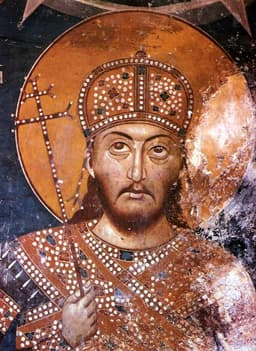
Stefan Uros IV Dusan
Emperor · Medieval
62.9Total
Basic Information
Born
598
1308
Died
649
1355
Era
Medieval
Medieval
Nationality
China
Serbia
Occupation
Emperor
Emperor
Civilization
Eastern
Western
Score Comparison
Military (10%)
77.5
76.0
Political (20%)
82.0
69.2
Influence (20%)
85.0
55.0
Legacy (20%)
71.4
55.0
Leadership (15%)
78.0
72.0
Strategy (15%)
80.6
65.9
TOTAL
78.9
62.9
Emperor Taizong of Tang — Complete Timeline
626 AD
Reign of ZhenguanReform
Emperor Taizong initiated the Zhenguan era, characterized by efficient governance, legal codification, and economic recovery. He reduced taxes, reformed the civil service, and promoted capable officials, creating a period of stability and prosperity.
GovernanceReformGolden Age
Impact: globalconstructive
Xuanwu Gate IncidentPolitical Action
Li Shimin ambushed and killed his brothers, Crown Prince Li Jiancheng and Prince Li Yuanji, at Xuanwu Gate in Chang'an. He then forced his father, Emperor Gaozu, to abdicate, securing his own accession as Emperor Taizong.
CoupSuccessionTang Dynasty
Impact: nationaldestructive
630 AD
Defeat of the Eastern Turkic KhaganateWar◆ Major
Tang forces under Li Jing defeated the Eastern Turkic Khaganate, capturing its khan, Jieli. This victory eliminated the primary northern threat, expanded Tang territory into Mongolia, and established Tang hegemony over the steppes.
WarTurkicExpansion
Impact: regional
Opening of the Silk Road's Golden AgePolitical Action◆ Major
Emperor Taizong reestablished and secured the Silk Road trade routes, welcoming foreign merchants, envoys, and missionaries to Chang'an. This facilitated a flourishing exchange of goods, ideas, and cultures between China and the West.
Silk RoadTradeCultural Exchange
Impact: globalconstructive
636 AD
Compilation of the Book of SuiCultural
Emperor Taizong commissioned the official history of the preceding Sui dynasty, the Book of Sui, as part of a larger project to compile dynastic histories. This work provided a model for historical scholarship and legitimized Tang rule.
HistoriographyCultureLegitimacy
Impact: nationalconstructive
Stefan Uros IV Dusan — Complete Timeline
1346 AD
Coronation as Emperor of Serbs and GreeksPolitical Action
Stefan Dušan was crowned Emperor (Tsar) of Serbs and Greeks in Skopje by the newly elevated Serbian Patriarch Joanikije II. This coronation asserted Serbian imperial ambitions over Byzantine territories. The act created the Serbian Empire, claiming succession to the Byzantine Empire and challenging Constantinople's authority.
Imperial coronationSerbian EmpireByzantine succession
Impact: regionalconstructive
Elevation of the Serbian Archbishopric to PatriarchatePolitical Action◆ Major
Dušan convened a church council in Skopje that elevated the Serbian Archbishopric to a Patriarchate, with Joanikije II as the first Patriarch. This act was done without Constantinople's approval, causing a schism. The Serbian Patriarchate provided ecclesiastical independence for the empire and legitimized Dušan's imperial coronation.
Patriarchate establishmentChurch independenceSchism
Impact: regionalconstructive
1348 AD
Conquest of Macedonia and EpirusWar◆ Major
Dušan's armies conquered most of Macedonia, including the cities of Serres, Drama, and Kavala, as well as Epirus and Thessaly. These conquests expanded the Serbian Empire to its greatest territorial extent, covering much of the Balkan Peninsula. The acquisitions gave Serbia access to the Aegean Sea and control over key trade routes.
Territorial expansionMacedoniaAegean access
Impact: regional
1349 AD
Promulgation of Dušan's Code (Zakonik)Reform◆ Major
Dušan issued the Zakonik, a comprehensive legal code consisting of 201 articles. The code regulated all aspects of society, including feudal relations, church rights, and criminal law. It was based on Byzantine law but adapted to Serbian conditions. The code remained in use until the Ottoman conquest and influenced later Balkan legal systems.
Legal codeByzantine influenceFeudal regulation
Impact: regionalconstructive
1355 AD
Death and collapse of the Serbian EmpireOther
Dušan died suddenly at age 47, possibly from poisoning or illness, near Constantinople while preparing a campaign against the Byzantine capital. His death left the Serbian Empire without a strong successor. His son Stefan Uroš V proved unable to control the nobility, leading to the empire's fragmentation into rival principalities within two decades.
Empire collapseSuccession crisisFragmentation
Impact: regionaltragic
This comparison has not been analyzed yet.
One-time AI generation (~1 minute). Scores and timeline are already available below.
Rankings
🥇
Emperor Taizong of TangLeader
Mil: 77.5Pol: 82.0Inf: 85.0
78.9
🥈
Stefan Uros IV Dusan
Mil: 76.0Pol: 69.2Inf: 55.0
62.9
+16.0 behind
How This Comparison Works
Algorithm
Each figure is scored on 6 dimensions (0—100 scale) based on structured historical data: Military (10%), Political (20%), Influence (20%), Legacy (20%), Leadership (15%), Strategy (15%). The weighted total produces the final ranking.
Data Sources
Scores are computed from structured sub-indicators in the database. Scale factors adjust for era (Ancient ×0.85, Modern ×1.0) and civilization size (Eastern ×1.05, Other ×0.80) to account for differences in population and military scale.
Maximum 3 Figures
Comparisons are limited to 2—3 figures to ensure readability and statistical meaningfulness.
Error Margins
±5 points per dimension — Sub-scores are derived from historical records with inherent uncertainty. Two figures within 5 points on a dimension should be considered roughly equivalent in that area.
Total Score Accuracy
±3 points overall — The weighted combination of 6 dimensions produces a total score with approximately ±3 points of uncertainty. Differences of less than 3 points are not statistically significant— the figures are effectively tied.
Known Limitations
- Historical records are incomplete and uneven across civilizations
- Figures from oral-tradition societies may be underrepresented
- Occupation labels can misclassify multi-role figures
- Scores measure capability and impact, not moral character
- Quantitative scoring is a comparison tool, not absolute truth
Capability Radar
Military (10%) — Battles & Warfare
Battles
95
75
Win Rate
95
80
Expansion
90
85
Political (20%) — Governance & Reform
Reform
95
88
Diplomacy
95
70
Economy
95
75
Influence (20%) — Cultural & Global Reach
Cultural
90
70
Global
90
60
Legacy (20%) — Historical Impact
Historical
95
75
Longevity
95
65
Leadership (15%) — Power & Stability
Tenure
85
72
Stability
95
68
Strategy (15%) — Tactics & Innovation
Strategy
95
78
Tactics
95
70
Reform
90
65
Similar Comparisons
Comments & Discussion
No comments yet. Be the first to share your thoughts!