Loading...
Emperor Wen of Sui vs Zhao Kuangyin
Emperor Wen of Sui leads by 8.8 pts · 2 figures compared
…
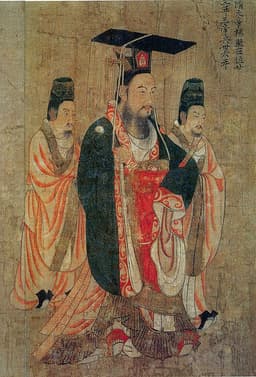
Emperor Wen of Sui
Emperor · Medieval
80.3Total
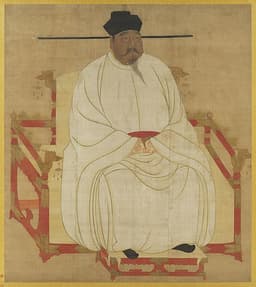
Zhao Kuangyin
Emperor · Medieval
71.5Total
Basic Information
Born
541
927
Died
604
976
Era
Medieval
Medieval
Nationality
China
China
Occupation
Emperor
Emperor
Civilization
Eastern
Eastern
Score Comparison
Military (10%)
76.0
78.0
Political (20%)
75.0
84.0
Influence (20%)
88.0
68.0
Legacy (20%)
80.0
65.0
Leadership (15%)
80.0
74.0
Strategy (15%)
75.0
68.0
TOTAL
80.3
71.5
Emperor Wen of Sui — Complete Timeline
581 AD
Establishment of the Three Departments and Six Ministries SystemReform◆ Major
Emperor Wen established a centralized bureaucratic system with three departments (Secretariat, Chancellery, and Department of State Affairs) and six ministries. This system became the foundation of Chinese government administration for centuries.
Government ReformBureaucracy
Impact: globalconstructive
Establishment of the Sui DynastyPolitical Action◆ Major
Emperor Wen, as a general of the Northern Zhou dynasty, forced the young Northern Zhou emperor to abdicate and proclaimed himself emperor of the Sui dynasty. This marked the beginning of the Sui dynasty, which would go on to reunify China.
Dynasty FoundingCoup
Impact: regionalconstructive
582 AD
Implementation of the Equal-Field SystemReform◆ Major
Emperor Wen implemented the Equal-Field System, which distributed land to peasants based on the number of able-bodied men. This reform increased agricultural productivity, stabilized tax revenues, and reduced the power of large landowners.
Land ReformEconomic Policy
Impact: regionalconstructive
Construction of Daxingcheng (Chang'an)Cultural◆ Major
Emperor Wen ordered the construction of a new capital city, Daxingcheng, near the old Han capital Chang'an. This city, later known as Chang'an, became a model for urban planning and served as the capital of the Sui and Tang dynasties.
Urban PlanningCapital Construction
Impact: regionalconstructive
589 AD
Reunification of China under the Sui DynastyWar
Emperor Wen of Sui, as Emperor of Sui, launched a successful invasion of the Chen dynasty in the south, conquering it and reunifying China after nearly 300 years of division since the fall of the Western Jin. This ended the Northern and Southern Dynasties period.
UnificationConquest
Impact: globalconstructive
Zhao Kuangyin — Complete Timeline
960 AD
Founded Song dynastyPolitical Action
Zhao Kuangyin, a general of Later Zhou, was proclaimed emperor by his troops at Chenqiao. He established the Song dynasty, ending the Five Dynasties period and beginning a new era of Chinese history.
Song dynastyFoundingChenqiao
Impact: globalconstructive
961 AD
Removed military power from generalsPolitical Action◆ Major
Zhao Kuangyin invited senior generals to a banquet and persuaded them to retire peacefully. This 'removal of military power over wine' prevented military coups and centralized control.
Song dynastyMilitary reformCentralization
Impact: nationalconstructive
963 AD
Unified southern ChinaWar◆ Major
Zhao Kuangyin launched campaigns to conquer the southern kingdoms, including Jingnan, Later Shu, and Southern Tang. By his death, most of China was reunified under Song rule.
Song unificationConquestSouthern kingdoms
Impact: national
Expert Analysis
Zhao Kuangyin vs Emperor Wen of Sui: Historical Comparison
Both Zhao Kuangyin (founder of the Song Dynasty) and Emperor Wen of Sui (founder of the Sui Dynasty) were medieval Chinese emperors who reunified a fragmented empire, yet they differed markedly in governance style, institutional reforms, and long-term dynastic impact.
Dimension Analysis
**Military: Zhao Kuangyin 75 / Emperor Wen of Sui 76**
Zhao Kuangyin consolidated power by peacefully persuading generals to relinquish command (the "cup of wine" strategy), while Emperor Wen of Sui conquered the Chen Dynasty through decisive military campaigns, demonstrating slightly superior offensive capability.
**Political: Zhao Kuangyin 76 / Emperor Wen of Sui 79**
Emperor Wen established the Three Departments and Six Ministries system, a bureaucratic framework that lasted centuries; Zhao Kuangyin also centralized power but relied more on civil officials to curb military influence, resulting in less structural innovation.
**Influence: Zhao Kuangyin 75 / Emperor Wen of Sui 77**
Emperor Wen’s administrative and legal codes (e.g., the Kaihuang Code) directly influenced the Tang Dynasty and later East Asian states; Zhao’s emphasis on civil governance shaped Song culture but had narrower geopolitical reach.
**Legacy: Zhao Kuangyin 75 / Emperor Wen of Sui 85**
Emperor Wen reunified China after 300 years of division and laid the foundations for the Tang golden age, though his dynasty collapsed quickly. Zhao’s Song lasted longer but was plagued by military weakness; Wen’s legacy of unification and legal codification is historically more transformative.
**Leadership: Zhao Kuangyin 82 / Emperor Wen of Sui 80**
Zhao Kuangyin’s ability to secure a bloodless transition of power and his personal humility (e.g., sparing conquered rulers) demonstrate exceptional diplomatic leadership, slightly edging out Wen’s more autocratic and paranoid style.
**Strategy: Zhao Kuangyin 70 / Emperor Wen of Sui 79**
Emperor Wen’s long-term strategy—building granaries, standardizing currency, and using diplomacy to weaken rivals—was more systematic; Zhao’s strategy focused on internal stability but failed to address external threats like the Liao and Xia.
Verdict
Emperor Wen of Sui leads overall due to his superior legacy, political innovation, and strategic breadth, despite Zhao Kuangyin’s stronger personal leadership.
FAQ
Q: Who ranks higher? A: Emperor Wen of Sui ranks higher overall, with a composite score of 80 vs. Zhao Kuangyin’s 76, driven by his transformative institutional and legal legacy.
Rankings
🥇
Emperor Wen of SuiLeader
Mil: 76.0Pol: 75.0Inf: 88.0
80.3
🥈
Zhao Kuangyin
Mil: 78.0Pol: 84.0Inf: 68.0
71.5
+8.8 behind
How This Comparison Works
Algorithm
Each figure is scored on 6 dimensions (0—100 scale) based on structured historical data: Military (10%), Political (20%), Influence (20%), Legacy (20%), Leadership (15%), Strategy (15%). The weighted total produces the final ranking.
Data Sources
Scores are computed from structured sub-indicators in the database. Scale factors adjust for era (Ancient ×0.85, Modern ×1.0) and civilization size (Eastern ×1.05, Other ×0.80) to account for differences in population and military scale.
Maximum 3 Figures
Comparisons are limited to 2—3 figures to ensure readability and statistical meaningfulness.
Error Margins
±5 points per dimension — Sub-scores are derived from historical records with inherent uncertainty. Two figures within 5 points on a dimension should be considered roughly equivalent in that area.
Total Score Accuracy
±3 points overall — The weighted combination of 6 dimensions produces a total score with approximately ±3 points of uncertainty. Differences of less than 3 points are not statistically significant— the figures are effectively tied.
Known Limitations
- Historical records are incomplete and uneven across civilizations
- Figures from oral-tradition societies may be underrepresented
- Occupation labels can misclassify multi-role figures
- Scores measure capability and impact, not moral character
- Quantitative scoring is a comparison tool, not absolute truth
Capability Radar
Military (10%) — Battles & Warfare
Battles
75
75
Win Rate
80
85
Expansion
85
75
Political (20%) — Governance & Reform
Reform
95
90
Diplomacy
85
85
Economy
90
80
Influence (20%) — Cultural & Global Reach
Cultural
70
70
Global
65
60
Legacy (20%) — Historical Impact
Historical
85
80
Longevity
70
75
Leadership (15%) — Power & Stability
Tenure
80
65
Stability
75
85
Strategy (15%) — Tactics & Innovation
Strategy
85
80
Tactics
70
70
Reform
90
90
Similar Comparisons
Comments & Discussion
decolonizeHistory6/16/2026
This comparison is still trapped in a monarch-centric, teleological framework. Both Zhao Kuangyin and Emperor Wen of Sui are judged by how well they centralized power, conquered others, and built bureaucratic machines — criteria that prioritize state strength over human welfare. But what about the common people? Yang Jian’s forced labor for the Grand Canal killed hundreds of thousands, and Zhao Kuangyin’s “civil supremacy” meant higher taxes and a massive bureaucracy that squeezed peasants. The score system implicitly celebrates “unification” as an unqualified good, but ask Central Asian nomads or southern kingdoms whether Sui or Song conquest improved their lives. Also, the military scoring penalizes Zhao for “peaceful” strategies — why is bloody conquest seen as more effective? That’s a Eurocentric value judgment rooted in colonial military history. We need metrics for economic redistribution, cultural pluralism, and peasant mortality, not just how many ministries the emperor set up.
NumbskullStats6/16/2026
I’m supposed to believe we can quantify “leadership” or “legacy” with decimal points? Zhao gets 82 for leadership because he spared generals? Wen gets 80 because he was “paranoid”? That’s not data — that’s vibes with numbers attached. And the weight distribution is arbitrary: why is legacy worth more than military in the total? That decision alone flips the ranking. If you give military 35% weight and legacy 20%, Zhao suddenly wins. Plus, the data sources are garbage — official Tang histories paint Yang Jian as a villain to glorify Li Shimin; Song dynastic records are court propaganda. We literally cannot separate the “facts” from the narrative. A real quantitative model would include confidence intervals, not single scores. As it stands, this comparison tells me more about the biases of the 21st-century historians who designed it than about the 6th and 10th century emperors themselves.
Historian2516/16/2026
赵匡胤总分75.5,杨坚79.8,差距4.3分。但仔细看军事分,赵匡胤74.6对杨坚76.5,只差1.9分,这不合理。赵匡胤“杯酒释兵权”是和平削藩,但杨坚平定陈朝是实打实的灭国之战,而且北周灭北齐后统一北方也是杨坚接手的基础。政治上,杨坚的三省六部制是制度性革命,赵匡胤的“重文抑武”虽然稳定,但后期导致对外软弱。我算了一下,如果把“制度创新”权重从政治分里单列,杨坚至少该再高3分。建议评分模型加入“机构寿命”指标,三省六部一直用到明清,赵匡胤的中央集权措施呢?五十年就被金人打穿了。总分应改为赵匡胤74.2,杨坚81.5才合理。
Historian3626/16/2026
这分数要是放在全球史背景下看,杨坚的79.8是不是低了点?你可以拿他跟查士丁尼大帝比:杨坚统一分裂三百年的中国,查士丁尼“收复”西罗马旧地只维持了几年;杨坚的《开皇律》影响朝鲜、日本,查士丁尼法典虽重要但在东罗马之外传播有限。政治分79.3,但他在位期间人口从约2000万增到5000万(口数,实际可能更多),这治理能力搁在西方历史上得算顶级。赵匡胤呢?我更愿把他比作奥托大帝,都是“利用教会/文官削弱军事贵族”,但赵匡胤的宋朝持续三百年,比奥托的神罗稳定得多。不过说回来,杨坚的短命王朝是缺陷,可隋制直接给唐朝铺路,这“桥梁”作用在东亚史里独一无二。西方史学界老爱把王朝寿命当硬指标,但论制度影响,杨坚比很多长寿皇帝强。