Loading...
Erich Ludendorff vs Pancho Villa
Erich Ludendorff leads by 5.3 pts · 2 figures compared
…
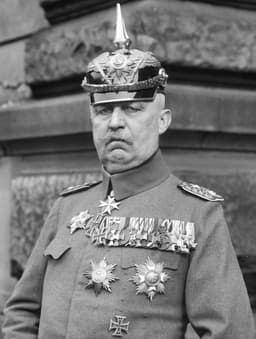
Erich Ludendorff
General · Modern
57.2Total
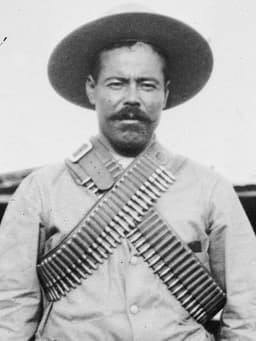
Pancho Villa
General · Modern
51.9Total
Basic Information
Born
1865
1878
Died
1937
1923
Era
Modern
Modern
Nationality
Germany
Mexico
Occupation
General
General
Civilization
Western
Western
Score Comparison
Military (10%)
80.0
70.0
Political (20%)
35.1
35.1
Influence (20%)
55.0
55.0
Legacy (20%)
52.0
54.0
Leadership (15%)
68.0
47.3
Strategy (15%)
70.0
52.5
TOTAL
57.2
51.9
Erich Ludendorff — Complete Timeline
1914 AD
Battle of TannenbergWar
As chief of staff to Hindenburg, Ludendorff planned the encirclement and destruction of the Russian Second Army. The victory established his reputation as a brilliant military strategist and made him a national hero.
World War IEastern FrontVictory
Impact: regional
1916 AD
Appointed Quartermaster GeneralPolitical Action◆ Major
Ludendorff was appointed First Quartermaster General of the German Army, effectively becoming the deputy to Hindenburg and the de facto military dictator of Germany. He directed all military and much civilian policy for the remainder of the war.
World War ICommandDictatorship
Impact: national
1917 AD
Unrestricted Submarine Warfare ResumedWar◆ Major
Ludendorff and Hindenburg convinced the German government to resume unrestricted submarine warfare, despite the risk of drawing the United States into the war. This decision led to the US declaration of war in April 1917.
World War INaval WarfareUS Entry
Impact: globaldestructive
1918 AD
Spring Offensive (Kaiserschlacht)War◆ Major
Ludendorff planned and launched a series of massive German offensives on the Western Front, aiming to win the war before American forces arrived. The offensives initially gained ground but ultimately failed due to Allied resistance and logistical problems.
World War IWestern FrontOffensive
Impact: global
Fled to Sweden After ArmisticePolitical Action
After the German collapse and armistice, Ludendorff fled to Sweden in disguise, fearing retribution. He later returned to Germany and became involved in far-right political movements, including the Kapp Putsch.
World War IExilePost-War
Impact: national
1923 AD
Participated in the Beer Hall PutschPolitical Action
Ludendorff marched alongside Adolf Hitler and other Nazis in the failed Beer Hall Putsch in Munich. He was later acquitted of treason charges, but his involvement linked him to the early Nazi movement.
Nazi MovementPutschFar-Right
Impact: nationaldestructive
Pancho Villa — Complete Timeline
1911 AD
Battle of Ciudad JuarezWar◆ Major
Villa's forces, under Madero's command, captured Ciudad Juarez, a key border city. The victory forced Porfirio Diaz to resign and sign the Treaty of Ciudad Juarez, ending the first phase of the revolution.
BattleRevolutionDiaz Resignation
Impact: national
1913 AD
Division of the North CommandWar◆ Major
After Victoriano Huerta's coup, Villa formed the Division of the North, a powerful military force. He led it to victories at Torreon and Zacatecas, becoming a dominant revolutionary general.
Military CommandRevolutionary ArmyVictories
Impact: regional
1914 AD
Battle of ZacatecasWar
Villa's Division of the North decisively defeated Huerta's federal forces at Zacatecas. The victory broke Huerta's military power and led to his resignation, but also caused a rift with Carranza.
BattleHuerta DefeatRevolutionary Victory
Impact: national
1916 AD
Columbus RaidWar◆ Major
Villa's forces attacked Columbus, New Mexico, killing 18 Americans. The raid prompted U.S. President Wilson to send a punitive expedition under General Pershing into Mexico, which failed to capture Villa.
Cross-Border RaidUS InterventionPunitive Expedition
Impact: regionaldestructive
1923 AD
Assassination of Pancho VillaPolitical Action◆ Major
Villa was assassinated by gunmen while driving in Parral, Chihuahua. The attack was likely ordered by political rivals, ending his post-revolutionary influence and securing the government's control.
AssassinationPolitical ViolenceEnd of Era
Impact: nationaltragic
Expert Analysis
Origins
Erich Ludendorff was born on April 9, 1865, in Kruszewnia, Prussia (now Poland), into a minor noble family. His father was a cavalry officer, and young Erich entered the army at age 12, attending the cadet corps. He excelled academically, later joining the Prussian General Staff. His early career was marked by meticulous planning and a rigid adherence to military doctrine.
Pancho Villa was born José Doroteo Arango Arámbula on June 5, 1878, in San Juan del Río, Durango, Mexico, to a poor peasant family. His father died when he was young, and he worked as a sharecropper. After killing a hacienda owner who assaulted his sister, he fled to the mountains and joined a bandit group. This formative experience shaped his lifelong defiance of authority.
Rise to Power
Ludendorff's rise came during World War I. In 1914, as chief of staff to General Paul von Hindenburg, he orchestrated the Battle of Tannenberg (August 26–30, 1914), encircling and destroying the Russian Second Army. This victory made him a national hero. By August 1916, he was appointed First Quartermaster General, effectively running Germany's war effort alongside Hindenburg. His military score of 80.0 reflects his tactical acumen.
Villa rose during the Mexican Revolution. In 1911, he joined Francisco Madero's rebellion against Porfirio Díaz, capturing Ciudad Juárez in May 1911. After Madero's assassination in 1913, Villa formed the Division of the North and won decisive victories at Torreón (March 1914) and Zacatecas (June 1914), the latter breaking Victoriano Huerta's regime. His military score of 70.0 is lower than Ludendorff's, but his guerrilla tactics were effective.
Leadership & Governance
Ludendorff's leadership was autocratic and centralized. He imposed a "silent dictatorship" over Germany, controlling not only the military but also economic and political decisions. He advocated for total war, including unrestricted submarine warfare (resumed February 1, 1917), which brought the U.S. into the war. His political score of 35.1 shows his poor judgment in non-military affairs.
Villa led by personal charisma and direct action. He governed Chihuahua with a mix of populist reforms—land redistribution, schools, and military hospitals—but his rule was often chaotic. He lacked administrative skills and relied on loyalty rather than institutions. His political score of 35.1 matches Ludendorff's, indicating similar weaknesses in governance.
Triumph & Tragedy
Ludendorff's greatest triumph was the Spring Offensive (March–July 1918), a series of attacks that nearly broke the Allied lines. However, his failure to secure a decisive victory and his insistence on continuing the war led to Germany's collapse. He fled to Sweden in disguise after the armistice, a personal tragedy. His legacy score of 52.0 reflects his mixed reputation.
Villa's triumph was the Battle of Zacatecas, which cemented his power. His tragedy came after his defeat by Carranza and Obregón. The Columbus Raid (March 9, 1916) against the U.S. prompted a punitive expedition that failed to capture him but damaged his cause. He was assassinated on July 20, 1923, in Parral. His legacy score of 54.0 is slightly higher than Ludendorff's.
Character & Destiny
Ludendorff was methodical, arrogant, and inflexible. His strategic score of 70.0 indicates competence, but his refusal to accept defeat prolonged the war needlessly. After the war, he dabbled in far-right politics, participating in the 1920 Kapp Putsch and later supporting Hitler's rise, though he became disillusioned. His character led to a tragic end.
Villa was impulsive, charismatic, and ruthless. His leadership score of 47.3 is lower than Ludendorff's 68.0, reflecting his inability to maintain discipline and build lasting structures. His destiny was shaped by his bandit origins; he never transitioned from revolutionary to statesman. Both men's characters limited their long-term impact.
Legacy
Ludendorff's legacy is tied to World War I and the "stab-in-the-back" myth he promoted, which fueled Nazi propaganda. His military innovations influenced later blitzkrieg tactics, but his total war concept had devastating consequences. Today, he is remembered as a brilliant but flawed strategist.
Villa's legacy is more positive in Mexico, where he is seen as a folk hero who fought for the poor. He remains a symbol of resistance against foreign intervention. However, his failure to build a stable government limited his impact. In the comparison, Ludendorff's total score of 57.2 edges Villa's 51.9, but Villa's cultural influence endures.
Conclusion
While Ludendorff achieved higher military scores (80.0 vs. 70.0) and strategic influence (70.0 vs. 52.5), Villa's legacy as a revolutionary icon arguably had a more lasting social impact. However, in terms of historical significance and sheer scale of effect on world events, Ludendorff's role in World War I—a conflict that reshaped global politics—gives him the edge. His strategic decisions affected millions, while Villa's operations were regional. Thus, Erich Ludendorff had a greater overall impact, despite his lower legacy score.
Rankings
🥇
Erich LudendorffLeader
Mil: 80.0Pol: 35.1Inf: 55.0
57.2
🥈
Pancho Villa
Mil: 70.0Pol: 35.1Inf: 55.0
51.9
+5.3 behind
How This Comparison Works
Algorithm
Each figure is scored on 6 dimensions (0—100 scale) based on structured historical data: Military (10%), Political (20%), Influence (20%), Legacy (20%), Leadership (15%), Strategy (15%). The weighted total produces the final ranking.
Data Sources
Scores are computed from structured sub-indicators in the database. Scale factors adjust for era (Ancient ×0.85, Modern ×1.0) and civilization size (Eastern ×1.05, Other ×0.80) to account for differences in population and military scale.
Maximum 3 Figures
Comparisons are limited to 2—3 figures to ensure readability and statistical meaningfulness.
Error Margins
±5 points per dimension — Sub-scores are derived from historical records with inherent uncertainty. Two figures within 5 points on a dimension should be considered roughly equivalent in that area.
Total Score Accuracy
±3 points overall — The weighted combination of 6 dimensions produces a total score with approximately ±3 points of uncertainty. Differences of less than 3 points are not statistically significant— the figures are effectively tied.
Known Limitations
- Historical records are incomplete and uneven across civilizations
- Figures from oral-tradition societies may be underrepresented
- Occupation labels can misclassify multi-role figures
- Scores measure capability and impact, not moral character
- Quantitative scoring is a comparison tool, not absolute truth
Capability Radar
Military (10%) — Battles & Warfare
Battles
85
65
Win Rate
75
60
Expansion
60
40
Political (20%) — Governance & Reform
Reform
20
20
Diplomacy
25
25
Economy
15
15
Influence (20%) — Cultural & Global Reach
Cultural
40
55
Global
60
50
Legacy (20%) — Historical Impact
Historical
70
60
Longevity
55
45
Leadership (15%) — Power & Stability
Tenure
65
35
Stability
10
10
Strategy (15%) — Tactics & Innovation
Strategy
85
55
Tactics
80
70
Reform
70
30
Similar Comparisons
Comments & Discussion
No comments yet. Be the first to share your thoughts!