Loading...
This comparison has not been analyzed yet.
One-time AI generation (~1 minute). Scores and timeline are already available below.
Ernst Udet vs Osman Digna
Osman Digna leads by 7.2 pts · 2 figures compared
…
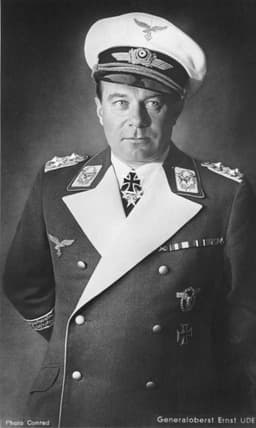
Ernst Udet
General · Modern
47.5Total

Osman Digna
General · Modern
54.7Total
Basic Information
Born
1896
1840
Died
1941
1926
Era
Modern
Modern
Nationality
Germany
Sudan
Occupation
General
General
Civilization
Western
Other
Score Comparison
Military (10%)
46.7
67.5
Political (20%)
30.8
39.4
Influence (20%)
58.0
61.0
Legacy (20%)
46.7
50.0
Leadership (15%)
40.4
62.0
Strategy (15%)
60.0
50.0
TOTAL
47.5
54.7
Ernst Udet — Complete Timeline
1918 AD
World War I Fighter AceWar◆ Major
Udet became the highest-scoring German fighter ace to survive World War I, with 62 confirmed victories. He flew with Jagdstaffel 11 and later commanded Jagdgeschwader 1. His aerial exploits made him a national hero and a celebrated figure in post-war Germany.
World War IAerial CombatFighter Ace
Impact: national
1936 AD
Appointment as Chief of the Luftwaffe's Technical OfficePolitical Action◆ Major
Udet was appointed head of the Technisches Amt (Technical Office) of the Luftwaffe, responsible for aircraft development and production. Despite his fame, he lacked administrative experience. His tenure was marked by mismanagement, delays in producing modern aircraft like the He 177 and Me 262, and a focus on dive-bombers.
LuftwaffeAircraft ProductionWorld War II
Impact: nationaldestructive
1941 AD
SuicideOther◆ Major
Udet committed suicide by gunshot after being blamed for the Luftwaffe's technical failures and production shortfalls during the Battle of Britain. His death was officially reported as a test flight accident. He was given a state funeral by Hermann G
SuicideLuftwaffeWorld War II
Impact: nationaltragic
Osman Digna — Complete Timeline
1884 AD
Command at the Battle of TamaiWar◆ Major
Osman Digna led Mahdist forces to victory against a British-Egyptian army at the Battle of Tamai in eastern Sudan. The defeat forced British forces to retreat and secured Mahdist control over the Red Sea coast region.
Mahdist WarBattle of TamaiRed Sea
Impact: regional
Siege of SuakinWar◆ Major
Osman Digna besieged the British-held port of Suakin from 1884 to 1885. Although he failed to capture the city, his forces repeatedly defeated British relief columns and tied down significant British military resources.
Siege of SuakinMahdist WarBritish Blockade
Impact: regional
1891 AD
Defeat at the Battle of TokarWar◆ Major
Osman Digna's forces were decisively defeated by British-Egyptian troops at the Battle of Tokar. This loss ended Mahdist control over the eastern Sudan region and forced Digna to retreat into the interior.
Mahdist WarBattle of TokarBritish Victory
Impact: regional
1900 AD
Capture and ImprisonmentWar◆ Major
Osman Digna was captured by British forces in January 1900 after years of guerrilla warfare. He was imprisoned in Egypt, first in Cairo and later in Alexandria, where he remained until his death in 1926.
CaptureImprisonmentMahdist Defeat
Impact: regionaltragic
This comparison has not been analyzed yet.
One-time AI generation (~1 minute). Scores and timeline are already available below.
Rankings
🥇
Osman DignaLeader
Mil: 67.5Pol: 39.4Inf: 61.0
54.7
🥈
Ernst Udet
Mil: 46.7Pol: 30.8Inf: 58.0
47.5
+7.2 behind
How This Comparison Works
Algorithm
Each figure is scored on 6 dimensions (0—100 scale) based on structured historical data: Military (10%), Political (20%), Influence (20%), Legacy (20%), Leadership (15%), Strategy (15%). The weighted total produces the final ranking.
Data Sources
Scores are computed from structured sub-indicators in the database. Scale factors adjust for era (Ancient ×0.85, Modern ×1.0) and civilization size (Eastern ×1.05, Other ×0.80) to account for differences in population and military scale.
Maximum 3 Figures
Comparisons are limited to 2—3 figures to ensure readability and statistical meaningfulness.
Error Margins
±5 points per dimension — Sub-scores are derived from historical records with inherent uncertainty. Two figures within 5 points on a dimension should be considered roughly equivalent in that area.
Total Score Accuracy
±3 points overall — The weighted combination of 6 dimensions produces a total score with approximately ±3 points of uncertainty. Differences of less than 3 points are not statistically significant— the figures are effectively tied.
Known Limitations
- Historical records are incomplete and uneven across civilizations
- Figures from oral-tradition societies may be underrepresented
- Occupation labels can misclassify multi-role figures
- Scores measure capability and impact, not moral character
- Quantitative scoring is a comparison tool, not absolute truth
Capability Radar
Military (10%) — Battles & Warfare
Battles
30
65
Win Rate
35
60
Expansion
20
55
Political (20%) — Governance & Reform
Reform
15
20
Diplomacy
20
40
Economy
10
15
Influence (20%) — Cultural & Global Reach
Cultural
45
40
Global
35
35
Legacy (20%) — Historical Impact
Historical
40
50
Longevity
30
45
Leadership (15%) — Power & Stability
Tenure
30
55
Stability
5
30
Strategy (15%) — Tactics & Innovation
Strategy
25
65
Tactics
55
70
Reform
40
30
Similar Comparisons
Comments & Discussion
No comments yet. Be the first to share your thoughts!