Loading...
Eugenia Charles vs Taha Yassin Ramadan
Eugenia Charles leads by 7.7 pts · 2 figures compared
…
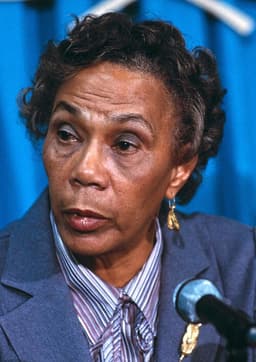
Eugenia Charles
Politician · Modern
55.7Total

Taha Yassin Ramadan
Politician · Modern
48.0Total
Basic Information
Born
1919
1938
Died
2005
—
Era
Modern
Modern
Nationality
Dominica
Iraq
Occupation
Politician
Politician
Civilization
Western
Middle Eastern
Score Comparison
Military (10%)
49.7
41.6
Political (20%)
62.7
33.6
Influence (20%)
60.0
50.2
Legacy (20%)
48.3
39.2
Leadership (15%)
66.0
74.0
Strategy (15%)
43.3
53.5
TOTAL
55.7
48.0
Eugenia Charles — Complete Timeline
1980 AD
Implemented Economic ReformsReform◆ Major
Charles's government implemented free-market economic reforms, including privatization, tax cuts, and attracting foreign investment. These policies stabilized Dominica's economy but increased inequality.
Economic ReformFree MarketPrivatization
Impact: nationalconstructive
Became First Female Prime Minister of DominicaPolitical Action
Charles led the Dominica Freedom Party to victory in the 1980 general election, becoming the first female Prime Minister of Dominica and the first female head of government in the Caribbean.
First Female PMGender EqualityMilestone
Impact: regionalprogressive
1981 AD
Survived a Coup AttemptPolitical Action◆ Major
Charles's government survived a coup attempt by white supremacist mercenaries, who planned to overthrow her and install a white-led government. The plot was foiled by US and Dominican authorities.
Coup AttemptMercenariesPolitical Violence
Impact: nationaltragic
1983 AD
Led the US Invasion of GrenadaPolitical Action◆ Major
Charles was a key advocate for the US-led invasion of Grenada in 1983, following the execution of Maurice Bishop. She argued that the invasion was necessary to restore democracy and stability in the region.
US InvasionGrenadaForeign PolicyRegional Intervention
Impact: regionalconstructive
Taha Yassin Ramadan — Complete Timeline
1991 AD
Appointment as Vice PresidentPolitical Action◆ Major
Ramadan was appointed Vice President of Iraq under Saddam Hussein. He served as a loyal deputy, overseeing economic affairs and the implementation of sanctions-era policies. He remained in office until the 2003 invasion.
Vice PresidencySaddam RegimeSanctions
Impact: national
Role in suppressing the 1991 uprisingsPolitical Action◆ Major
Ramadan was involved in the brutal suppression of the Shia and Kurdish uprisings that followed the Gulf War. He oversaw the use of force and the destruction of infrastructure in rebel-held areas, contributing to widespread casualties.
UprisingRepressionCivil War
Impact: nationaldestructive
2003 AD
Capture and trial after the 2003 invasionPolitical Action◆ Major
Ramadan was captured by US forces in August 2003. He was later tried by the Iraqi High Tribunal for crimes against humanity, including the 1991 uprisings. He was sentenced to death and executed by hanging in 2007.
CaptureTrialExecution
Impact: nationaltragic
Expert Analysis
Origins
Eugenia Charles was born on May 15, 1919, in Pointe Michel, Dominica, into a wealthy mixed-race family. Her father was a prosperous landowner and businessman. She studied law in the UK at the University of London and was called to the bar at Gray's Inn in 1947. Returning to Dominica, she practiced law and entered politics. Taha Yassin Ramadan was born on February 22, 1938, in Mosul, Iraq, into a lower-middle-class Sunni Arab family. He studied at the Iraqi Military Academy and became an officer in the Iraqi Army. He joined the Ba'ath Party in the 1950s and participated in the 1963 coup that brought the party to power.
Rise to Power
Charles entered politics in the 1960s, co-founding the Dominica Freedom Party in 1968. She became the party's leader and won a seat in the legislature in 1970. Her rise culminated in the 1980 general election, where she led the DFP to victory, becoming Prime Minister on July 21, 1980, at age 61. She was the first female head of government in the Caribbean. Ramadan rose within the Ba'ath Party hierarchy through loyalty and military service. After the 1968 Ba'athist coup, he became a close associate of Saddam Hussein. He served as Minister of Industry and later as Vice President, appointed on March 23, 1991, during the aftermath of the Gulf War. His role was to oversee economic affairs and internal security.
Leadership & Governance
Charles governed as a conservative, pro-Western leader implementing free-market reforms. She privatized state-owned enterprises, reduced tariffs, and promoted foreign investment. Her government also pursued austerity measures to reduce debt. She was a strong advocate for democracy and human rights, often clashing with opposition forces. Ramadan was a loyal enforcer of Saddam's regime. He oversaw the implementation of UN oil-for-food programs and managed the economy under sanctions. He was known for his brutality in suppressing dissent, particularly during the 1991 uprisings. His governance style was authoritarian, with no tolerance for political opposition.
Triumph & Tragedy
Charles's greatest triumph was her role in the 1983 US-led invasion of Grenada. She convinced the US, supported by other Caribbean nations, to intervene after the execution of Prime Minister Maurice Bishop. This restored democracy in Grenada. Her tragedy was the economic hardship her reforms caused, leading to unemployment and social unrest. She also faced a 1981 coup attempt by white supremacist mercenaries, which she survived. Ramadan's triumph was his survival within Saddam's regime for decades, maintaining power through loyalty. His tragedy was his involvement in the 1991 suppression of Shia and Kurdish uprisings, resulting in thousands of deaths. He was captured in 2003, tried for crimes against humanity, and executed in 2007.
Character & Destiny
Charles was known as the "Iron Lady of the Caribbean" for her strong will and determination. She was decisive, often making unpopular decisions for what she believed was right. Her character led her to stand up to larger powers, as seen in Grenada. Her destiny was to be a pioneer for women in politics, though her legacy is mixed due to economic policies. Ramadan was a loyalist, known for his ruthlessness and obedience to Saddam. He lacked independent initiative, which kept him alive in a brutal regime but also sealed his fate as a war criminal. His character made him a tool of oppression, leading to his condemnation.
Legacy
Charles's legacy is as a trailblazer for women in Caribbean politics. She proved that a woman could lead a nation and stand firm in international affairs. However, her economic policies are criticized for increasing inequality. She scored 48.3 in legacy, reflecting a mixed but significant impact. Ramadan's legacy is entirely negative. He is remembered as a perpetrator of crimes against humanity. His legacy score of 39.2 reflects his association with Saddam's brutal regime. His impact was to uphold a dictatorship that caused immense suffering.
Conclusion
Eugenia Charles had a greater impact than Taha Yassin Ramadan. She scored 55.7 overall to Ramadan's 48.0, a gap of 7.7 points. Charles's leadership in promoting democracy and women's rights, despite flaws, contributed positively to global governance. Ramadan's role in oppression and violence left a destructive legacy. While both were political figures, Charles's influence was constructive and pioneering, whereas Ramadan's was destructive and repressive. Therefore, Eugenia Charles is the more significant historical figure.
Rankings
🥇
Eugenia CharlesLeader
Mil: 49.7Pol: 62.7Inf: 60.0
55.7
🥈
Taha Yassin Ramadan
Mil: 41.6Pol: 33.6Inf: 50.2
48.0
+7.7 behind
How This Comparison Works
Algorithm
Each figure is scored on 6 dimensions (0—100 scale) based on structured historical data: Military (10%), Political (20%), Influence (20%), Legacy (20%), Leadership (15%), Strategy (15%). The weighted total produces the final ranking.
Data Sources
Scores are computed from structured sub-indicators in the database. Scale factors adjust for era (Ancient ×0.85, Modern ×1.0) and civilization size (Eastern ×1.05, Other ×0.80) to account for differences in population and military scale.
Maximum 3 Figures
Comparisons are limited to 2—3 figures to ensure readability and statistical meaningfulness.
Error Margins
±5 points per dimension — Sub-scores are derived from historical records with inherent uncertainty. Two figures within 5 points on a dimension should be considered roughly equivalent in that area.
Total Score Accuracy
±3 points overall — The weighted combination of 6 dimensions produces a total score with approximately ±3 points of uncertainty. Differences of less than 3 points are not statistically significant— the figures are effectively tied.
Known Limitations
- Historical records are incomplete and uneven across civilizations
- Figures from oral-tradition societies may be underrepresented
- Occupation labels can misclassify multi-role figures
- Scores measure capability and impact, not moral character
- Quantitative scoring is a comparison tool, not absolute truth
Capability Radar
Military (10%) — Battles & Warfare
Battles
30
10
Win Rate
29
10
Expansion
37
10
Political (20%) — Governance & Reform
Reform
55
20
Diplomacy
65
30
Economy
50
20
Influence (20%) — Cultural & Global Reach
Cultural
45
15
Global
45
15
Legacy (20%) — Historical Impact
Historical
50
20
Longevity
40
15
Leadership (15%) — Power & Stability
Tenure
60
60
Stability
55
30
Strategy (15%) — Tactics & Innovation
Strategy
38
10
Tactics
43
10
Reform
43
10
Similar Comparisons
Comments & Discussion
No comments yet. Be the first to share your thoughts!