Loading...
Fang Xiaoru vs Julius Caesar
Julius Caesar leads by 33.8 pts · 2 figures compared
…
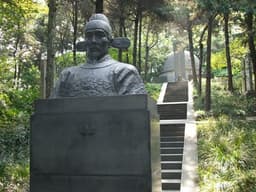
Fang Xiaoru
Politician · Medieval
49.0Total

Julius Caesar
General · Ancient
82.8Total
Basic Information
Born
1357
-100
Died
1402
-44
Era
Medieval
Ancient
Nationality
China
Roman Republic
Occupation
Politician
General
Civilization
Eastern
Western
Score Comparison
Military (10%)
45.7
88.0
Political (20%)
33.6
78.0
Influence (20%)
59.0
85.0
Legacy (20%)
58.0
82.0
Leadership (15%)
43.8
80.0
Strategy (15%)
35.9
85.0
TOTAL
49.0
82.8
Fang Xiaoru — Complete Timeline
1402 AD
Refused to Draft Edict for Yongle EmperorPolitical Action
After the Yongle Emperor usurped the throne, he ordered Fang Xiaoru to draft the accession edict. Fang refused, calling the usurper a traitor. This act of defiance led to his execution and the massacre of his entire clan.
Ming DynastyConfucian ScholarDefiance
Impact: nationaltragic
Executed with Ten ClansPolitical Action◆ Major
Fang Xiaoru was executed by dismemberment, and his family, students, and associates
Ming DynastyMassacreConfucian Resistance
Impact: nationaldestructive
Julius Caesar — Complete Timeline
58 BC
Gallic WarsWar◆ Major
Caesar, as proconsul of Gaul, launched a series of campaigns that conquered all of Gaul (modern France, Belgium, and parts of Switzerland). He fought numerous battles, including against the Helvetii, the Belgae, and the Gallic chieftain Vercingetorix. The wars brought immense wealth and a loyal army to Caesar.
Gallic WarsConquestRoman Expansion
Impact: regional
49 BC
Crossing the RubiconPolitical Action◆ Major
Caesar led Legio XIII across the Rubicon River into Italy, defying the Roman Senate's order to disband his army. This act triggered a civil war against Pompey and the Optimates, ultimately leading to Caesar's dictatorship and the end of the Roman Republic.
Roman Civil WarEnd of RepublicPower Struggle
Impact: global
48 BC
Battle of PharsalusWar◆ Major
Caesar's outnumbered army defeated the larger forces of Pompey the Great at Pharsalus in Greece. Caesar's tactical use of a reserve line to counter Pompey's cavalry charge proved decisive. Pompey fled to Egypt, where he was assassinated, leaving Caesar as the undisputed master of the Roman world.
Roman Civil WarBattleDecisive Victory
Impact: regional
44 BC
Appointment as Dictator for LifePolitical Action◆ Major
The Roman Senate appointed Caesar dictator perpetuo (dictator for life), granting him unprecedented personal power. This move concentrated military, legislative, and judicial authority in one person, effectively ending the Roman Republic's traditional system of checks and balances and alarming many senators.
DictatorshipEnd of RepublicPower Consolidation
Impact: regionaldestructive
Assassination on the Ides of MarchPolitical Action◆ Major
A group of Roman senators, led by Marcus Junius Brutus and Gaius Cassius Longinus, stabbed Caesar to death at a meeting of the Senate in the Theatre of Pompey. The assassination was intended to restore the Republic, but instead triggered another civil war that led to the rise of the Roman Empire.
AssassinationRoman PoliticsEnd of Republic
Impact: globaldestructive
Expert Analysis
fang-xiaoru-vs-julius-caesar
# The Scholar and the Soldier: When Principle Meets Power
On the Ides of March in 44 BCE, Julius Caesar fell beneath twenty-three dagger thrusts, his blood pooling on the floor of the Roman Senate. The man who had conquered Gaul and crossed the Rubicon died not in battle, but in a chamber of politics. Exactly 1,446 years later, in the summer of 1402, Fang Xiaoru was dragged to the execution grounds of Nanjing, his tongue cut out before he was dismembered piece by piece. One man had built an empire through iron and will; the other had refused to build a single sentence for a usurper. Both died violently. But what drove them—and what drove their worlds apart—could not have been more different.
Origins
Julius Caesar was born into the chaos of the late Roman Republic, a world of senatorial intrigue, civil wars, and crumbling traditions. His family, the Julii, claimed descent from the goddess Venus, but they were not among the ruling elite. Caesar grew up watching his uncle Marius and his rival Sulla tear Rome apart. From his earliest years, he learned that power was not inherited—it was seized, and it was personal.
Fang Xiaoru came from a very different world: Ming Dynasty China, where order, hierarchy, and Confucian virtue were the very air a scholar breathed. Born in 1357, he was raised on the Four Books and Five Classics, mastering the art of essay and ritual. His father was a local official, and young Fang was celebrated as a prodigy—a "little Confucius," some said. In his universe, the emperor was the Son of Heaven, and loyalty was not a choice but a cosmic duty.
Where Caesar's Rome was a violent competition of ambitious men, Fang's China was a system of ranks and roles. The difference in their upbringings was not merely cultural—it was philosophical. Caesar learned that the world was a stage for action; Fang learned that the world was a text to be interpreted correctly.
Rise to Power
Caesar clawed his way upward through debt, bribery, and military glory. He borrowed fortunes to fund public games, bought allies, and seduced enemies. His true breakthrough came when he secured command of Gaul in 58 BCE. Over eight years, he slaughtered, enslaved, and pacified a territory larger than Italy itself. The Gallic Wars made him rich, feared, and beloved by his legions. When the Senate ordered him to disband his army, he instead uttered the famous words "Alea iacta est"—the die is cast—and crossed the Rubicon River into Italy. He was now a rebel, and he knew it.
Fang Xiaoru's rise was quieter but no less significant. He became a trusted advisor to the Jianwen Emperor, the young grandson of the Hongwu Emperor. When the emperor's uncle, Zhu Di, rebelled and marched on Nanjing, Fang stood by his sovereign. He wrote edicts, composed war proclamations, and offered counsel—all in the name of legitimacy. His power came not from armies but from the brush. In China, the written word could move mountains, or so the scholars believed.
Leadership & Governance
Caesar's rule was a masterclass in pragmatism. As dictator, he reformed the calendar, granted citizenship to provincials, and launched massive building projects. He pardoned many of his enemies—a calculated mercy that earned him loyalty but also, ultimately, his death. His military genius was undeniable: he won battles against overwhelming odds, from the siege of Alesia to the civil war at Pharsalus. But his political wisdom was flawed. He centralized power, mocked the Senate, and allowed himself to be crowned dictator for life. He governed like a general, not a statesman.
Fang Xiaoru never ruled. He advised, and he wrote. When Zhu Di demanded that Fang draft the edict of his own accession—a document that would legitimize the usurpation—Fang refused. He threw his brush to the ground and said, "Death is no threat. The edict will not be written." This was not governance; it was the ultimate act of political resistance through inaction. Where Caesar acted, Fang refused to act. Both were forms of power, but Fang's was the power of the martyr, not the king.
Triumph & Tragedy
Caesar's greatest triumph was Gaul—the conquest that made him. His greatest tragedy was that he never saw the empire he built. He was killed by men he had pardoned, betrayed by a Senate he had tried to reform. His last words, according to Shakespeare, were "Et tu, Brute?"—but history records only silence.
Fang's triumph was moral, not military. He chose principle over life. His tragedy was that his refusal cost not only his own life but the lives of his entire clan, his students, and everyone associated with him—ten clans, perhaps over a thousand people. The Yongle Emperor ordered this unprecedented punishment to erase Fang's defiance from memory. But it did not work.
Character & Destiny
Caesar was ambitious, charismatic, and ruthless. He believed in his own star. His character drove him to take risks that no sane man would take—and they paid off, until they didn't. His destiny was to break the Republic and build the Empire, whether he intended it or not.
Fang was rigid, principled, and deeply traditional. He believed that the universe had a moral order, and that a single refusal could uphold it. His character drove him to a kind of purity that the world could not accommodate. His destiny was to become a symbol—not of power, but of integrity.
Legacy
Caesar's legacy is the Roman Empire itself. His name became a title: Kaiser, Tsar, Caesar. He changed the course of Western history. Today, he is remembered as a military genius, a flawed politician, and a man who dared too much.
Fang Xiaoru's legacy is quieter but no less enduring. In China, he is remembered as a model of Confucian loyalty—the scholar who would rather die than betray his principles. His story is taught in schools, and his name is invoked whenever integrity confronts tyranny. His total score of 58.2 reflects a man who was not a conqueror, but a keeper of conscience.
Conclusion
Caesar and Fang Xiaoru never met, never could have met. One lived in a world of action, the other in a world of words. One built an empire, the other refused to build a lie. Their deaths were both violent, but their meanings were opposite: Caesar died because he had too much power; Fang died because he had too little. Yet both teach us something about the human condition—that we are shaped by our times, but also by our choices. The general and the scholar, the sword and the brush: history remembers them both, each in his own way, eternal.
Rankings
🥇
Julius CaesarLeader
Mil: 88.0Pol: 78.0Inf: 85.0
82.8
🥈
Fang Xiaoru
Mil: 45.7Pol: 33.6Inf: 59.0
49.0
+33.8 behind
How This Comparison Works
Algorithm
Each figure is scored on 6 dimensions (0—100 scale) based on structured historical data: Military (10%), Political (20%), Influence (20%), Legacy (20%), Leadership (15%), Strategy (15%). The weighted total produces the final ranking.
Data Sources
Scores are computed from structured sub-indicators in the database. Scale factors adjust for era (Ancient ×0.85, Modern ×1.0) and civilization size (Eastern ×1.05, Other ×0.80) to account for differences in population and military scale.
Maximum 3 Figures
Comparisons are limited to 2—3 figures to ensure readability and statistical meaningfulness.
Error Margins
±5 points per dimension — Sub-scores are derived from historical records with inherent uncertainty. Two figures within 5 points on a dimension should be considered roughly equivalent in that area.
Total Score Accuracy
±3 points overall — The weighted combination of 6 dimensions produces a total score with approximately ±3 points of uncertainty. Differences of less than 3 points are not statistically significant— the figures are effectively tied.
Known Limitations
- Historical records are incomplete and uneven across civilizations
- Figures from oral-tradition societies may be underrepresented
- Occupation labels can misclassify multi-role figures
- Scores measure capability and impact, not moral character
- Quantitative scoring is a comparison tool, not absolute truth
Capability Radar
Military (10%) — Battles & Warfare
Battles
38
95
Win Rate
41
92
Expansion
45
97
Political (20%) — Governance & Reform
Reform
20
90
Diplomacy
10
85
Economy
10
82
Influence (20%) — Cultural & Global Reach
Cultural
55
88
Global
40
94
Legacy (20%) — Historical Impact
Historical
60
95
Longevity
65
96
Leadership (15%) — Power & Stability
Tenure
15
75
Stability
5
60
Strategy (15%) — Tactics & Innovation
Strategy
45
94
Tactics
53
96
Reform
54
88
Similar Comparisons
Comments & Discussion
No comments yet. Be the first to share your thoughts!