Loading...
Felipe VI of Spain vs Titu Cusi Yupanqui
Felipe VI of Spain leads by 2.2 pts · 2 figures compared
…

Felipe VI of Spain
Emperor · Modern
53.8Total
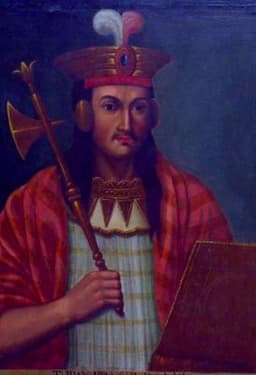
Titu Cusi Yupanqui
Emperor · Modern
51.6Total
Basic Information
Born
1968
1529
Died
—
1571
Era
Modern
Modern
Nationality
Spain
Inca Empire
Occupation
Emperor
Emperor
Civilization
Western
Western
Score Comparison
Military (10%)
46.7
50.0
Political (20%)
61.3
46.6
Influence (20%)
54.9
54.1
Legacy (20%)
41.7
45.0
Leadership (15%)
72.0
65.7
Strategy (15%)
50.0
50.0
TOTAL
53.8
51.6
Felipe VI of Spain — Complete Timeline
2014 AD
Proclamation as King of SpainPolitical Action◆ Major
Felipe VI was proclaimed king after the abdication of his father Juan Carlos I. He inherited a monarchy facing public scrutiny due to scandals, and his reign has focused on restoring the institution's credibility and transparency.
ProclamationMonarchyReform
Impact: national
2017 AD
Address during the Catalan independence crisisPolitical Action◆ Major
In response to the Catalan independence referendum, Felipe VI gave a televised address condemning the separatist actions and defending the Spanish Constitution. His speech was seen as a firm stance against secession, but also drew criticism for its lack of conciliation.
CataloniaCrisisConstitution
Impact: national
2020 AD
Renunciation of inheritance from Juan Carlos IPolitical Action
Felipe VI renounced his personal inheritance from his father Juan Carlos I, who was under investigation for financial irregularities. This move was intended to distance the monarchy from the scandals and demonstrate a commitment to transparency and accountability.
ScandalTransparencyMonarchy
Impact: nationalconstructive
Titu Cusi Yupanqui — Complete Timeline
1561 AD
Coronation as Sapa Inca of VilcabambaPolitical Action◆ Major
Titu Cusi Yupanqui succeeded his brother Sayri Tupac as the ruler of the Neo-Inca state in Vilcabamba. He revived resistance against Spanish rule, refusing to accept Spanish authority and maintaining an independent Inca kingdom.
CoronationVilcabambaInca
Impact: regional
1568 AD
Negotiations with Spanish EnvoysPolitical Action
Titu Cusi Yupanqui engaged in negotiations with Spanish envoys, including the viceroy's representatives, seeking a peace treaty. The talks failed due to mutual distrust, and Titu Cusi continued guerrilla warfare against Spanish settlements.
NegotiationPeaceInca
Impact: regional
1570 AD
Dictation of the 'Instrucción al Rey'Cultural◆ Major
Titu Cusi Yupanqui dictated a chronicle to Spanish missionary Fray Marcos Garc
ChronicleIncaSpanish
Impact: regional
1571 AD
Death of Titu Cusi YupanquiOther◆ Major
Titu Cusi Yupanqui died suddenly, possibly from illness or poisoning. His death led to the succession of his brother Tupac Amaru, who was later captured and executed by the Spanish, ending the Vilcabamba resistance.
DeathSuccessionInca
Impact: regionaltragic
Expert Analysis
Origins
Felipe VI of Spain was born on January 30, 1968, in Madrid, to King Juan Carlos I and Queen Sofía. He received a comprehensive education, including military training at the General Military Academy, the Naval Academy, and the Air Force Academy, and later studied law and economics at the Autonomous University of Madrid and Georgetown University. His upbringing was that of a modern European monarch, groomed for a ceremonial yet constitutional role.
Titu Cusi Yupanqui was born around 1529 in the Inca Empire, likely in Cusco. He was a son of Manco Inca Yupanqui, the first ruler of the Neo-Inca state in Vilcabamba after the Spanish conquest. Titu Cusi grew up in a context of ongoing guerrilla warfare against Spanish colonizers. His early life was shaped by the fall of the Inca Empire and the resistance efforts led by his father and later his brother Sayri Tupac.
Rise to Power
Felipe VI ascended the throne on June 19, 2014, after the abdication of his father Juan Carlos I, who had been king since 1975. Felipe's rise was smooth, as he was the designated heir and had been prepared for kingship. His coronation came amid scandals surrounding his father's finances and the monarchy's declining popularity. Felipe sought to restore trust by emphasizing transparency and constitutional duty.
Titu Cusi Yupanqui became Sapa Inca in 1560 after his brother Sayri Tupac died under disputed circumstances. He ruled from the remote jungle city of Vilcabamba, continuing the resistance against Spanish rule. His rise was marked by a revival of military campaigns and diplomatic efforts. He negotiated with Spanish authorities, seeking a peace treaty that would recognize Inca autonomy, but these talks ultimately failed.
Leadership & Governance
Felipe VI operates as a constitutional monarch with limited political power. His leadership is largely symbolic and ceremonial, focusing on representing Spain abroad and promoting national unity. He scored 72.0 in leadership, reflecting his ability to navigate crises like the Catalan independence push. In 2017, he delivered a televised address condemning the Catalan referendum, defending the constitution. He also renounced his inheritance from his father to distance himself from scandals.
Titu Cusi Yupanqui was an active ruler of a small but resilient state. He combined military resistance with diplomacy, sending envoys to the Spanish king and even allowing missionaries into Vilcabamba. His governance was pragmatic: he allowed Spanish friars to baptize him (he was baptized as Diego) but maintained Inca traditions. His leadership score of 65.7 reflects his ability to hold together a fragmented resistance movement. However, his political score of 46.6 indicates limited success in negotiations.
Triumph & Tragedy
Felipe VI's greatest success has been stabilizing the Spanish monarchy after his father's scandals. He has maintained the institution's relevance in a modern democracy. His address during the Catalan crisis was seen as a defense of constitutional order. However, his reign has been marred by ongoing republican sentiment and the monarchy's inability to connect with younger generations. His legacy score of 41.7 reflects uncertainty about the monarchy's future.
Titu Cusi Yupanqui's triumph was prolonging Inca resistance for over a decade and producing the 'Instrucción al Rey,' a unique chronicle that provides an Inca perspective on the conquest. His tragedy was his sudden death in 1571, likely from illness or poisoning, which led to the capture and execution of his brother Tupac Amaru, ending the Neo-Inca state. His military score of 50.0 and political score of 46.6 highlight his mixed success.
Character & Destiny
Felipe VI is seen as dutiful, reserved, and principled. He has prioritized duty over personal gain, as shown by renouncing his inheritance. His character has helped him navigate crises, but his lack of personal charisma compared to his father has limited his influence. His destiny is tied to the survival of the Spanish monarchy.
Titu Cusi Yupanqui was pragmatic and adaptive, willing to engage with Spanish culture while resisting domination. His chronicle shows intelligence and a desire to be heard. His sudden death ended his efforts, and the Vilcabamba state collapsed soon after. Historians speculate that his decision to allow Spanish missionaries may have led to internal divisions.
Legacy
Felipe VI's legacy is still forming. He has strengthened the monarchy's constitutional role but has not reversed its decline in popularity. His impact on Spanish politics is moderate, with a total score of 53.8. He is likely to be remembered as a steady king during turbulent times.
Titu Cusi Yupanqui's legacy is significant as the last effective Inca ruler and author of a key historical document. His chronicle, 'Instrucción al Rey,' is a vital source for understanding Inca resistance. He scored 45.0 in legacy, reflecting his importance in indigenous history but limited broader impact. The Neo-Inca state's fall marked the final chapter of Inca civilization.
Conclusion
Felipe VI and Titu Cusi Yupanqui represent different forms of leadership: one as a modern constitutional monarch, the other as a resistance leader. Felipe VI has had a greater impact on contemporary Spain, preserving the monarchy through crisis. However, his influence is constrained by his constitutional role. Titu Cusi Yupanqui's impact, though limited to a small region and period, was more direct in shaping the history of indigenous resistance. In terms of historical significance, Titu Cusi Yupanqui's legacy as a chronicler and symbol of resistance arguably has a more lasting influence on cultural memory. Therefore, while Felipe VI scores higher overall (53.8 vs 51.6), Titu Cusi Yupanqui's impact on historical understanding and indigenous identity is greater.
Rankings
🥇
Felipe VI of SpainLeader
Mil: 46.7Pol: 61.3Inf: 54.9
53.8
🥈
Titu Cusi Yupanqui
Mil: 50.0Pol: 46.6Inf: 54.1
51.6
+2.2 behind
How This Comparison Works
Algorithm
Each figure is scored on 6 dimensions (0—100 scale) based on structured historical data: Military (10%), Political (20%), Influence (20%), Legacy (20%), Leadership (15%), Strategy (15%). The weighted total produces the final ranking.
Data Sources
Scores are computed from structured sub-indicators in the database. Scale factors adjust for era (Ancient ×0.85, Modern ×1.0) and civilization size (Eastern ×1.05, Other ×0.80) to account for differences in population and military scale.
Maximum 3 Figures
Comparisons are limited to 2—3 figures to ensure readability and statistical meaningfulness.
Error Margins
±5 points per dimension — Sub-scores are derived from historical records with inherent uncertainty. Two figures within 5 points on a dimension should be considered roughly equivalent in that area.
Total Score Accuracy
±3 points overall — The weighted combination of 6 dimensions produces a total score with approximately ±3 points of uncertainty. Differences of less than 3 points are not statistically significant— the figures are effectively tied.
Known Limitations
- Historical records are incomplete and uneven across civilizations
- Figures from oral-tradition societies may be underrepresented
- Occupation labels can misclassify multi-role figures
- Scores measure capability and impact, not moral character
- Quantitative scoring is a comparison tool, not absolute truth
Capability Radar
Military (10%) — Battles & Warfare
Battles
24
25
Win Rate
29
20
Expansion
29
10
Political (20%) — Governance & Reform
Reform
30
30
Diplomacy
60
50
Economy
40
20
Influence (20%) — Cultural & Global Reach
Cultural
30
35
Global
40
20
Legacy (20%) — Historical Impact
Historical
20
40
Longevity
30
30
Leadership (15%) — Power & Stability
Tenure
50
40
Stability
70
25
Strategy (15%) — Tactics & Innovation
Strategy
35
25
Tactics
37
30
Reform
40
15
Similar Comparisons
Comments & Discussion
No comments yet. Be the first to share your thoughts!