Loading...
Ferdinand Foch vs Oda Nobunaga
Ferdinand Foch leads by 7.0 pts · 2 figures compared
…
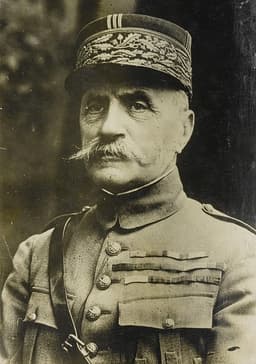
Ferdinand Foch
General · Modern
70.8Total

Oda Nobunaga
General · Modern
63.8Total
Basic Information
Born
1851
1534
Died
1929
1582
Era
Modern
Modern
Nationality
France
Japan
Occupation
General
General
Civilization
Western
Eastern
Score Comparison
Military (10%)
78.0
85.0
Political (20%)
72.0
78.0
Influence (20%)
75.0
65.0
Legacy (20%)
65.0
40.0
Leadership (15%)
68.0
62.0
Strategy (15%)
70.0
80.0
TOTAL
70.8
63.8
Ferdinand Foch — Complete Timeline
1914 AD
First Battle of the MarneWar
As commander of the French Ninth Army, Foch's forces held the line and counterattacked at the First Battle of the Marne, helping to halt the German advance on Paris. This battle saved France from early defeat.
World War IWestern FrontDefense
Impact: global
1918 AD
Hundred Days OffensiveWar
Foch planned and directed the Allied Hundred Days Offensive, a series of coordinated attacks that broke the German lines and forced the German army to retreat. The offensive led directly to the Armistice.
World War IWestern FrontOffensive
Impact: global
Appointed Allied Supreme CommanderPolitical Action◆ Major
Foch was appointed Supreme Commander of the Allied Armies on the Western Front, coordinating the forces of France, Britain, the United States, and other allies. This unified command was crucial for the final Allied offensives.
World War ICommandAllied Unity
Impact: globalconstructive
Accepted the German ArmisticePolitical Action
Foch, as Allied Supreme Commander, accepted the German armistice delegation in a railway carriage at Compi
World War IArmisticePeace
Impact: global
Oda Nobunaga — Complete Timeline
1560 AD
Battle of OkehazamaWar
Oda Nobunaga led a surprise attack against the much larger army of Imagawa Yoshimoto at Okehazama. Nobunaga's victory, achieved through a daring raid during a thunderstorm, eliminated a major rival and established him as a rising power in Japan.
BattleSengokuRise to Power
Impact: regional
1568 AD
Capture of KyotoPolitical Action◆ Major
Oda Nobunaga marched into Kyoto and installed Ashikaga Yoshiaki as the 15th shogun, effectively controlling the shogunate. This move gave Nobunaga political legitimacy and control over the imperial capital, a key step toward unifying Japan.
KyotoShogunatePolitical Control
Impact: national
1573 AD
Expulsion of Ashikaga YoshiakiPolitical Action◆ Major
Oda Nobunaga expelled Ashikaga Yoshiaki from Kyoto, effectively ending the Ashikaga shogunate. This act removed the last obstacle to Nobunaga's supreme authority and marked the beginning of the Azuchi-Momoyama period of unification.
ShogunateEnd of EraUnification
Impact: national
1575 AD
Battle of NagashinoWar◆ Major
Oda Nobunaga and his ally Tokugawa Ieyasu defeated the Takeda clan at Nagashino. Nobunaga's innovative use of volley fire from arquebusiers behind wooden palisades marked a turning point in Japanese warfare, demonstrating the effectiveness of firearms.
BattleFirearmsMilitary Innovation
Impact: national
1582 AD
Incident at Honnō-jiPolitical Action
Oda Nobunaga was betrayed and attacked by his general Akechi Mitsuhide at Honn
BetrayalDeathUnification
Impact: nationaltragic
Expert Analysis
Origins
Ferdinand Foch was born on October 2, 1851, in Tarbes, France, into a devout Catholic family. His father, a civil servant, and his mother instilled discipline. Foch attended the École Polytechnique and later the École Supérieure de Guerre, where he became a professor of military history, developing his strategic theories on the offensive spirit.
Oda Nobunaga was born on June 23, 1534, in Owari Province, Japan, as the son of Oda Nobuhide, a warlord. His early life was marked by family strife; he was considered eccentric and unruly. After his father's death in 1551, Nobunaga consolidated control over Owari through ruthless tactics, defeating his relatives and rivals.
Rise to Power
Foch's rise came during World War I. In 1914, as commander of the French Ninth Army, he held the line at the First Battle of the Marne (September 6-9), counterattacking to halt the German advance. This earned him fame. He later became commander of the French Army Group North in 1915, but his offensives at Artois and Verdun were costly. In 1917, he served as Chief of Staff. His pivotal moment came in March 1918 when he was appointed Supreme Commander of the Allied Armies, coordinating French, British, American, and Belgian forces.
Nobunaga's rise began at the Battle of Okehazama in June 1560. With only 2,000 men, he launched a surprise attack on Imagawa Yoshimoto's 25,000-strong army, killing Yoshimoto. This victory propelled him to prominence. He then allied with Tokugawa Ieyasu and captured Kyoto in 1568, installing Ashikaga Yoshiaki as shogun, effectively controlling the shogunate. In 1571, he destroyed the Buddhist monastery of Mount Hiei, massacring thousands to eliminate opposition. By 1573, he expelled Yoshiaki, ending the Ashikaga shogunate.
Leadership & Governance
Foch, with a leadership score of 68.0, was a collaborative but firm commander. He emphasized coordination among Allied forces, often mediating between generals like Haig and Pershing. His governance approach was tactical and focused on the Western Front. He believed in the offensive 'à outrance' but adapted to defensive strategies when needed. His political score of 72.0 reflects his ability to navigate Allied politics.
Nobunaga, with a leadership score of 62.0, was autocratic and ruthless. He centralized power, broke the power of Buddhist monasteries, and implemented land surveys to tax efficiently. He pioneered the use of firearms with volley fire at the Battle of Nagashino (1575), where 3,000 arquebusiers behind wooden palisades decimated the Takeda cavalry. His political score of 78.0 shows his skill in forming alliances and defeating rivals, but his harsh rule created enemies.
Triumph & Tragedy
Foch's greatest triumph was orchestrating the Hundred Days Offensive (August-November 1918), which broke the German lines and led to the Armistice. He accepted Germany's surrender in a railway carriage at Compiègne on November 11, 1918. However, his failures include costly offensives earlier in the war, such as the Second Battle of Artois (1915) that gained little ground. He also failed to foresee the rise of Nazism, famously saying the Treaty of Versailles was 'only a truce for twenty years'.
Nobunaga's triumphs include unifying half of Japan, ending the Ashikaga shogunate, and modernizing warfare. His tragedy was his betrayal and death: on June 21, 1582, his general Akechi Mitsuhide attacked him at Honnō-ji temple. Nobunaga committed seppuku as the temple burned. His failure to secure loyalty led to his downfall, leaving his successor Toyotomi Hideyoshi to complete unification.
Character & Destiny
Foch, with a strategy score of 70.0, was methodical and intellectually rigorous. His character—disciplined, Catholic, and optimistic—shaped his belief in the offensive. He was respected but not beloved. His destiny was to be the architect of Allied victory, but his insistence on harsh peace terms contributed to future conflict.
Nobunaga, with a strategy score of 80.0, was innovative and ruthless. He embraced new technologies and was known for his cruelty, such as the massacre at Mount Hiei. His character—arrogant and uncompromising—created many enemies. His destiny was to unify Japan through force but die before completion, a classic tale of hubris.
Legacy
Foch's legacy is mixed. He is remembered as the Supreme Commander who won WWI, but his military score of 78.0 is overshadowed by his political influence (72.0) and influence score (75.0). The Armistice carriage became a symbol; Hitler used it in 1940. Foch's strategic principles influenced later NATO command structures. His legacy score of 65.0 reflects the ambiguous outcome of his victory.
Nobunaga's legacy is profound in Japan. He broke the old order, centralized power, and pioneered firearms, leading to the unification under Hideyoshi and Tokugawa. His military score of 85.0 and strategy score of 80.0 highlight his battlefield prowess. However, his legacy score of 40.0 is low because his rule was cut short, and his methods were harsh. He is remembered as a revolutionary but often overshadowed by his successors.
Conclusion
Ferdinand Foch, with a total score of 70.8, had a greater immediate global impact. His coordination of Allied forces ended World War I, a conflict that reshaped the world. Oda Nobunaga, scoring 63.8, was a transformative figure in Japan but his influence was regional and his unification incomplete. While Nobunaga was more innovative in military tactics (85.0 vs 78.0), Foch's political and leadership skills in a coalition war were more consequential. Foch's victory directly shaped the 20th century, whereas Nobunaga's legacy was realized by others. Therefore, Ferdinand Foch had a greater overall impact.
Rankings
🥇
Ferdinand FochLeader
Mil: 78.0Pol: 72.0Inf: 75.0
70.8
🥈
Oda Nobunaga
Mil: 85.0Pol: 78.0Inf: 65.0
63.8
+7.0 behind
How This Comparison Works
Algorithm
Each figure is scored on 6 dimensions (0—100 scale) based on structured historical data: Military (10%), Political (20%), Influence (20%), Legacy (20%), Leadership (15%), Strategy (15%). The weighted total produces the final ranking.
Data Sources
Scores are computed from structured sub-indicators in the database. Scale factors adjust for era (Ancient ×0.85, Modern ×1.0) and civilization size (Eastern ×1.05, Other ×0.80) to account for differences in population and military scale.
Maximum 3 Figures
Comparisons are limited to 2—3 figures to ensure readability and statistical meaningfulness.
Error Margins
±5 points per dimension — Sub-scores are derived from historical records with inherent uncertainty. Two figures within 5 points on a dimension should be considered roughly equivalent in that area.
Total Score Accuracy
±3 points overall — The weighted combination of 6 dimensions produces a total score with approximately ±3 points of uncertainty. Differences of less than 3 points are not statistically significant— the figures are effectively tied.
Known Limitations
- Historical records are incomplete and uneven across civilizations
- Figures from oral-tradition societies may be underrepresented
- Occupation labels can misclassify multi-role figures
- Scores measure capability and impact, not moral character
- Quantitative scoring is a comparison tool, not absolute truth
Capability Radar
Military (10%) — Battles & Warfare
Battles
85
85
Win Rate
80
80
Expansion
60
80
Political (20%) — Governance & Reform
Reform
50
85
Diplomacy
85
70
Economy
40
75
Influence (20%) — Cultural & Global Reach
Cultural
60
75
Global
80
65
Legacy (20%) — Historical Impact
Historical
85
85
Longevity
70
70
Leadership (15%) — Power & Stability
Tenure
65
60
Stability
55
50
Strategy (15%) — Tactics & Innovation
Strategy
90
85
Tactics
75
90
Reform
70
95
Similar Comparisons
Comments & Discussion
No comments yet. Be the first to share your thoughts!