Loading...
Ferdinand I of Aragon vs Umar
Umar leads by 19.4 pts · 2 figures compared
…
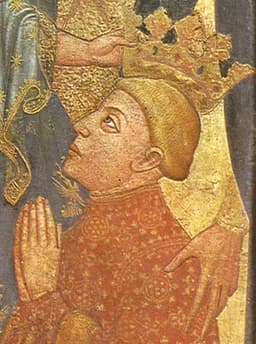
Ferdinand I of Aragon
Emperor · Medieval
54.8Total

Umar
Emperor · Medieval
74.2Total
Basic Information
Born
1380
584
Died
1416
644
Era
Medieval
Medieval
Nationality
Aragon
Rashidun Caliphate
Occupation
Emperor
Emperor
Civilization
Western
Middle Eastern
Score Comparison
Military (10%)
40.0
77.1
Political (20%)
68.0
70.3
Influence (20%)
55.7
67.4
Legacy (20%)
45.0
82.0
Leadership (15%)
74.0
78.0
Strategy (15%)
43.3
69.2
TOTAL
54.8
74.2
Ferdinand I of Aragon — Complete Timeline
1412 AD
Compromise of CaspePolitical Action
Ferdinand I was elected King of Aragon by the Compromise of Caspe, a commission of nine representatives from Aragon, Catalonia, and Valencia. This resolved the succession crisis following the death of Martin I without a direct heir, bringing the Trastamara dynasty to the Aragonese throne.
Succession crisisTrastamara dynasty
Impact: regionalconstructive
1414 AD
Conquest of SardiniaWar◆ Major
Ferdinand I launched a military campaign to subdue the rebellious Sardinian nobles who had resisted Aragonese rule. The campaign successfully reasserted Aragonese control over the island, consolidating the Crown of Aragon's Mediterranean possessions.
Mediterranean expansionSardinia
Impact: regional
1415 AD
Reform of the Aragonese administrationReform
Ferdinand I implemented administrative reforms in the Crown of Aragon, including the reorganization of the royal council and the standardization of tax collection. These reforms strengthened royal authority and improved the efficiency of governance across the diverse territories of Aragon.
Administrative reformRoyal authority
Impact: nationalconstructive
Umar — Complete Timeline
634 AD
Caliphate of UmarPolitical Action◆ Major
Umar ibn al-Khattab became the second caliph after Abu Bakr's death. His ten-year reign saw the rapid expansion of the Islamic empire, including the conquest of the Sassanid Empire and Byzantine territories in the Levant and Egypt.
CaliphateExpansionRashidun
Impact: global
636 AD
Conquest of the Sassanid EmpireWar
Umar's forces, led by Sa'd ibn Abi Waqqas, defeated the Sassanid army at the Battle of al-Qadisiyyah in 636. This victory led to the Muslim conquest of Iraq and later the fall of the Sassanid capital Ctesiphon, ending Persian imperial rule.
Islamic ConquestSassanid EmpireRashidun
Impact: global
Conquest of Byzantine Syria and EgyptWar◆ Major
Umar's generals, including Khalid ibn al-Walid and Amr ibn al-As, conquered Byzantine Syria after the Battle of Yarmouk (636) and Egypt after the surrender of Babylon Fortress (641). These conquests added vast territories to the caliphate.
Islamic ConquestByzantine EmpireRashidun
Impact: global
638 AD
Establishment of the Islamic CalendarReform◆ Major
Umar instituted the Hijri calendar, dating from the migration (Hijra) of Muhammad to Medina in 622. This calendar became the standard for the Islamic world, used for religious and administrative purposes.
CalendarReformRashidun
Impact: globalconstructive
644 AD
Assassination of UmarPolitical Action◆ Major
Umar was stabbed by a Persian slave named Abu Lu'lu'a while leading prayers in Medina. He died three days later, having appointed a council to elect his successor. His death marked the end of the first phase of rapid expansion.
AssassinationSuccessionRashidun
Impact: globaltragic
Expert Analysis
Origins
Ferdinand I of Aragon was born in 1380 as the son of John I of Castile and Eleanor of Aragon. He was raised in the Castilian court, surrounded by the conflicts of the Reconquista. His Trastamara lineage gave him a strong claim to the Aragonese throne, but he was not the direct heir. Umar ibn al-Khattab was born in 584 in Mecca, a member of the Banu Adi clan of the Quraysh tribe. Initially a fierce opponent of Islam, he converted in 616 after a dramatic encounter with the Quran. His early life as a merchant and warrior shaped his decisive leadership.
Rise to Power
Ferdinand rose through the Compromise of Caspe in 1412, where nine representatives from Aragon, Catalonia, and Valencia elected him king after the death of Martin of Aragon without a direct heir. This political settlement ended a two-year interregnum. Umar became the second caliph in 634 after Abu Bakr's death, chosen by Abu Bakr's nomination. His rise was swift due to his close companionship with Muhammad and his organizational skills. While Ferdinand's ascent relied on legal and political maneuvering, Umar's was rooted in religious authority and military leadership.
Leadership & Governance
Ferdinand I focused on administrative reforms, reorganizing the royal council and standardizing taxes. He suppressed revolts in Sardinia, reasserting Aragonese control. His governance was characterized by legalism and consolidation. Umar, by contrast, expanded the Islamic empire from Arabia to include the Sassanid Empire and Byzantine Syria and Egypt. He established the diwan (administrative register), the Hijri calendar, and provincial governance. Umar's leadership scored 78.0 in leadership, while Ferdinand scored 74.0, but Umar's reach was far greater. Umar's military score of 77.1 dwarfs Ferdinand's 40.0, reflecting his direct role in conquests.
Triumph & Tragedy
Ferdinand's greatest success was securing the Aragonese throne and stabilizing the realm. However, his military campaigns were limited; his conquest of Sardinia was a minor achievement. His failure to expand significantly beyond the Mediterranean left his legacy modest. Umar's triumphs include the conquest of the Sassanid Empire (Battle of al-Qadisiyyah, 636) and Byzantine Syria (Battle of Yarmouk, 636) and Egypt (641). His tragedy was his assassination in 644 by a Persian slave, Abu Lu'lu'a, while leading prayers. This sudden death ended a transformative reign.
Character & Destiny
Ferdinand was cautious and legalistic, relying on diplomacy and reform. His character was suited to peacetime consolidation but not expansion. Umar was decisive, austere, and hands-on; he personally led armies and administered justice. His strict adherence to Islamic law earned him the title 'Al-Faruq' (the one who distinguishes). Ferdinand's destiny was to be a transitional figure, while Umar's destiny was to forge an empire. Historical assessments note Umar's strategic vision, scoring 69.2 in strategy versus Ferdinand's 43.3.
Legacy
Ferdinand's legacy is tied to the Compromise of Caspe and the strengthening of Aragonese institutions. However, his influence is limited regionally. Umar's legacy is immense: the Islamic calendar, administrative systems, and the rapid expansion of Islam. His total score of 74.2 far exceeds Ferdinand's 54.8. The Rashidun Caliphate under Umar set the stage for the Umayyad and Abbasid empires. Umar's influence score of 67.4 versus Ferdinand's 55.7 underscores this.
Conclusion
Umar had significantly greater impact. His conquests reshaped the Middle East and beyond, while Ferdinand's reforms were confined to Aragon. The 19.4-point score gap reflects this. Umar's leadership and strategic prowess transformed the Islamic world; Ferdinand's achievements, while competent, pale in comparison. Umar is the clear greater figure.
Rankings
🥇
UmarLeader
Mil: 77.1Pol: 70.3Inf: 67.4
74.2
🥈
Ferdinand I of Aragon
Mil: 40.0Pol: 68.0Inf: 55.7
54.8
+19.4 behind
How This Comparison Works
Algorithm
Each figure is scored on 6 dimensions (0—100 scale) based on structured historical data: Military (10%), Political (20%), Influence (20%), Legacy (20%), Leadership (15%), Strategy (15%). The weighted total produces the final ranking.
Data Sources
Scores are computed from structured sub-indicators in the database. Scale factors adjust for era (Ancient ×0.85, Modern ×1.0) and civilization size (Eastern ×1.05, Other ×0.80) to account for differences in population and military scale.
Maximum 3 Figures
Comparisons are limited to 2—3 figures to ensure readability and statistical meaningfulness.
Error Margins
±5 points per dimension — Sub-scores are derived from historical records with inherent uncertainty. Two figures within 5 points on a dimension should be considered roughly equivalent in that area.
Total Score Accuracy
±3 points overall — The weighted combination of 6 dimensions produces a total score with approximately ±3 points of uncertainty. Differences of less than 3 points are not statistically significant— the figures are effectively tied.
Known Limitations
- Historical records are incomplete and uneven across civilizations
- Figures from oral-tradition societies may be underrepresented
- Occupation labels can misclassify multi-role figures
- Scores measure capability and impact, not moral character
- Quantitative scoring is a comparison tool, not absolute truth
Capability Radar
Military (10%) — Battles & Warfare
Battles
40
85
Win Rate
45
90
Expansion
50
92
Political (20%) — Governance & Reform
Reform
45
90
Diplomacy
60
80
Economy
50
85
Influence (20%) — Cultural & Global Reach
Cultural
35
85
Global
30
88
Legacy (20%) — Historical Impact
Historical
40
90
Longevity
30
95
Leadership (15%) — Power & Stability
Tenure
55
85
Stability
50
82
Strategy (15%) — Tactics & Innovation
Strategy
40
88
Tactics
35
80
Reform
30
85
Similar Comparisons
Comments & Discussion
No comments yet. Be the first to share your thoughts!