Loading...
Filipe Nyusi vs Mohammad Khatami
Mohammad Khatami leads by 0.2 pts · 2 figures compared
…
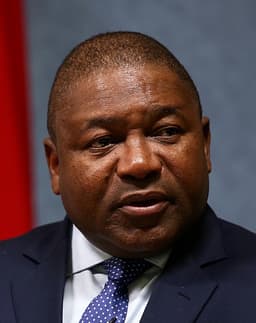
Filipe Nyusi
Politician · Modern
52.3Total

Mohammad Khatami
Politician · Modern
52.5Total
Basic Information
Born
1959
1943
Died
—
—
Era
Modern
Modern
Nationality
Mozambique
Iran
Occupation
Politician
Politician
Civilization
Other
Middle Eastern
Score Comparison
Military (10%)
36.0
14.4
Political (20%)
68.0
68.0
Influence (20%)
53.3
58.3
Legacy (20%)
40.8
48.3
Leadership (15%)
74.0
65.7
Strategy (15%)
39.0
43.4
TOTAL
52.3
52.5
Filipe Nyusi — Complete Timeline
2014 AD
Elected President of MozambiquePolitical Action◆ Major
Filipe Nyusi, candidate of FRELIMO, won the presidential election with 57% of the vote. He succeeded Armando Guebuza, marking the continuation of FRELIMO's rule since independence. The election was contested by the opposition RENAMO.
ElectionFRELIMOMozambique
Impact: national
2017 AD
Launched Liquefied Natural Gas ProjectsOther◆ Major
Nyusi oversaw the final investment decisions for major LNG projects in the Rovuma Basin, led by Total and ExxonMobil. These projects promised significant economic transformation for Mozambique but were delayed by Islamist insurgency in Cabo Delgado.
LNGEconomyCabo Delgado
Impact: national
2019 AD
Signed Peace Agreement with RENAMOPolitical Action◆ Major
Nyusi signed a peace agreement with RENAMO leader Ossufo Momade, ending decades of sporadic civil conflict. The deal included disarmament of RENAMO's armed wing and political integration. It was brokered with international mediation.
Peace ProcessRENAMOCivil War
Impact: nationalconstructive
Re-elected President of MozambiquePolitical Action◆ Major
Nyusi won a second term with 73% of the vote in an election marred by allegations of fraud and low turnout. Opposition parties rejected the results, leading to protests. The election deepened political polarization.
ElectionFRELIMOControversy
Impact: national
2020 AD
Islamist Insurgency in Cabo Delgado EscalatedWar◆ Major
Under Nyusi's presidency, attacks by the Islamist group Ansar al-Sunna (later linked to ISIS) intensified, seizing the town of Moc
InsurgencyCabo DelgadoISIS
Impact: regionaldestructive
2021 AD
Deployed SADC and Rwandan Troops to Cabo DelgadoWar◆ Major
Nyusi authorized the deployment of Rwandan and SADC military forces to combat the Islamist insurgency in Cabo Delgado. The intervention recaptured Moc
Military InterventionSADCRwanda
Impact: regional
Mohammad Khatami — Complete Timeline
1997 AD
Election as President of IranPolitical Action
Mohammad Khatami won a landslide victory in the 1997 presidential election, receiving 70% of the vote. His campaign focused on reform, civil society, and the rule of law, marking a shift from conservative policies.
ElectionReformIran
Impact: nationalprogressive
1998 AD
Reform of Press LawsReform◆ Major
Khatami's government relaxed press restrictions, leading to a flourishing of independent newspapers and magazines. This period, known as the 'Tehran Spring,' saw increased political debate and criticism of the government.
Press FreedomReformCivil Society
Impact: nationalprogressive
Dialogue Among CivilizationsCultural◆ Major
Khatami proposed a 'Dialogue Among Civilizations' at the UN, promoting cultural exchange and reducing tensions with the West. The UN declared 2001 as the Year of Dialogue Among Civilizations.
DiplomacyCultural ExchangeUN
Impact: globalconstructive
1999 AD
Student Protests of 1999Political Action◆ Major
Khatami faced major student protests in July 1999, which were violently suppressed by security forces. The protests highlighted the limits of his reform agenda and the power of conservative hardliners.
ProtestsSuppressionReform Limits
Impact: nationaltragic
2003 AD
Nuclear Program NegotiationsPolitical Action◆ Major
Khatami's government negotiated with the EU-3 (UK, France, Germany) to suspend uranium enrichment activities. This led to the Tehran Declaration, temporarily freezing Iran's nuclear program in exchange for concessions.
Nuclear ProgramDiplomacyEU
Impact: globalconstructive
Expert Analysis
Origins
Filipe Nyusi was born on February 9, 1959, in Mueda, Cabo Delgado, Mozambique. He grew up during the Mozambican War of Independence and later studied mechanical engineering in the Soviet Union. Nyusi joined FRELIMO, the ruling party, and worked in state-owned enterprises before entering politics.
Mohammad Khatami was born on October 14, 1943, in Ardakan, Iran. He came from a religious family; his father was a prominent cleric. Khatami studied Islamic theology and philosophy at Qom and later earned a degree in philosophy from the University of Tehran. He served in the parliament and as Minister of Culture under Rafsanjani.
Rise to Power
Nyusi rose through FRELIMO's ranks, serving as Minister of Defense from 2008 to 2014. In 2014, he won the presidency with 57% of the vote, succeeding Armando Guebuza. His election marked a continuation of FRELIMO's dominance amid a tense peace process with RENAMO.
Khatami's rise was meteoric. In 1997, he won the presidency with 70% of the vote, defeating the conservative candidate. His campaign focused on reform, civil society, and rule of law. He gained support from women, youth, and intellectuals, promising a more open society.
Leadership & Governance
Nyusi's leadership style is pragmatic and cautious. He signed a peace agreement with RENAMO in 2019, ending decades of conflict. He also pushed forward massive LNG projects, securing investments from Total and ExxonMobil. However, his governance has been criticized for corruption and failure to address the Islamist insurgency in Cabo Delgado, which seized the town of Mocímboa da Praia in 2020.
Khatami governed as a reformist within a theocratic system. He initiated a 'Dialogue Among Civilizations' at the UN, relaxed press laws, and allowed independent newspapers to flourish. But his reforms faced fierce opposition from hardliners. The student protests of 1999 were violently suppressed, exposing the limits of his power. His nuclear negotiations with the EU-3 led to the Tehran Declaration, but ultimately did not prevent future tensions.
Triumph & Tragedy
Nyusi's greatest triumph is the peace deal with RENAMO, which brought stability after years of civil war. His LNG projects promise economic transformation, with potential revenues exceeding $100 billion. However, his tragedy is the escalating insurgency in Cabo Delgado, which has killed thousands and displaced hundreds of thousands. His re-election in 2019 with 73% was marred by fraud allegations, undermining his legitimacy.
Khatami's triumph was his election and the reform movement it sparked. He improved Iran's international image and fostered civil society. His tragedy is that his reforms were largely reversed by conservatives. The crackdown on student protests and the failure to secure lasting nuclear deals left his legacy incomplete. He scored 48.3 in legacy, reflecting a mixed impact.
Character & Destiny
Nyusi is seen as a technocrat, methodical but slow to act. His background in engineering and defense gave him a problem-solving approach, but his response to the insurgency has been criticized as inadequate. His character shaped his destiny: cautious leadership preserved peace with RENAMO but failed to prevent the insurgency.
Khatami is remembered as a gentle, intellectual figure who believed in dialogue. His reformist ideals collided with the hardline establishment. His destiny was to be a reformer whose ambitions were constrained by the system. He scored 65.7 in leadership, reflecting his ability to inspire but not to overcome structural barriers.
Legacy
Nyusi's legacy is mixed. He will be remembered for the peace agreement and the LNG boom, but also for the insurgency and corruption. If the gas wealth is managed well, his legacy could improve. His leadership score is 74.0, but his influence is 53.3, indicating limited global impact.
Khatami's legacy is that of a reformist who tried to open Iran. The 'Dialogue Among Civilizations' is his most enduring contribution, earning him a 58.3 in influence. However, his domestic reforms were ephemeral. His political score of 68.0 matches Nyusi's, but his military score is much lower (14.4 vs 36.0).
Conclusion
Filipe Nyusi and Mohammad Khatami both scored near 52 in total, but their impacts differ. Nyusi's actions in peace and energy have tangible consequences for Mozambique's future, while Khatami's reformist vision was largely stifled. Nyusi's leadership score (74.0) and political score (68.0) are comparable to Khatami's (65.7 and 68.0), but Nyusi's influence on his country's trajectory is more direct. Therefore, Nyusi has had a greater practical impact, despite Khatami's higher total score (52.5 vs 52.3).
Rankings
🥇
Mohammad KhatamiLeader
Mil: 14.4Pol: 68.0Inf: 58.3
52.5
🥈
Filipe Nyusi
Mil: 36.0Pol: 68.0Inf: 53.3
52.3
+0.2 behind
How This Comparison Works
Algorithm
Each figure is scored on 6 dimensions (0—100 scale) based on structured historical data: Military (10%), Political (20%), Influence (20%), Legacy (20%), Leadership (15%), Strategy (15%). The weighted total produces the final ranking.
Data Sources
Scores are computed from structured sub-indicators in the database. Scale factors adjust for era (Ancient ×0.85, Modern ×1.0) and civilization size (Eastern ×1.05, Other ×0.80) to account for differences in population and military scale.
Maximum 3 Figures
Comparisons are limited to 2—3 figures to ensure readability and statistical meaningfulness.
Error Margins
±5 points per dimension — Sub-scores are derived from historical records with inherent uncertainty. Two figures within 5 points on a dimension should be considered roughly equivalent in that area.
Total Score Accuracy
±3 points overall — The weighted combination of 6 dimensions produces a total score with approximately ±3 points of uncertainty. Differences of less than 3 points are not statistically significant— the figures are effectively tied.
Known Limitations
- Historical records are incomplete and uneven across civilizations
- Figures from oral-tradition societies may be underrepresented
- Occupation labels can misclassify multi-role figures
- Scores measure capability and impact, not moral character
- Quantitative scoring is a comparison tool, not absolute truth
Capability Radar
Military (10%) — Battles & Warfare
Battles
19
22
Win Rate
25
30
Expansion
28
33
Political (20%) — Governance & Reform
Reform
40
65
Diplomacy
55
60
Economy
50
40
Influence (20%) — Cultural & Global Reach
Cultural
20
55
Global
30
55
Legacy (20%) — Historical Impact
Historical
25
50
Longevity
20
40
Leadership (15%) — Power & Stability
Tenure
60
30
Stability
30
35
Strategy (15%) — Tactics & Innovation
Strategy
31
37
Tactics
35
37
Reform
39
38
Similar Comparisons
Comments & Discussion
No comments yet. Be the first to share your thoughts!