Loading...
This comparison has not been analyzed yet.
One-time AI generation (~1 minute). Scores and timeline are already available below.
Francisco Morazan vs Waclaw Rzewuski
Francisco Morazan leads by 9.7 pts · 2 figures compared
…
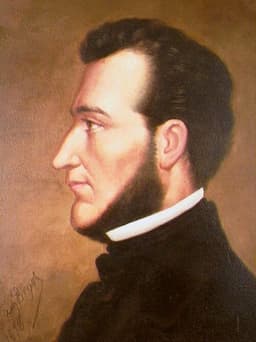
Francisco Morazan
General · Modern
58.0Total

Waclaw Rzewuski
General · Modern
48.3Total
Basic Information
Born
1792
1706
Died
1842
1779
Era
Modern
Modern
Nationality
Honduras
Poland-Lithuania
Occupation
General
General
Civilization
Western
Western
Score Comparison
Military (10%)
52.5
50.0
Political (20%)
60.0
36.5
Influence (20%)
62.0
54.1
Legacy (20%)
50.0
42.5
Leadership (15%)
68.0
57.6
Strategy (15%)
55.0
50.0
TOTAL
58.0
48.3
Francisco Morazan — Complete Timeline
1824 AD
Abolition of slavery in Central AmericaReform◆ Major
As a key leader in the liberal movement, Moraz
AbolitionSlaveryLiberal Reform
Impact: regionalprogressive
1827 AD
Battle of La TrinidadWar◆ Major
Morazán led a liberal army to victory against conservative forces at La Trinidad, Honduras. This battle was a key turning point in the Central American civil war, allowing Morazán to consolidate power and eventually become president of the federation.
BattleLiberal VictoryCivil War
Impact: regional
1830 AD
Presidency of the Federal Republic of Central AmericaPolitical Action
Morazán was elected president of the Federal Republic of Central America, a union of Guatemala, El Salvador, Honduras, Nicaragua, and Costa Rica. He pursued liberal reforms including separation of church and state, free trade, and land reform, facing opposition from conservatives.
Federal RepublicLiberal ReformsCentral America
Impact: regionalconstructive
1842 AD
Execution by firing squadPolitical Action
After a failed attempt to restore the Federal Republic, Moraz
ExecutionEnd of FederationLiberal Defeat
Impact: regionaltragic
Waclaw Rzewuski — Complete Timeline
1752 AD
Appointed Field Hetman of the CrownPolitical Action◆ Major
Waclaw Rzewuski was appointed Field Hetman of the Crown, the second-highest military commander in the Polish-Lithuanian Commonwealth. He was responsible for military operations in the eastern territories.
Military CommandHetman
Impact: national
1760 AD
Published works on Polish military historyCultural
Rzewuski wrote several works on Polish military history and the art of war. His writings contributed to the preservation of Polish military traditions and the study of the Commonwealth's military past.
LiteratureMilitary History
Impact: nationalconstructive
1764 AD
Defended the Golden Liberty in the SejmPolitical Action◆ Major
Rzewuski was a vocal defender of the Golden Liberty and the liberum veto in the Sejm. He opposed the reforms of King Stanis
Golden LibertyConservatism
Impact: nationaldestructive
This comparison has not been analyzed yet.
One-time AI generation (~1 minute). Scores and timeline are already available below.
Rankings
🥇
Francisco MorazanLeader
Mil: 52.5Pol: 60.0Inf: 62.0
58.0
🥈
Waclaw Rzewuski
Mil: 50.0Pol: 36.5Inf: 54.1
48.3
+9.7 behind
How This Comparison Works
Algorithm
Each figure is scored on 6 dimensions (0—100 scale) based on structured historical data: Military (10%), Political (20%), Influence (20%), Legacy (20%), Leadership (15%), Strategy (15%). The weighted total produces the final ranking.
Data Sources
Scores are computed from structured sub-indicators in the database. Scale factors adjust for era (Ancient ×0.85, Modern ×1.0) and civilization size (Eastern ×1.05, Other ×0.80) to account for differences in population and military scale.
Maximum 3 Figures
Comparisons are limited to 2—3 figures to ensure readability and statistical meaningfulness.
Error Margins
±5 points per dimension — Sub-scores are derived from historical records with inherent uncertainty. Two figures within 5 points on a dimension should be considered roughly equivalent in that area.
Total Score Accuracy
±3 points overall — The weighted combination of 6 dimensions produces a total score with approximately ±3 points of uncertainty. Differences of less than 3 points are not statistically significant— the figures are effectively tied.
Known Limitations
- Historical records are incomplete and uneven across civilizations
- Figures from oral-tradition societies may be underrepresented
- Occupation labels can misclassify multi-role figures
- Scores measure capability and impact, not moral character
- Quantitative scoring is a comparison tool, not absolute truth
Capability Radar
Military (10%) — Battles & Warfare
Battles
55
25
Win Rate
60
20
Expansion
40
10
Political (20%) — Governance & Reform
Reform
70
20
Diplomacy
45
30
Economy
50
15
Influence (20%) — Cultural & Global Reach
Cultural
45
30
Global
35
15
Legacy (20%) — Historical Impact
Historical
50
25
Longevity
40
20
Leadership (15%) — Power & Stability
Tenure
55
40
Stability
30
20
Strategy (15%) — Tactics & Innovation
Strategy
55
25
Tactics
50
30
Reform
45
15
Similar Comparisons
Comments & Discussion
No comments yet. Be the first to share your thoughts!