Loading...
Fuad Chehab vs Jose Antonio Paez
Jose Antonio Paez leads by 9.8 pts · 2 figures compared
…
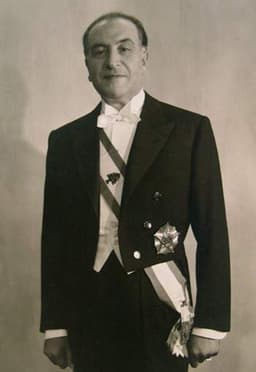
Fuad Chehab
General · Modern
49.9Total

Jose Antonio Paez
General · Modern
59.7Total
Basic Information
Born
1902
1790
Died
1973
1873
Era
Modern
Modern
Nationality
Lebanon
Venezuela
Occupation
General
General
Civilization
Middle Eastern
Western
Score Comparison
Military (10%)
10.2
61.7
Political (20%)
70.0
48.5
Influence (20%)
54.1
65.2
Legacy (20%)
44.2
56.0
Leadership (15%)
72.0
68.0
Strategy (15%)
30.3
58.0
TOTAL
49.9
59.7
Fuad Chehab — Complete Timeline
1958 AD
Launched Chehabist reforms and modernizationReform◆ Major
President Chehab implemented a series of reforms known as Chehabism, including administrative modernization, economic planning, and strengthening state institutions. He established the Central Bank of Lebanon and the Civil Service Board.
ReformModernizationState Building
Impact: nationalconstructive
Elected President of LebanonPolitical Action◆ Major
Fuad Chehab was elected President of Lebanon on September 23, 1958, succeeding Camille Chamoun. His election ended the 1958 crisis and was supported by both Christian and Muslim factions seeking stability.
PresidencyElectionStabilization
Impact: nationalconstructive
Created the Deuxième Bureau intelligence agencyPolitical Action
Chehab expanded the role of the Deuxi
IntelligenceSecurityAuthoritarianism
Impact: national
1960 AD
Presided over the 1960s economic boomOther
Under Chehab's presidency, Lebanon experienced a period of economic growth and stability, with Beirut becoming a major financial and tourism hub. His policies attracted foreign investment and expanded the middle class.
Economic GrowthBeirutProsperity
Impact: nationalconstructive
1964 AD
Refused to amend constitution for a second termPolitical Action
Chehab declined to seek a second term as president, respecting the constitutional limit. He retired from politics in 1964, setting a precedent for peaceful transitions of power in Lebanon.
ConstitutionTerm LimitRetirement
Impact: nationalconstructive
Jose Antonio Paez — Complete Timeline
1819 AD
Battle of Las Queseras del MedioWar◆ Major
Paez led 153 llanero cavalry in a daring charge against Spanish forces, achieving a decisive victory. This action secured his reputation as a key military commander in the Venezuelan War of Independence and demonstrated the effectiveness of llanero tactics.
Venezuelan War of IndependenceBattleLlaneros
Impact: regional
1821 AD
Battle of CaraboboWar
Paez commanded the Venezuelan llanero cavalry under Sim
Venezuelan War of IndependenceBattleLiberation
Impact: regional
1829 AD
Separation of Venezuela from Gran ColombiaPolitical Action◆ Major
Paez led a separatist movement that declared Venezuela's independence from Gran Colombia. He became the first president of the new Republic of Venezuela, ending the union with Colombia and Ecuador established by Sim
Gran ColombiaSeparatismFounding of Venezuela
Impact: regional
1830 AD
First Presidency of VenezuelaPolitical Action◆ Major
Paez was elected as the first president of independent Venezuela, serving from 1830 to 1835. His administration established the foundations of the Venezuelan state, including a new constitution and economic policies favoring landowners.
PresidencyState BuildingConstitution
Impact: nationalconstructive
1835 AD
Revolt of the ReformsWar
Paez suppressed the Revolt of the Reforms, a liberal uprising against his conservative government. He defeated the rebels and restored order, consolidating his power and maintaining the conservative oligarchy's control over Venezuela.
Civil WarConservative RuleRebellion
Impact: national
1850 AD
Exile and ReturnPolitical Action
After losing power, Paez was exiled from Venezuela in 1850. He lived in the United States and later returned in 1861 to lead a conservative rebellion during the Federal War, briefly serving as dictator before being forced into permanent exile.
ExileFederal WarDictatorship
Impact: nationaltragic
Expert Analysis
Origins
Fuad Chehab was born in 1902 into a prominent Lebanese Maronite family, the son of a diplomat. He studied at the French military academy of Saint-Cyr and served in the French colonial army. His background combined military discipline with diplomatic exposure, shaping his reformist but cautious approach.
Jose Antonio Paez was born in 1790 in Coro, Venezuela, to a poor family of Spanish and indigenous descent. He grew up on the plains, becoming a llanero cowboy. Largely self-educated, he learned military tactics through experience, leading irregular cavalry against Spanish forces. His harsh upbringing forged a resilient and charismatic leader.
Rise to Power
Chehab's rise was gradual. He became commander of the Lebanese army in 1945, maintaining neutrality during the 1958 crisis. When President Chamoun's tenure sparked civil strife, Chehab was elected president on September 23, 1958, as a compromise candidate, ending the conflict. His military reputation and non-sectarian stance made him acceptable to factions.
Paez rose through military prowess. He joined the independence movement in 1810 and became a trusted commander under Simón Bolívar. His decisive victory at the Battle of Las Queseras del Medio in 1819, where he led 153 llaneros against 1,000 Spanish troops, cemented his fame. At the Battle of Carabobo in 1821, his cavalry broke the royalist lines, securing Venezuelan independence. He later led the separation of Venezuela from Gran Colombia in 1830, becoming the new republic's first president.
Leadership & Governance
Chehab implemented Chehabism, a reform program emphasizing administrative modernization, economic planning, and strengthening state institutions. He created the Central Inspection and Planning Board to combat corruption and improve efficiency. His government oversaw the 1960s economic boom, making Beirut a financial hub. However, he expanded the Deuxième Bureau intelligence agency to monitor opponents, which later became a symbol of state repression. His leadership scored 72.0 in Leadership, reflecting his reformist yet authoritarian tendencies.
Paez governed as a caudillo, relying on personal authority and the llanero network. His first presidency (1830-1835) established conservative rule, emphasizing order, property rights, and the Catholic Church. He suppressed the Revolt of the Reforms (1835-1836), a liberal uprising, and later served intermittently as president until 1863. His political score of 48.5 reflects his authoritarian style and instability of the era. He scored 61.7 in military, showing his battlefield strength but weaker governance.
Triumph & Tragedy
Chehab's triumph was stabilizing Lebanon after the 1958 crisis and modernizing the state. His refusal to amend the constitution for a second term in 1964 set a precedent for peaceful transition. However, his reliance on the Deuxième Bureau created a security state that eroded civil liberties. His failure to address sectarian tensions contributed to future conflicts. He scored 44.2 in Legacy, reflecting mixed long-term impact.
Paez's triumph was leading Venezuela to independence and founding its republic. His military victories, especially Carabobo, are celebrated. However, his rule entrenched caudillismo, leading to decades of political instability. He failed to build lasting democratic institutions. His legacy score of 56.0 is higher than Chehab's, but his political score of 48.5 is lower, indicating a mixed record.
Character & Destiny
Chehab was cautious, disciplined, and reformist but also secretive and autocratic. His military background made him prioritize stability over democracy. He believed in state-led modernization but distrusted popular participation. His character shaped a presidency that achieved economic growth but left a security apparatus that later governments abused.
Paez was bold, charismatic, and pragmatic. His llanero roots made him a natural leader of men, but his lack of formal education limited his vision. He was loyal to Bolívar but later broke with him for personal ambition. His character led to military success but political fragmentation.
Legacy
Chehab's legacy is Chehabism, a reformist ideology that influenced later Lebanese presidents. His administrative reforms modernized the state, but the Deuxième Bureau's legacy of surveillance damaged public trust. Lebanon's economic golden age under him is remembered fondly, but his failure to address sectarianism is criticized. He scored 54.1 in Influence.
Paez is a national hero in Venezuela, honored as a founding father. His military tactics are studied, and his role in independence is celebrated. However, his caudillo style set a precedent for military strongmen, contributing to Venezuela's authoritarian cycles. His Influence score of 65.2 reflects his enduring symbolic importance.
Conclusion
Jose Antonio Paez had greater overall impact, scoring 59.7 versus Chehab's 49.9. Paez's military contributions (61.7) and influence (65.2) decisively shaped Venezuela's existence and identity. While Chehab's reforms improved Lebanon temporarily, his legacy is more mixed. Paez's role in independence and nation-building outweighs Chehab's achievements. Thus, Paez's impact is more profound and lasting.
Rankings
🥇
Jose Antonio PaezLeader
Mil: 61.7Pol: 48.5Inf: 65.2
59.7
🥈
Fuad Chehab
Mil: 10.2Pol: 70.0Inf: 54.1
49.9
+9.8 behind
How This Comparison Works
Algorithm
Each figure is scored on 6 dimensions (0—100 scale) based on structured historical data: Military (10%), Political (20%), Influence (20%), Legacy (20%), Leadership (15%), Strategy (15%). The weighted total produces the final ranking.
Data Sources
Scores are computed from structured sub-indicators in the database. Scale factors adjust for era (Ancient ×0.85, Modern ×1.0) and civilization size (Eastern ×1.05, Other ×0.80) to account for differences in population and military scale.
Maximum 3 Figures
Comparisons are limited to 2—3 figures to ensure readability and statistical meaningfulness.
Error Margins
±5 points per dimension — Sub-scores are derived from historical records with inherent uncertainty. Two figures within 5 points on a dimension should be considered roughly equivalent in that area.
Total Score Accuracy
±3 points overall — The weighted combination of 6 dimensions produces a total score with approximately ±3 points of uncertainty. Differences of less than 3 points are not statistically significant— the figures are effectively tied.
Known Limitations
- Historical records are incomplete and uneven across civilizations
- Figures from oral-tradition societies may be underrepresented
- Occupation labels can misclassify multi-role figures
- Scores measure capability and impact, not moral character
- Quantitative scoring is a comparison tool, not absolute truth
Capability Radar
Military (10%) — Battles & Warfare
Battles
5
65
Win Rate
5
70
Expansion
5
60
Political (20%) — Governance & Reform
Reform
65
55
Diplomacy
60
58
Economy
50
50
Influence (20%) — Cultural & Global Reach
Cultural
30
55
Global
25
48
Legacy (20%) — Historical Impact
Historical
35
60
Longevity
30
50
Leadership (15%) — Power & Stability
Tenure
55
60
Stability
45
45
Strategy (15%) — Tactics & Innovation
Strategy
10
68
Tactics
10
72
Reform
20
55
Similar Comparisons
Comments & Discussion
No comments yet. Be the first to share your thoughts!