Loading...
Fuad Pasha vs Petro Poroshenko
Fuad Pasha leads by 13.8 pts · 2 figures compared
…
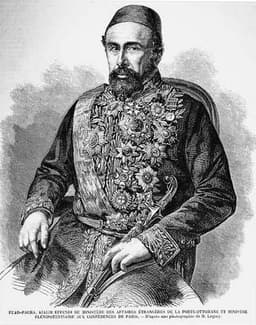
Fuad Pasha
Politician · Modern
60.0Total

Petro Poroshenko
Politician · Modern
46.2Total
Basic Information
Born
1814
1965
Died
1869
—
Era
Modern
Modern
Nationality
Ottoman Empire
Ukraine
Occupation
Politician
Politician
Civilization
Middle Eastern
Western
Score Comparison
Military (10%)
40.8
36.6
Political (20%)
78.0
45.0
Influence (20%)
60.0
54.1
Legacy (20%)
49.2
43.3
Leadership (15%)
85.0
40.0
Strategy (15%)
41.8
54.3
TOTAL
60.0
46.2
Fuad Pasha — Complete Timeline
1860 AD
Suppression of the 1860 Mount Lebanon ConflictPolitical Action◆ Major
As Foreign Minister, Fuad Pasha was sent to Lebanon in 1860 to restore order after sectarian violence between Maronites and Druze. He implemented a harsh crackdown, executing dozens of Druze leaders and imposing a new administrative structure that created the Mount Lebanon Mutasarrifate.
InterventionSectarian ConflictLebanon
Impact: regionaldestructive
1861 AD
Appointment as Grand VizierPolitical Action◆ Major
Fuad Pasha was appointed Grand Vizier for the first time in 1861. He had previously served as Foreign Minister and was a key architect of the Tanzimat reforms alongside Mehmed Emin Ali Pasha. His tenure focused on administrative centralization and legal modernization.
AppointmentTanzimatReform
Impact: nationalconstructive
1864 AD
Promotion of the Ottoman Law of VilayetsReform◆ Major
Fuad Pasha helped draft and implement the Ottoman Law of Vilayets in 1864, which reorganized provincial administration. The law created larger provinces (vilayets) with appointed governors and councils, aiming to improve governance and centralize control, though implementation was uneven.
ReformAdministrationTanzimat
Impact: nationalconstructive
1867 AD
Diplomatic Mission to EuropePolitical Action
Fuad Pasha traveled to Europe in 1867 to negotiate with European powers over Ottoman debts and reforms. He secured a loan from France and Britain and discussed the future of Crete and the Balkans, but failed to prevent increasing European intervention in Ottoman affairs.
DiplomacyDebtEuropean Relations
Impact: regional
1869 AD
Death in OfficePolitical Action
Fuad Pasha died in 1869 while serving as Grand Vizier. His death, along with that of Mehmed Emin Ali Pasha two years later, removed the leading Tanzimat reformers from power, contributing to the slowdown of reforms in the late Ottoman Empire.
DeathTanzimatOttoman Politics
Impact: national
Petro Poroshenko — Complete Timeline
2014 AD
War in Donbas and Minsk AgreementsWar◆ Major
Poroshenko led Ukraine during the war in Donbas against Russian-backed separatists. He signed the Minsk I and Minsk II ceasefire agreements, which ultimately failed to stop the conflict.
DonbasMinsk AgreementsCeasefire
Impact: regionaltragic
Elected President of UkrainePolitical Action◆ Major
Poroshenko won the Ukrainian presidential election in the first round with 54% of the vote, following the Euromaidan revolution and the ousting of Viktor Yanukovych. He took office in June 2014.
ElectionEuromaidanPresident
Impact: nationalconstructive
Signed EU-Ukraine Association AgreementPolitical Action◆ Major
Poroshenko signed the EU-Ukraine Association Agreement, which Yanukovych had rejected, deepening Ukraine's political and economic ties with the European Union.
EUAssociation AgreementIntegration
Impact: globalconstructive
2019 AD
Lost Re-election to Volodymyr ZelenskyyPolitical Action◆ Major
Poroshenko lost the 2019 Ukrainian presidential election in a landslide to Volodymyr Zelenskyy, receiving only 24% of the vote in the runoff. He conceded defeat.
ElectionDefeatTransition
Impact: national
2021 AD
Indicted for TreasonPolitical Action◆ Major
Poroshenko was indicted on charges of high treason and supporting terrorism, related to his alleged involvement in coal trade with separatists. He denied the charges, calling them politically motivated.
TreasonIndictmentPolitical Controversy
Impact: nationaldestructive
Expert Analysis
Origins
**Fuad Pasha** (1815-1869) was born into a modest Ottoman family in Constantinople. His father was a minor official. He received a traditional Islamic education but also studied French and European literature, becoming one of the first Ottoman statesmen fluent in Western languages. He entered the Translation Office of the Sublime Porte, a common path for reformers.
**Petro Poroshenko** (born 1965) was born in Bolhrad, Ukrainian SSR, to a wealthy family involved in the confectionery business. He studied international relations at Kyiv University and later earned a degree in law. He built a business empire in chocolate and other industries, becoming a billionaire oligarch before entering politics.
Rise to Power
Fuad Pasha rose through the diplomatic ranks, serving as ambassador to London and St. Petersburg. His appointment as Foreign Minister in 1852 marked his entry into high politics. He became Grand Vizier in 1861, a position he held multiple times. His rise was aided by his close relationship with Sultan Abdülaziz and his partnership with fellow reformer Mehmed Emin Ali Pasha.
Poroshenko entered politics in 1998 as a member of parliament. He served as Minister of Trade and Economic Development in 2012. His political ascent culminated in winning the presidency in 2014 with 54% of the vote, following the Euromaidan revolution. He positioned himself as a pro-European reformer and a strong leader against Russian aggression.
Leadership & Governance
Fuad Pasha was a key architect of the Tanzimat reforms, which aimed to modernize the Ottoman Empire through legal and administrative changes. He helped draft the 1856 Imperial Reform Edict, guaranteeing equality for all subjects. As Grand Vizier, he implemented the Law of Vilayets (1864), reorganizing provinces into larger units with appointed governors. His governance style was pragmatic and centralizing, seeking to strengthen the state against European pressure.
Poroshenko governed during a period of war and economic crisis. He signed the EU-Ukraine Association Agreement in 2014, deepening ties with Europe. He pursued decentralization reforms and sought NATO membership. However, his presidency was marked by slow progress on anti-corruption, and he faced criticism for oligarchic influence. His leadership score of 40.0 reflects these mixed results.
Triumph & Tragedy
Fuad Pasha's greatest success was suppressing the 1860 Mount Lebanon conflict, where he restored order after sectarian violence, arresting and executing 200 perpetrators. He also secured a European loan in 1867 to stabilize Ottoman finances. His failure was the inability to prevent the empire's continued decline; the Tanzimat reforms did not halt nationalist movements or territorial losses. He died in office in 1869, leaving reforms incomplete.
Poroshenko's triumph was securing the EU Association Agreement and maintaining Ukraine's sovereignty during the war in Donbas. He also oversaw the creation of a unified Ukrainian Orthodox Church. His tragedy was losing re-election in a landslide to Volodymyr Zelenskyy in 2019, receiving only 24% of the vote. Later, he was indicted for treason, damaging his legacy.
Character & Destiny
Fuad Pasha was known for his diplomatic skill, intelligence, and pragmatism. He was a reformer who believed in Western-style modernization but remained loyal to the Ottoman state. His character shaped his fate: he was able to navigate between the sultan, the bureaucracy, and European powers, but his death removed a key moderate voice, contributing to the end of the Tanzimat era.
Poroshenko is seen as a shrewd businessman and politician, but his oligarch background and perceived self-interest undermined his popularity. His leadership score of 40.0 reflects a lack of decisive action against corruption. His fate was sealed by voter fatigue and the rise of an outsider candidate.
Legacy
Fuad Pasha's legacy is the Tanzimat reforms, which laid groundwork for modern Turkish bureaucracy. The Law of Vilayets influenced administrative structures in the Middle East. He scored 49.2 in legacy, reflecting his role in shaping Ottoman modernization, though reforms were ultimately insufficient.
Poroshenko's legacy includes the EU Association Agreement and the strengthening of Ukrainian national identity. However, his failure to combat corruption and his indictment tarnish his record. His legacy score of 43.3 places him slightly below Fuad Pasha.
Conclusion
Fuad Pasha had a greater impact on history. His total score of 60.0, with leadership at 85.0 and political skill at 78.0, demonstrates his effectiveness as a reformer in a challenging imperial context. Poroshenko's lower scores (total 46.2) reflect his inability to overcome Ukraine's deep-rooted problems. While Poroshenko faced a more immediate existential threat, Fuad Pasha's structural reforms influenced generations. The data supports a clear conclusion: Fuad Pasha's contributions to state modernization outweigh Poroshenko's wartime leadership.
Rankings
🥇
Fuad PashaLeader
Mil: 40.8Pol: 78.0Inf: 60.0
60.0
🥈
Petro Poroshenko
Mil: 36.6Pol: 45.0Inf: 54.1
46.2
+13.8 behind
How This Comparison Works
Algorithm
Each figure is scored on 6 dimensions (0—100 scale) based on structured historical data: Military (10%), Political (20%), Influence (20%), Legacy (20%), Leadership (15%), Strategy (15%). The weighted total produces the final ranking.
Data Sources
Scores are computed from structured sub-indicators in the database. Scale factors adjust for era (Ancient ×0.85, Modern ×1.0) and civilization size (Eastern ×1.05, Other ×0.80) to account for differences in population and military scale.
Maximum 3 Figures
Comparisons are limited to 2—3 figures to ensure readability and statistical meaningfulness.
Error Margins
±5 points per dimension — Sub-scores are derived from historical records with inherent uncertainty. Two figures within 5 points on a dimension should be considered roughly equivalent in that area.
Total Score Accuracy
±3 points overall — The weighted combination of 6 dimensions produces a total score with approximately ±3 points of uncertainty. Differences of less than 3 points are not statistically significant— the figures are effectively tied.
Known Limitations
- Historical records are incomplete and uneven across civilizations
- Figures from oral-tradition societies may be underrepresented
- Occupation labels can misclassify multi-role figures
- Scores measure capability and impact, not moral character
- Quantitative scoring is a comparison tool, not absolute truth
Capability Radar
Military (10%) — Battles & Warfare
Battles
22
5
Win Rate
25
5
Expansion
27
5
Political (20%) — Governance & Reform
Reform
75
60
Diplomacy
70
65
Economy
55
55
Influence (20%) — Cultural & Global Reach
Cultural
40
30
Global
50
35
Legacy (20%) — Historical Impact
Historical
55
40
Longevity
40
20
Leadership (15%) — Power & Stability
Tenure
60
55
Stability
50
40
Strategy (15%) — Tactics & Innovation
Strategy
29
10
Tactics
35
5
Reform
38
30
Similar Comparisons
Comments & Discussion
No comments yet. Be the first to share your thoughts!