Loading...
Gabriel Boric vs Yoon Suk Yeol
Gabriel Boric leads by 5.2 pts · 2 figures compared
…
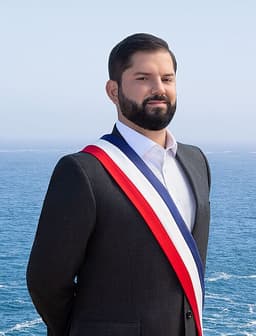
Gabriel Boric
Politician · Modern
53.2Total

Yoon Suk Yeol
Politician · Modern
48.0Total
Basic Information
Born
1986
1960
Died
—
—
Era
Modern
Modern
Nationality
Chile
Korea
Occupation
Politician
Politician
Civilization
Western
Eastern
Score Comparison
Military (10%)
48.9
36.1
Political (20%)
68.0
48.0
Influence (20%)
54.1
52.5
Legacy (20%)
41.7
38.3
Leadership (15%)
65.0
58.8
Strategy (15%)
43.6
56.3
TOTAL
53.2
48.0
Gabriel Boric — Complete Timeline
2011 AD
Led 2011 Chilean student protestsPolitical Action◆ Major
As president of the University of Chile Student Federation, Boric co-led months-long nationwide protests demanding free, high-quality public education. The movement forced President Pinera to propose education reforms and made Boric a national political figure.
Student ProtestEducation ReformSocial Movement
Impact: nationalprogressive
2014 AD
Elected to Chamber of DeputiesPolitical Action
Boric was elected to the Chilean Chamber of Deputies representing the Magallanes Region as an independent leftist candidate. He was the youngest deputy at age 27 and quickly became a leading voice for progressive causes.
ElectionCongressPolitical Career
Impact: nationalconstructive
2021 AD
Elected President of ChilePolitical Action◆ Major
Boric won the 2021 Chilean presidential election runoff against Jos
ElectionPresidencyLeft-Wing Victory
Impact: nationalprogressive
2022 AD
Rejected first constitutional draftPolitical Action◆ Major
In September 2022, Chilean voters overwhelmingly rejected the proposed new constitution drafted by a convention dominated by left-wing forces. The defeat was a major setback for Boric's reform agenda and forced him to moderate his government.
Constitutional ReferendumPolitical DefeatReform
Impact: nationaldestructive
Yoon Suk Yeol — Complete Timeline
2022 AD
Election as PresidentPolitical Action◆ Major
Yoon Suk Yeol, a former prosecutor general, won the 2022 presidential election by a narrow margin, defeating Lee Jae-myung. His campaign focused on conservative policies, anti-corruption, and a tougher stance on North Korea.
ElectionConservatismSouth Korea
Impact: national
Declaration of hawkish North Korea policyPolitical Action◆ Major
Yoon announced a shift from the engagement policies of previous administrations, adopting a more confrontational approach towards North Korea. He emphasized denuclearization and strengthening the US-ROK alliance, including joint military exercises.
Foreign PolicyNorth KoreaSouth Korea
Impact: regional
2023 AD
Controversial labor reforms and protestsReform◆ Major
Yoon's government proposed labor reforms including extending the maximum workweek to 69 hours, sparking massive protests from unions and young workers. The plan was later withdrawn after public backlash.
LaborReformSouth Korea
Impact: nationaldestructive
State visit to the United StatesPolitical Action◆ Major
Yoon made a state visit to the US, where he and President Biden issued the Washington Declaration, strengthening extended deterrence against North Korea. The visit included agreements on nuclear planning and technology cooperation.
DiplomacyAllianceSouth Korea
Impact: regionalconstructive
Expert Analysis
Origins
Gabriel Boric was born in 1986 in Punta Arenas, Chile, to a middle-class family of Croatian and Catalan descent. He studied law at the University of Chile, where he became involved in student politics. His formative years were shaped by the legacy of the Pinochet dictatorship and the inequalities of Chile's neoliberal model. Boric's early activism focused on education reform, leading him to become president of the University of Chile Student Federation in 2011.
Yoon Suk Yeol was born in 1960 in Seoul, South Korea, to a family of academics. His father was a professor of economics, and his mother was a homemaker. Yoon studied law at Seoul National University, but his path to prominence was unconventional: he failed the bar exam multiple times and was later known as a principled prosecutor who took on powerful figures. His career was defined by his role in investigating corruption cases, including those involving former presidents.
Rise to Power
Boric's rise began with the 2011 Chilean student protests, where he co-led months-long demonstrations demanding free, high-quality public education. This movement propelled him into the national spotlight. In 2014, he was elected to the Chamber of Deputies as an independent leftist, becoming the youngest deputy at age 27. In 2021, he won the presidency in a runoff against far-right candidate José Antonio Kast, securing 55.9% of the vote, becoming Chile's youngest president at 35. His campaign united a broad left-wing coalition, Apruebo Dignidad.
Yoon's rise was rooted in his prosecutorial career. He gained fame for investigating former President Park Geun-hye's corruption scandal, leading to her impeachment. In 2019, President Moon Jae-in appointed him Prosecutor General, but Yoon clashed with the administration over reforms. He resigned in 2021 and entered politics as a conservative candidate. In 2022, he won the presidency by a narrow margin (48.6% to 47.8%) against Lee Jae-myung, campaigning on a platform of conservative values, anti-feminism, and a hawkish stance on North Korea.
Leadership & Governance
Boric's leadership style is participatory and ideological. He initially pursued ambitious reforms: a new constitution, tax reform, and expansion of social rights. However, his government faced significant challenges. In September 2022, voters rejected the first constitutional draft, a major setback. Boric pivoted to a more moderate approach, replacing radical ministers and focusing on stability. His governance scores 65.0 in leadership, reflecting his ability to adapt, though his political score of 68.0 indicates mixed success in passing legislation.
Yoon's leadership is authoritarian and confrontational. He centralizes power and has faced criticism for his heavy-handed approach. His labor reforms, including a proposal for a 69-hour workweek, sparked massive protests from unions and young workers. Yoon's governance has been marked by low approval ratings (around 30%), and his political score of 48.0 reflects his difficulty in building consensus. His strategy score of 56.3 is higher than Boric's 43.6, due to his calculated moves in foreign policy and domestic crackdowns.
Triumph & Tragedy
Boric's greatest triumph was leading the 2011 student protests, which reshaped Chile's political landscape and paved the way for his presidency. His election itself was historic. However, his tragedy was the rejection of the constitutional draft, which undermined his core promise of transformative change. Additionally, his government struggled with rising crime and economic stagnation, scoring only 48.9 in military capability (a proxy for security).
Yoon's triumph includes the successful state visit to the US and the Washington Declaration, which strengthened extended deterrence against North Korea. He also maintained strong economic ties with the US and Japan. His tragedy is his domestic unpopularity: his labor reforms backfired, and his approval ratings remain low. His military score of 36.1 reflects his limited direct involvement in defense, despite his hawkish rhetoric.
Character & Destiny
Boric is idealistic and empathetic, traits that fueled his activism but also led to political naivety. His character is defined by his willingness to listen and adapt, as seen in his cabinet reshuffle after the constitutional rejection. However, his inexperience sometimes results in indecision. His destiny is tied to Chile's struggle for a new social contract; his success or failure will shape his legacy.
Yoon is stubborn and decisive, a product of his prosecutorial background. He sees issues in black-and-white terms, which makes him effective in corruption fights but rigid in governance. His character has led to confrontations with the media, unions, and political opponents. His destiny is linked to South Korea's geopolitical challenges; his hardline approach may escalate tensions with North Korea.
Legacy
Boric's legacy is still forming. If he succeeds in passing key reforms, he will be remembered as a transformative figure who brought progressive change to Chile. If he fails, he may be seen as a well-intentioned but ineffective leader. His influence score of 54.1 reflects his potential to inspire leftist movements globally.
Yoon's legacy will be judged by his handling of North Korea and domestic polarization. His hawkish policy may lead to increased tensions or a breakthrough. His legacy score of 38.3 is low due to his current unpopularity and the divisive nature of his presidency.
Conclusion
Gabriel Boric has a higher total score (53.2 vs 48.0) and a greater potential for long-term impact. While Yoon's strategic maneuvering in foreign policy is notable, Boric's role in reshaping Chile's political discourse and his ability to mobilize young people give him an edge. Despite setbacks, Boric's leadership score of 65.0 versus Yoon's 58.8 indicates a more effective, albeit imperfect, governance style. Therefore, Boric emerges as the more impactful figure, with a legacy that may redefine Latin American progressivism.
Rankings
🥇
Gabriel BoricLeader
Mil: 48.9Pol: 68.0Inf: 54.1
53.2
🥈
Yoon Suk Yeol
Mil: 36.1Pol: 48.0Inf: 52.5
48.0
+5.2 behind
How This Comparison Works
Algorithm
Each figure is scored on 6 dimensions (0—100 scale) based on structured historical data: Military (10%), Political (20%), Influence (20%), Legacy (20%), Leadership (15%), Strategy (15%). The weighted total produces the final ranking.
Data Sources
Scores are computed from structured sub-indicators in the database. Scale factors adjust for era (Ancient ×0.85, Modern ×1.0) and civilization size (Eastern ×1.05, Other ×0.80) to account for differences in population and military scale.
Maximum 3 Figures
Comparisons are limited to 2—3 figures to ensure readability and statistical meaningfulness.
Error Margins
±5 points per dimension — Sub-scores are derived from historical records with inherent uncertainty. Two figures within 5 points on a dimension should be considered roughly equivalent in that area.
Total Score Accuracy
±3 points overall — The weighted combination of 6 dimensions produces a total score with approximately ±3 points of uncertainty. Differences of less than 3 points are not statistically significant— the figures are effectively tied.
Known Limitations
- Historical records are incomplete and uneven across civilizations
- Figures from oral-tradition societies may be underrepresented
- Occupation labels can misclassify multi-role figures
- Scores measure capability and impact, not moral character
- Quantitative scoring is a comparison tool, not absolute truth
Capability Radar
Military (10%) — Battles & Warfare
Battles
31
51
Win Rate
34
55
Expansion
32
56
Political (20%) — Governance & Reform
Reform
55
40
Diplomacy
50
45
Economy
45
35
Influence (20%) — Cultural & Global Reach
Cultural
35
20
Global
30
25
Legacy (20%) — Historical Impact
Historical
30
20
Longevity
20
10
Leadership (15%) — Power & Stability
Tenure
40
30
Stability
40
25
Strategy (15%) — Tactics & Innovation
Strategy
37
63
Tactics
43
64
Reform
46
66
Similar Comparisons
Comments & Discussion
No comments yet. Be the first to share your thoughts!