Loading...
Galba vs Sennacherib
Sennacherib leads by 28.2 pts · 2 figures compared
…
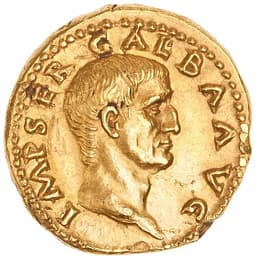
Galba
Emperor · Ancient
33.8Total

Sennacherib
Emperor · Ancient
62.0Total
Basic Information
Born
-3
-705
Died
69
-681
Era
Ancient
Ancient
Nationality
Roman Empire
Assyria
Occupation
Emperor
Emperor
Civilization
Western
Middle Eastern
Score Comparison
Military (10%)
22.6
85.0
Political (20%)
27.9
45.0
Influence (20%)
42.4
60.0
Legacy (20%)
35.0
54.0
Leadership (15%)
36.9
72.0
Strategy (15%)
25.0
75.0
TOTAL
33.8
62.0
Galba — Complete Timeline
68 AD
Proclamation as EmperorPolitical Action◆ Major
Galba was proclaimed emperor by the Roman Senate after the suicide of Nero. He was governor of Hispania Tarraconensis and had rebelled against Nero. His accession ended the Julio-Claudian dynasty and began the Year of the Four Emperors.
Year of the Four EmperorsNeroProclamation
Impact: national
69 AD
Assassination of GalbaPolitical Action◆ Major
Galba was murdered by Praetorian Guards in the Roman Forum after adopting Lucius Calpurnius Piso as his successor. His unpopularity and failure to pay the Praetorians led to his overthrow by Otho. This event triggered a series of civil wars.
AssassinationPraetorian GuardOtho
Impact: nationaltragic
Sennacherib — Complete Timeline
701 BC
Siege of JerusalemWar◆ Major
Sennacherib besieged Jerusalem after Hezekiah of Judah rebelled. The Assyrian army captured many Judean cities but failed to take Jerusalem. Hezekiah paid heavy tribute, and the siege was lifted, possibly due to disease or divine intervention as recorded in the Bible.
JerusalemSiegeHezekiah
Impact: regional
700 BC
Construction of the Southwest Palace at NinevehCultural◆ Major
Sennacherib built the 'Palace Without Rival' at Nineveh, a massive complex with extensive reliefs depicting his campaigns. The palace included advanced water systems and gardens, making Nineveh a grand capital of the Assyrian Empire.
ArchitectureNinevehPalace
Impact: regionalconstructive
689 BC
Sack of BabylonWar◆ Major
Sennacherib ordered the complete destruction of Babylon after a rebellion. The city was flooded, its temples razed, and the statue of Marduk removed. This act shocked the ancient Near East and was later blamed for Sennacherib's assassination.
BabylonDestructionRebellion
Impact: regionaldestructive
681 BC
Assassination of SennacheribPolitical Action◆ Major
Sennacherib was murdered by his sons Arda-Mulissu and Sharezer while praying in the temple of Nisroch. The assassination was likely motivated by his choice of Esarhaddon as heir over his older sons. Esarhaddon then seized the throne.
AssassinationSuccessionEsarhaddon
Impact: regionaltragic
Expert Analysis
Origins
Galba was born in 3 BC near Terracina, Italy, into an ancient patrician family. His full name was Servius Sulpicius Galba. He was raised by his stepmother Livia Ocellina after his father's death. Galba's early career followed the typical senatorial path, serving as praetor and then governor of Aquitania. He later governed Hispania Tarraconensis from 61 AD.
Sennacherib was born around 745 BC, likely in Nimrud or Nineveh, as the son of King Sargon II. He was educated in the royal court and trained in military and administrative skills. Unlike Galba, Sennacherib was groomed for kingship from youth, serving as a prince and overseeing building projects. He ascended to the throne in 705 BC after Sargon's death in battle.
Rise to Power
Galba's rise came amid chaos. In 68 AD, Nero's rule collapsed. Galba, then governor of Hispania, initially hesitated but was proclaimed emperor by his troops. The Senate quickly recognized him after Nero's suicide. His march on Rome was supported by key figures like Otho, who later turned against him. Galba's claim rested on his senatorial status and rebellion against Nero, but he lacked a strong power base.
Sennacherib's rise was smoother as legitimate heir. He became king upon Sargon II's death in 705 BC. His early reign focused on consolidating power and suppressing rebellions in the empire. His first major campaign in 703 BC crushed a revolt in Babylon, installing a puppet king. Sennacherib's authority was challenged by the Elamites and Babylonians, but he systematically reasserted Assyrian dominance.
Leadership & Governance
Galba's leadership was marked by austerity and strict discipline. He refused to pay the promised donative to the Praetorian Guard, earning their enmity. He also executed many of Nero's favorites and reversed Nero's policies. His governance was rigid and unpopular; he failed to build alliances. His adoption of Piso as successor alienated Otho, who then conspired with the Praetorians. Galba's political score of 27.9 reflects his inability to secure loyalty.
Sennacherib ruled with iron will but also administrative innovation. He moved the capital to Nineveh, transforming it into a grand city with advanced water systems and the "Palace Without Rival." He reorganized the army, emphasizing siege warfare and engineering. His military score of 85.0 reflects his campaigns, but his political score of 45.0 is lower due to internal strife, including his assassination by his sons. He was ruthless in suppressing rebellions, notably the destruction of Babylon in 689 BC.
Triumph & Tragedy
Galba's triumph was his swift elevation and initial acceptance. He ended Nero's tyranny and restored senatorial authority. However, his tragedy was his brief rule: he lasted only seven months. His failure to pay the Praetorians and his adoption of Piso led to his assassination on January 15, 69 AD. He was killed in the Forum, his head paraded on a pole. His legacy is a cautionary tale of poor political judgment.
Sennacherib's triumphs include the successful siege of Lachish and the submission of Jerusalem, though he failed to capture the city. His greatest achievement was the rebuilding of Nineveh, a marvel of ancient engineering. His tragedy was the destruction of Babylon, which alienated many subjects. His assassination by his sons, likely over succession disputes, ended his reign in 681 BC. Despite his military prowess, internal family conflict marred his legacy.
Character & Destiny
Galba was known for his severity and frugality. Ancient sources describe him as old-fashioned and stingy. His character made him unwilling to compromise, leading to isolation. His destiny was sealed by his inflexibility: he could have secured loyalty with a donative but chose not to. His assassination fulfilled the prophecy of his own warning: "I am but a temporary emperor." He scored 36.9 in leadership.
Sennacherib was proud and vengeful, but also a visionary builder. His destruction of Babylon was a calculated act of terror, but it also showed religious arrogance. He was energetic and meticulous, overseeing detailed reliefs of his campaigns. His character's flaw was perhaps his favoritism toward his son Esarhaddon, which may have spurred the assassination plot. His leadership score of 72.0 indicates a capable ruler undone by family intrigue.
Legacy
Galba's legacy is minimal. He is remembered as the first of the Four Emperors in 69 AD, a year of civil war. His failure set a precedent for military emperors. He has a total score of 33.8, reflecting his short reign and limited impact. No lasting institutions bear his name.
Sennacherib's legacy is substantial. He left a transformed Nineveh, with advanced irrigation and palaces. His military campaigns expanded Assyrian control. The destruction of Babylon influenced later Mesopotamian history. He is mentioned in the Bible for his siege of Jerusalem. His total score of 62.0 reflects a significant but not supreme impact. Assyrian power declined after his death, but his building projects endured.
Conclusion
Sennacherib had far greater impact than Galba. With a total score of 62.0 versus Galba's 33.8, Sennacherib excels in military (85.0 to 22.6), leadership (72.0 to 36.9), and legacy (54.0 to 35.0). Galba's reign was a footnote in Roman history, while Sennacherib's campaigns and building projects shaped the ancient Near East. Although both met violent ends, Sennacherib's achievements in empire-building and urban development outshine Galba's brief, failed rule. Sennacherib is the more consequential figure.
Rankings
🥇
SennacheribLeader
Mil: 85.0Pol: 45.0Inf: 60.0
62.0
🥈
Galba
Mil: 22.6Pol: 27.9Inf: 42.4
33.8
+28.2 behind
How This Comparison Works
Algorithm
Each figure is scored on 6 dimensions (0—100 scale) based on structured historical data: Military (10%), Political (20%), Influence (20%), Legacy (20%), Leadership (15%), Strategy (15%). The weighted total produces the final ranking.
Data Sources
Scores are computed from structured sub-indicators in the database. Scale factors adjust for era (Ancient ×0.85, Modern ×1.0) and civilization size (Eastern ×1.05, Other ×0.80) to account for differences in population and military scale.
Maximum 3 Figures
Comparisons are limited to 2—3 figures to ensure readability and statistical meaningfulness.
Error Margins
±5 points per dimension — Sub-scores are derived from historical records with inherent uncertainty. Two figures within 5 points on a dimension should be considered roughly equivalent in that area.
Total Score Accuracy
±3 points overall — The weighted combination of 6 dimensions produces a total score with approximately ±3 points of uncertainty. Differences of less than 3 points are not statistically significant— the figures are effectively tied.
Known Limitations
- Historical records are incomplete and uneven across civilizations
- Figures from oral-tradition societies may be underrepresented
- Occupation labels can misclassify multi-role figures
- Scores measure capability and impact, not moral character
- Quantitative scoring is a comparison tool, not absolute truth
Capability Radar
Military (10%) — Battles & Warfare
Battles
10
85
Win Rate
10
80
Expansion
5
80
Political (20%) — Governance & Reform
Reform
5
65
Diplomacy
10
60
Economy
5
70
Influence (20%) — Cultural & Global Reach
Cultural
5
60
Global
5
60
Legacy (20%) — Historical Impact
Historical
15
70
Longevity
5
65
Leadership (15%) — Power & Stability
Tenure
5
75
Stability
5
55
Strategy (15%) — Tactics & Innovation
Strategy
15
85
Tactics
15
90
Reform
5
70
Similar Comparisons
Comments & Discussion
No comments yet. Be the first to share your thoughts!