Loading...
Gamal Abdel Nasser vs Ton Duc Thang
Gamal Abdel Nasser leads by 14.7 pts · 2 figures compared
…
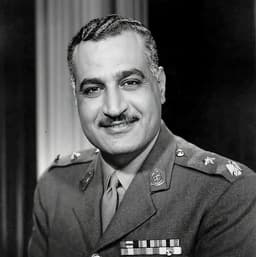
Gamal Abdel Nasser
Politician · Modern
66.1Total

Ton Duc Thang
Politician · Modern
51.4Total
Basic Information
Born
1918
1888
Died
1970
1980
Era
Modern
Modern
Nationality
Egypt
Vietnam
Occupation
Politician
Politician
Civilization
Middle Eastern
Eastern
Score Comparison
Military (10%)
50.0
33.2
Political (20%)
72.0
68.0
Influence (20%)
88.0
53.3
Legacy (20%)
52.0
45.0
Leadership (15%)
72.0
53.2
Strategy (15%)
45.0
52.8
TOTAL
66.1
51.4
Gamal Abdel Nasser — Complete Timeline
1952 AD
Led the 1952 Egyptian RevolutionPolitical Action◆ Major
Nasser was a key leader of the Free Officers Movement that overthrew King Farouk in the 1952 Egyptian Revolution. The coup ended the monarchy and British influence, establishing a republic. Nasser emerged as the dominant figure in the new government by 1954.
RevolutionRepublicEgypt
Impact: national
1956 AD
Nationalized the Suez CanalPolitical Action◆ Major
Nasser nationalized the Suez Canal Company, taking control of the vital waterway from British and French interests. This act triggered the Suez Crisis, where Israel, Britain, and France invaded Egypt. Nasser emerged politically strengthened after international pressure forced their withdrawal.
Suez CrisisNationalizationDecolonization
Impact: global
1958 AD
Formed the United Arab RepublicOther◆ Major
Nasser formed the United Arab Republic (UAR), a political union between Egypt and Syria. The union aimed to advance Arab nationalism and counter Western influence. It collapsed in 1961 when Syria seceded following a military coup, but Egypt retained the name until 1971.
Arab NationalismPolitical UnionMiddle East
Impact: regional
1961 AD
Implemented Land Reform and Arab SocialismPolitical Action◆ Major
Nasser implemented sweeping land reform laws and nationalized major industries, banks, and businesses. These socialist policies redistributed land from large landowners to peasants and expanded state control over the economy, fundamentally transforming Egyptian society.
Land ReformSocialismEconomic Policy
Impact: national
1967 AD
Suffered Defeat in the Six-Day WarWar◆ Major
Egypt under Nasser suffered a devastating military defeat in the Six-Day War against Israel. Israel captured the Sinai Peninsula, Gaza Strip, and other territories. Nasser offered to resign but remained in power after mass protests demanded he stay. The defeat severely damaged his prestige.
Six-Day WarMilitary DefeatArab-Israeli Conflict
Impact: globaldestructive
1969 AD
Launched the War of AttritionOther◆ Major
Nasser launched the War of Attrition against Israel along the Suez Canal. The conflict involved artillery exchanges, commando raids, and Soviet military support for Egypt. The war ended with a ceasefire in 1970, shortly before Nasser's death, without achieving Egyptian objectives.
War of AttritionArab-Israeli ConflictMilitary Strategy
Impact: regional
1970 AD
Accepted the Rogers Plan CeasefireOther◆ Major
Nasser accepted the US-sponsored Rogers Plan ceasefire to end the War of Attrition. This decision marked a shift toward diplomatic engagement with the United States and acceptance of UN Resolution 242, though it was controversial among hardliners in the Arab world.
CeasefireDiplomacyUS-Egypt Relations
Impact: national
Ton Duc Thang — Complete Timeline
1925 AD
Participated in Ba Son Shipyard StrikePolitical Action◆ Major
Ton Duc Thang participated in the Ba Son Shipyard strike in Saigon, a major labor action against French colonial rule. The strike demonstrated growing worker solidarity and influenced the development of the Vietnamese labor movement.
StrikeLabor MovementVietnam
Impact: nationalconstructive
1930 AD
Joined Indochinese Communist PartyPolitical Action◆ Major
Ton Duc Thang joined the Indochinese Communist Party shortly after its founding by Ho Chi Minh. He became a key figure in the party's southern operations, organizing resistance against French colonial authorities.
Communist PartyVietnamColonial Resistance
Impact: nationalconstructive
Imprisoned by French AuthoritiesPolitical Action◆ Major
Ton Duc Thang was arrested by French colonial authorities for his communist activities and sentenced to 20 years of hard labor. He was imprisoned on Poulo Condore island, where he endured harsh conditions and continued political organizing among prisoners.
ImprisonmentColonial RepressionVietnam
Impact: nationaltragic
1969 AD
Elected President of North VietnamPolitical Action◆ Major
Ton Duc Thang was elected President of North Vietnam on September 23, 1969, following the death of Ho Chi Minh. He served as a ceremonial head of state during the latter stages of the Vietnam War, symbolizing continuity of leadership.
PresidentNorth VietnamHo Chi Minh Succession
Impact: national
1976 AD
Became First President of Unified VietnamPolitical Action◆ Major
Ton Duc Thang became the first President of the unified Socialist Republic of Vietnam on July 2, 1976, after the formal reunification of North and South Vietnam. He held the position until his death in 1980, representing national unity.
PresidentReunificationVietnam
Impact: nationalconstructive
Expert Analysis
Origins
Gamal Abdel Nasser was born on January 15, 1918, in Alexandria, Egypt, to a postal clerk father and a mother who died when he was young. He attended the Royal Military Academy in Cairo, graduating in 1938, and was influenced by Egyptian nationalist movements. His early career in the army exposed him to the corruption of the monarchy and British occupation.
Ton Duc Thang was born on August 20, 1888, in Long Xuyen, southern Vietnam, into a peasant family. He learned French in school and became a mechanic, working at the Ba Son shipyard in Saigon. His exposure to labor movements and socialist ideas led him to participate in strikes against French colonial rule.
Rise to Power
Nasser rose to prominence as a key leader of the Free Officers Movement, which orchestrated the 1952 Egyptian Revolution. On July 23, 1952, the Free Officers overthrew King Farouk, ending the monarchy. Nasser emerged as the strongman behind the new regime, becoming Prime Minister in 1954 and President in 1956 after a power struggle with General Muhammad Naguib.
Ton Duc Thang joined the Indochinese Communist Party in 1930, becoming a leading figure in the southern branch. He was arrested by French authorities in 1930 for organizing the Ba Son strike and sentenced to 20 years of hard labor, spending time on Poulo Condore island. After his release in 1945, he continued his work with the Viet Minh, but remained in the shadow of Ho Chi Minh. He was elected President of North Vietnam in 1969 after Ho's death, and later became the first President of unified Vietnam in 1976.
Leadership & Governance
Nasser's leadership style was charismatic and authoritarian. He implemented a series of socialist reforms known as 'Arab Socialism,' including land reform in 1952 and 1961, and nationalization of major industries, banks, and the Suez Canal in 1956. He centralized power under his presidency, suppressing political opposition through the security apparatus. His governance emphasized pan-Arab unity, leading to the formation of the United Arab Republic with Syria from 1958 to 1961.
Ton Duc Thang, in contrast, served largely as a ceremonial figurehead. His political role was primarily symbolic, representing the continuity of the Communist Party after Ho Chi Minh. He presided over the reunification of Vietnam in 1976 but had limited influence on policy, which was controlled by party leaders like Le Duan. His governance style was more collaborative within the party framework, reflecting the collective leadership of Vietnamese communism.
Triumph & Tragedy
Nasser's greatest triumph was the nationalization of the Suez Canal in 1956, which boosted his popularity across the Arab world and forced British and French withdrawal. He also successfully implemented land reform that redistributed land to peasants. However, his tragic failure was the 1967 Six-Day War, where Egypt lost the Sinai Peninsula and Gaza to Israel, dealing a severe blow to his regime and Arab nationalism. The war also led to economic stagnation and increased dependence on Soviet aid.
Ton Duc Thang's triumph was his role in the unification of Vietnam, achieving a long-sought goal of Vietnamese communists. He became the first president of a united Vietnam. However, his tragedy was the lack of personal power and the overshadowing by Ho Chi Minh. He was imprisoned for 15 years by the French, and his later years saw the hardships of post-war reconstruction under a repressive regime.
Character & Destiny
Nasser was a decisive and ambitious leader, driven by a vision of Arab unity and anti-imperialism. His charisma and oratory skills mobilized millions, but his authoritarian tendencies and strategic overreach led to military defeat. Historians note his ability to inspire but also his isolation of Egypt internationally after the Six-Day War. His total score of 66.1 reflects strong political and influence scores (72.0 and 88.0) but low military (50.0) and strategy (45.0).
Ton Duc Thang was a loyal party man, patient and persistent. He endured imprisonment and remained committed to the communist cause. His destiny was to be a symbol rather than a decision-maker. His total score of 51.4 is lower across the board, with his political score (68.0) being his highest. He lacked Nasser's individual impact but contributed to the collective leadership of Vietnam.
Legacy
Nasser's legacy is mixed but enduring. He reshaped Egypt's political landscape, established the republic, and inspired Arab nationalism across the Middle East. The Suez Canal nationalization remains a symbol of anti-colonial resistance. However, his socialist policies led to economic inefficiencies, and his military defeat tarnished his reputation. His influence score of 88.0 is the highest among the two figures, reflecting his global impact.
Ton Duc Thang's legacy is primarily as a symbol of Vietnamese communism. He is remembered as a loyal follower of Ho Chi Minh and a representative of southern communist struggle. His presidency marked the formal reunification, but his personal impact on policy was minimal. He scored lower in influence (53.3) and legacy (45.0), indicating a more limited long-term effect.
Conclusion
Gamal Abdel Nasser had a greater impact than Ton Duc Thang, as evidenced by his higher total score of 66.1 versus 51.4. Nasser's actions altered the geopolitical landscape of the Middle East, challenged colonial powers, and inspired a generation of Arab nationalists. While Ton Duc Thang's role in Vietnamese unification was important, he was a figurehead in a collective leadership. Nasser's individual agency and transformative policies give him a clear edge in historical significance.
Rankings
🥇
Gamal Abdel NasserLeader
Mil: 50.0Pol: 72.0Inf: 88.0
66.1
🥈
Ton Duc Thang
Mil: 33.2Pol: 68.0Inf: 53.3
51.4
+14.7 behind
How This Comparison Works
Algorithm
Each figure is scored on 6 dimensions (0—100 scale) based on structured historical data: Military (10%), Political (20%), Influence (20%), Legacy (20%), Leadership (15%), Strategy (15%). The weighted total produces the final ranking.
Data Sources
Scores are computed from structured sub-indicators in the database. Scale factors adjust for era (Ancient ×0.85, Modern ×1.0) and civilization size (Eastern ×1.05, Other ×0.80) to account for differences in population and military scale.
Maximum 3 Figures
Comparisons are limited to 2—3 figures to ensure readability and statistical meaningfulness.
Error Margins
±5 points per dimension — Sub-scores are derived from historical records with inherent uncertainty. Two figures within 5 points on a dimension should be considered roughly equivalent in that area.
Total Score Accuracy
±3 points overall — The weighted combination of 6 dimensions produces a total score with approximately ±3 points of uncertainty. Differences of less than 3 points are not statistically significant— the figures are effectively tied.
Known Limitations
- Historical records are incomplete and uneven across civilizations
- Figures from oral-tradition societies may be underrepresented
- Occupation labels can misclassify multi-role figures
- Scores measure capability and impact, not moral character
- Quantitative scoring is a comparison tool, not absolute truth
Capability Radar
Military (10%) — Battles & Warfare
Battles
30
5
Win Rate
25
5
Expansion
20
5
Political (20%) — Governance & Reform
Reform
75
40
Diplomacy
65
50
Economy
50
30
Influence (20%) — Cultural & Global Reach
Cultural
70
30
Global
65
30
Legacy (20%) — Historical Impact
Historical
70
40
Longevity
55
30
Leadership (15%) — Power & Stability
Tenure
70
60
Stability
40
40
Strategy (15%) — Tactics & Innovation
Strategy
40
5
Tactics
35
5
Reform
60
5
Similar Comparisons
Comments & Discussion
No comments yet. Be the first to share your thoughts!