Loading...
Gamini Dissanayake vs Ioannis Kapodistrias
Ioannis Kapodistrias leads by 4.4 pts · 2 figures compared
…

Gamini Dissanayake
Politician · Modern
49.1Total
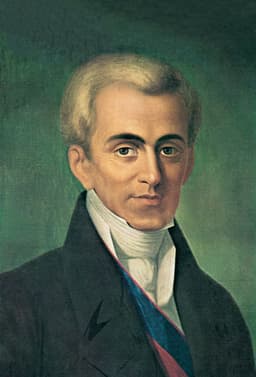
Ioannis Kapodistrias
Politician · Modern
53.5Total
Basic Information
Born
1942
1776
Died
—
1831
Era
Modern
Modern
Nationality
Sri Lanka
Greece
Occupation
Politician
Politician
Civilization
Indian
Western
Score Comparison
Military (10%)
52.6
41.6
Political (20%)
46.6
65.0
Influence (20%)
50.2
55.0
Legacy (20%)
40.0
58.0
Leadership (15%)
55.3
40.0
Strategy (15%)
60.0
53.8
TOTAL
49.1
53.5
Gamini Dissanayake — Complete Timeline
1977 AD
Served as Minister of AgriculturePolitical Action
Dissanayake was appointed Minister of Agriculture in the UNP government under President Jayewardene. He implemented agricultural modernization programs, including irrigation projects and the promotion of high-yield crops, contributing to Sri Lanka's Green Revolution.
Minister of AgricultureGreen RevolutionIrrigation
Impact: nationalconstructive
1994 AD
Killed by an LTTE Suicide BombWar◆ Major
Dissanayake was assassinated by an LTTE suicide bomber during an election rally in Colombo. The bomb killed him and over 50 others. His death occurred just weeks before the presidential election, which was subsequently won by Chandrika Kumaratunga.
AssassinationLTTEElection Rally
Impact: nationaltragic
Appointed as UNP Presidential CandidatePolitical Action◆ Major
Dissanayake was selected as the presidential candidate for the United National Party (UNP) in the 1994 presidential election. He was a prominent UNP politician and had served as a minister under Presidents Jayewardene and Premadasa.
Presidential CandidateUNPElection
Impact: national
Ioannis Kapodistrias — Complete Timeline
1827 AD
Elected First Governor of GreecePolitical Action◆ Major
The Third National Assembly at Troezen elected Kapodistrias as Governor of Greece for a seven-year term. He arrived in Greece in January 1828 to lead the newly independent state, which was still fighting the Ottoman Empire for full independence.
IndependenceGovernorshipState Building
Impact: nationalconstructive
1828 AD
Established the Hellenic StateReform◆ Major
Kapodistrias organized the first administrative system of independent Greece, creating ministries, a national bank, and a postal service. He also established the Philekpaideutiki Etaireia (Educational Society) to promote education and founded the first orphanage.
AdministrationEducationState Building
Impact: nationalconstructive
1830 AD
Negotiated the London ProtocolPolitical Action◆ Major
Kapodistrias secured the London Protocol of 1830, which recognized Greece as an independent sovereign state under the protection of Great Britain, France, and Russia. This diplomatic achievement ended the Greek War of Independence and established Greece's borders.
DiplomacyIndependenceTreaty
Impact: regionalconstructive
1831 AD
Assassination of KapodistriasPolitical Action◆ Major
Kapodistrias was assassinated on the steps of the Church of Saint Spyridon in Nafplio by members of the Mavromichalis family, a powerful Maniot clan. His death plunged Greece into a period of civil war and instability, leading to the imposition of a monarchy.
AssassinationPolitical CrisisCivil War
Impact: nationaltragic
Expert Analysis
Origins
Gamini Dissanayake was born in 1942 in Kandy, Sri Lanka, into a politically active family. His father was a member of the State Council. He studied at St. Anthony's College, Kandy, and later at the University of Ceylon, where he earned a degree in economics. He entered politics early, joining the United National Party (UNP) and winning a parliamentary seat in 1970.
Ioannis Kapodistrias was born in 1776 in Corfu, then under Venetian rule. His family was noble, with his father serving as a count. He studied medicine and philosophy in Padua, Italy, and later entered diplomacy. He served as Russia's foreign minister from 1815 to 1822, playing a key role in European diplomacy after the Napoleonic Wars.
Rise to Power
Dissanayake rose within the UNP, becoming a close ally of President J.R. Jayewardene. He was appointed Minister of Agriculture in 1977, implementing modernization programs. He later served as Minister of Highways and Minister of Plantation Industries. His key turning point came in 1994 when he was selected as the UNP presidential candidate, facing Chandrika Kumaratunga. The election was scheduled for November 9, 1994.
Kapodistrias gained prominence as a diplomat. He represented the Ionian Republic and later served Russia. His influence grew during the Congress of Vienna (1814-1815). In 1827, the Third National Assembly at Troezen elected him as the first Governor of Greece for a seven-year term. He arrived in Greece in January 1828 to lead the nascent state.
Leadership & Governance
Dissanayake was a pragmatic politician, known for his organizational skills. As Minister of Agriculture, he introduced new irrigation schemes and agricultural subsidies. He scored 55.3 in leadership, reflecting his ability to manage party machinery. However, his governance was limited by his short tenure; he never held executive power beyond ministerial posts.
Kapodistrias faced the monumental task of building a state from scratch. He established ministries, a national bank, a postal service, and an army. He scored 65.0 in political skill, higher than Dissanayake's 46.6. His approach was authoritarian, centralizing power and suppressing local factions, which created enemies. He implemented land reforms and education systems, but his heavy-handed style alienated many.
Triumph & Tragedy
Dissanayake's greatest success was his political ascent within the UNP, becoming its presidential candidate. He had a strong grassroots network. His tragedy was his assassination on October 24, 1994, by an LTTE suicide bomber during an election rally in Colombo. The blast killed him and over 50 others, effectively ending his political career and altering Sri Lanka's political landscape.
Kapodistrias's triumph was securing the London Protocol of 1830, which recognized Greece as an independent sovereign state under the protection of Great Britain, France, and Russia. He also established the Hellenic State's administrative framework. His tragedy was his assassination on October 9, 1831, in Nafplio by members of the Mavromichalis family, a powerful Maniot clan. His death plunged Greece into civil strife.
Character & Destiny
Dissanayake was described as affable and approachable, with a talent for compromise. His political score of 46.6 reflects his inability to win the presidency, though his death was beyond his control. His destiny was cut short by violence, a common fate in Sri Lanka's civil war.
Kapodistrias was austere, principled, and uncompromising. His leadership score of 40.0 is low, indicating his inability to build consensus. His authoritarian style led to his assassination. He scored 53.8 in strategy, showing his diplomatic acumen but lack of internal political maneuvering.
Legacy
Dissanayake's legacy is limited. He is remembered as a UNP stalwart whose death removed a moderate voice. His influence score of 50.2 is modest. The UNP declined after his death, and the LTTE continued its war until 2009. His agricultural reforms had some lasting impact.
Kapodistrias's legacy is foundational. He is considered the father of the modern Greek state. His administrative structures survived, and his diplomatic work secured Greek independence. He scored 58.0 in legacy, significantly higher than Dissanayake's 40.0. The Hellenic State he built evolved into modern Greece.
Conclusion
Ioannis Kapodistrias had a greater impact. His total score of 53.5 exceeds Dissanayake's 49.1 by 4.4 points. Kapodistrias's political and legacy scores are higher, reflecting his role in founding a nation. Dissanayake was a promising politician whose potential was unfulfilled. Kapodistrias, despite his flaws, created enduring institutions. Thus, Kapodistrias stands as the more significant historical figure.
Rankings
🥇
Ioannis KapodistriasLeader
Mil: 41.6Pol: 65.0Inf: 55.0
53.5
🥈
Gamini Dissanayake
Mil: 52.6Pol: 46.6Inf: 50.2
49.1
+4.4 behind
How This Comparison Works
Algorithm
Each figure is scored on 6 dimensions (0—100 scale) based on structured historical data: Military (10%), Political (20%), Influence (20%), Legacy (20%), Leadership (15%), Strategy (15%). The weighted total produces the final ranking.
Data Sources
Scores are computed from structured sub-indicators in the database. Scale factors adjust for era (Ancient ×0.85, Modern ×1.0) and civilization size (Eastern ×1.05, Other ×0.80) to account for differences in population and military scale.
Maximum 3 Figures
Comparisons are limited to 2—3 figures to ensure readability and statistical meaningfulness.
Error Margins
±5 points per dimension — Sub-scores are derived from historical records with inherent uncertainty. Two figures within 5 points on a dimension should be considered roughly equivalent in that area.
Total Score Accuracy
±3 points overall — The weighted combination of 6 dimensions produces a total score with approximately ±3 points of uncertainty. Differences of less than 3 points are not statistically significant— the figures are effectively tied.
Known Limitations
- Historical records are incomplete and uneven across civilizations
- Figures from oral-tradition societies may be underrepresented
- Occupation labels can misclassify multi-role figures
- Scores measure capability and impact, not moral character
- Quantitative scoring is a comparison tool, not absolute truth
Capability Radar
Military (10%) — Battles & Warfare
Battles
44
10
Win Rate
44
10
Expansion
48
10
Political (20%) — Governance & Reform
Reform
40
70
Diplomacy
40
75
Economy
35
60
Influence (20%) — Cultural & Global Reach
Cultural
20
55
Global
20
50
Legacy (20%) — Historical Impact
Historical
25
65
Longevity
15
60
Leadership (15%) — Power & Stability
Tenure
30
55
Stability
20
40
Strategy (15%) — Tactics & Innovation
Strategy
54
10
Tactics
54
10
Reform
59
15
Similar Comparisons
Comments & Discussion
No comments yet. Be the first to share your thoughts!