Loading...
This comparison has not been analyzed yet.
One-time AI generation (~1 minute). Scores and timeline are already available below.
Gan Ning vs Orontobates
Gan Ning leads by 8.3 pts · 2 figures compared
…

Gan Ning
General · Ancient
47.5Total
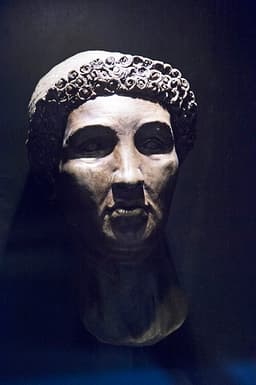
Orontobates
General · Ancient
39.2Total
Basic Information
Born
175
-350
Died
220
-330
Era
Ancient
Ancient
Nationality
China
Caria
Occupation
General
General
Civilization
Eastern
Middle Eastern
Score Comparison
Military (10%)
52.5
40.0
Political (20%)
35.0
35.0
Influence (20%)
49.4
47.1
Legacy (20%)
42.5
37.5
Leadership (15%)
57.1
30.0
Strategy (15%)
55.0
43.3
TOTAL
47.5
39.2
Gan Ning — Complete Timeline
208 AD
Raid on YilingWar
Gan Ning led a small force to capture Yiling from Cao Cao's forces. He held the city against a counterattack, demonstrating his tactical skill and bravery.
Three KingdomsRaidYiling
Impact: regional
Battle of Red CliffsWar◆ Major
Gan Ning served as a commander under Zhou Yu at Red Cliffs. He led a detachment in the fire attack, contributing to the defeat of Cao Cao's fleet.
Three KingdomsBattleRed Cliffs
Impact: global
213 AD
Raid on Cao Cao's Supply LinesWar◆ Major
Gan宁 led a night raid on Cao Cao's supply depot at Ruxu, capturing supplies and causing chaos. The raid forced Cao Cao to withdraw temporarily.
Three KingdomsRaidSupply Lines
Impact: regional
Orontobates — Complete Timeline
335 BC
Became satrap of CariaPolitical Action◆ Major
After the death of Pixodarus, Orontobates, a Persian noble and son-in-law of Pixodarus, became the satrap of Caria. He was appointed by the Achaemenid king Darius III to govern the region, continuing Persian control.
SatrapPersian Empire
Impact: regional
334 BC
Defended Halicarnassus against Alexander the GreatWar
Orontobates commanded the Persian defense of Halicarnassus during Alexander the Great's siege. Despite fierce resistance, the city fell after a prolonged assault. Orontobates escaped with his forces, but the loss was a major setback for the Persian Empire.
SiegeAlexander the GreatPersian Empire
Impact: regionaltragic
333 BC
Continued resistance in CariaWar
After the fall of Halicarnassus, Orontobates retreated to the citadel of Salmacis and continued to resist Alexander's forces. He held out for several months, but eventually surrendered or was defeated, ending Persian control in Caria.
ResistanceAlexander the Great
Impact: regionaltragic
330 BC
Death or disappearanceOther
Orontobates' fate after the fall of Caria is uncertain. He may have been killed in battle, executed by Alexander, or fled to the east. His disappearance marked the end of Persian satrapal rule in Caria.
DeathUncertain
This comparison has not been analyzed yet.
One-time AI generation (~1 minute). Scores and timeline are already available below.
Rankings
🥇
Gan NingLeader
Mil: 52.5Pol: 35.0Inf: 49.4
47.5
🥈
Orontobates
Mil: 40.0Pol: 35.0Inf: 47.1
39.2
+8.3 behind
How This Comparison Works
Algorithm
Each figure is scored on 6 dimensions (0—100 scale) based on structured historical data: Military (10%), Political (20%), Influence (20%), Legacy (20%), Leadership (15%), Strategy (15%). The weighted total produces the final ranking.
Data Sources
Scores are computed from structured sub-indicators in the database. Scale factors adjust for era (Ancient ×0.85, Modern ×1.0) and civilization size (Eastern ×1.05, Other ×0.80) to account for differences in population and military scale.
Maximum 3 Figures
Comparisons are limited to 2—3 figures to ensure readability and statistical meaningfulness.
Error Margins
±5 points per dimension — Sub-scores are derived from historical records with inherent uncertainty. Two figures within 5 points on a dimension should be considered roughly equivalent in that area.
Total Score Accuracy
±3 points overall — The weighted combination of 6 dimensions produces a total score with approximately ±3 points of uncertainty. Differences of less than 3 points are not statistically significant— the figures are effectively tied.
Known Limitations
- Historical records are incomplete and uneven across civilizations
- Figures from oral-tradition societies may be underrepresented
- Occupation labels can misclassify multi-role figures
- Scores measure capability and impact, not moral character
- Quantitative scoring is a comparison tool, not absolute truth
Capability Radar
Military (10%) — Battles & Warfare
Battles
45
30
Win Rate
50
20
Expansion
20
10
Political (20%) — Governance & Reform
Reform
5
15
Diplomacy
25
25
Economy
10
20
Influence (20%) — Cultural & Global Reach
Cultural
30
10
Global
15
10
Legacy (20%) — Historical Impact
Historical
35
15
Longevity
30
10
Leadership (15%) — Power & Stability
Tenure
20
40
Stability
15
20
Strategy (15%) — Tactics & Innovation
Strategy
40
30
Tactics
70
35
Reform
10
10
Similar Comparisons
Comments & Discussion
No comments yet. Be the first to share your thoughts!