Loading...
George I of Great Britain vs Gustaf V of Sweden
George I of Great Britain leads by 2.8 pts · 2 figures compared
…
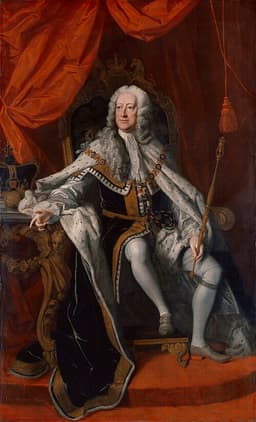
George I of Great Britain
Emperor · Modern
52.2Total

Gustaf V of Sweden
Emperor · Modern
49.4Total
Basic Information
Born
1660
1858
Died
1727
1950
Era
Modern
Modern
Nationality
United Kingdom
Sweden
Occupation
Emperor
Emperor
Civilization
Western
Western
Score Comparison
Military (10%)
21.2
16.6
Political (20%)
68.0
43.7
Influence (20%)
53.3
50.2
Legacy (20%)
45.0
43.3
Leadership (15%)
72.0
79.8
Strategy (15%)
45.0
58.7
TOTAL
52.2
49.4
George I of Great Britain — Complete Timeline
1714 AD
Accession to the British ThronePolitical Action◆ Major
George I became king of Great Britain and Ireland following the death of Queen Anne. He was the first Hanoverian monarch, succeeding under the Act of Settlement 1701. His accession established the House of Hanover on the British throne.
AccessionHanoverian DynastySuccession
Impact: national
1715 AD
Jacobite Rising of 1715War◆ Major
George I faced a Jacobite rebellion aimed at restoring the Stuart claimant James Francis Edward Stuart. The rebellion was suppressed by government forces at the Battle of Preston and the Battle of Sheriffmuir. This defeat secured George's throne.
Jacobite RebellionCivil WarStuart Claimant
Impact: national
1717 AD
Development of Cabinet GovernmentPolitical Action
George I ceased attending Cabinet meetings due to his limited English and lack of interest. This led to the development of the cabinet system under a chief minister, Sir Robert Walpole, who became the first de facto Prime Minister. This shift strengthened parliamentary governance.
Cabinet GovernmentPrime MinisterConstitutional Evolution
Impact: nationalconstructive
1727 AD
Death in HanoverOther
George I died of a stroke while traveling to Hanover. He was buried in the Leineschloss church in Hanover. His death passed the throne to his son George II. His reign established the Hanoverian dynasty in Britain.
DeathHanoverSuccession
Impact: national
Gustaf V of Sweden — Complete Timeline
1907 AD
Accession to the ThronePolitical Action◆ Major
Gustaf V became King of Sweden upon the death of his father, King Oscar II. His reign spanned both World Wars, during which Sweden maintained neutrality. Gustaf V's long reign saw the transition from an absolute monarchy to a constitutional one, with the king retaining significant influence in foreign affairs.
AccessionMonarchySweden
Impact: national
1914 AD
Swedish Neutrality in World War IPolitical Action◆ Major
Gustaf V maintained Sweden's neutrality during World War I, despite pressure from both the Allied and Central Powers. He supported the government's policy of non-alignment, which preserved Swedish sovereignty and avoided devastation. This decision shaped Sweden's long-term foreign policy of neutrality.
NeutralityWorld War IForeign Policy
Impact: nationalconstructive
1920 AD
Tennis Patronage and the Swedish Tennis BoomCultural
Gustaf V, an avid tennis player, competed in tournaments under the pseudonym 'Mr. G.' His passion for the sport helped popularize tennis in Sweden, leading to a national tennis boom. He supported the development of tennis facilities and encouraged young players, contributing to Sweden's later success in the sport.
TennisSports PatronageCultural Impact
Impact: nationalconstructive
1939 AD
Swedish Neutrality in World War IIPolitical Action◆ Major
Gustaf V again upheld Sweden's neutrality during World War II, though he faced criticism for allowing German troop transit through Sweden. His personal diplomacy with Nazi leaders, including Hitler, aimed to keep Sweden out of the war. This policy remains debated among historians.
NeutralityWorld War IIDiplomacy
Impact: national
Expert Analysis
Origins
George I (1660-1727) was born in Hanover, Germany, as the son of Ernest Augustus, Elector of Hanover, and Sophia of the Palatinate. He inherited the Electorate in 1698 and later the British throne through the Act of Settlement 1701, which excluded Catholic Stuarts. His upbringing in a German princely court emphasized dynastic politics over language skills—he never mastered English.
Gustaf V (1858-1950) was born at Drottningholm Palace as the eldest son of King Oscar II of Sweden and Sophia of Nassau. He received a traditional military education and served in the Swedish army. Unlike George, Gustaf was raised in a constitutional monarchy where the king's role was increasingly ceremonial. His early exposure to diplomacy and sports (especially tennis) shaped his long reign.
Rise to Power
George I became King of Great Britain and Ireland on August 1, 1714, following Queen Anne's death. His accession was smooth legally but faced immediate challenges: the Jacobite Rising of 1715 sought to restore James Francis Edward Stuart. George's forces suppressed the rebellion at the Battle of Preston and Sheriffmuir. He relied on the Whig Party, particularly Robert Walpole, to manage Parliament.
Gustaf V ascended the throne on December 8, 1907, after his father's death. His reign began in a period of political stability, but tensions were rising in Europe. He had limited constitutional power but used his personal influence to support neutrality policies. During World War I, he convened the 'King's Peace' meeting in 1914 to calm political conflicts between the government and opposition.
Leadership & Governance
George I's leadership was marked by his absence from cabinet meetings after 1717 due to language barriers and disinterest. This inadvertently strengthened the cabinet system under a prime minister (Robert Walpole from 1721). George scored 72.0 in leadership but only 45.0 in strategy, reflecting his passive governance. He focused on Hanoverian interests, embroiling Britain in the War of the Quadruple Alliance (1718-1720) for Hanoverian gains.
Gustaf V scored 79.8 in leadership, higher than George, but only 43.7 in political skill. He maintained Sweden's neutrality in both world wars, a strategic choice given Sweden's limited military strength (military score 16.6). He allowed German troop transit during WWII, a controversial decision that preserved peace but drew criticism. His tennis patronage boosted Sweden's sports profile, but his political influence was mostly symbolic.
Triumph & Tragedy
George I's greatest triumph was consolidating the Hanoverian succession and defeating the Jacobite threat. His greatest failure was his inability to engage with British politics, leading to the South Sea Bubble crisis (1720) which damaged public trust. He died in Hanover in 1727, leaving a legacy of constitutional evolution.
Gustaf V's triumph was steering Sweden through two world wars without conflict, maintaining sovereignty and economic stability. His tragedy was the perception of being too accommodating to Nazi Germany, especially after the war. His personal life also suffered: his marriage to Victoria of Baden was strained, and his son Gustaf VI Adolf took over many duties.
Character & Destiny
George I was reserved, stubborn, and focused on Hanover. His lack of English and interest in British affairs shaped the destiny of British governance toward cabinet rule. Historians view him as a placeholder king who inadvertently modernized the monarchy.
Gustaf V was dignified, diplomatic, and passionate about tennis (competing as 'Mr. G.' in the Wimbledon Championships). His character suited Sweden's need for a stabilizing figurehead. He remained neutral even when pressured, reflecting a cautious but steady personality.
Legacy
George I's legacy is the development of the cabinet system and the prime minister role. He scored 53.3 in influence and 45.0 in legacy. His reign set the stage for Britain's 18th-century parliamentary monarchy.
Gustaf V's legacy is Sweden's neutrality and the popularization of tennis. He scored 50.2 in influence and 43.3 in legacy. His long reign (43 years) saw Sweden transform from an agrarian to an industrial society, but his direct impact was limited.
Conclusion
George I had a greater impact on political structures, despite his lower leadership score (72.0 vs 79.8). His neglect created the cabinet system, a cornerstone of modern British governance. Gustaf V's neutrality preserved Sweden but left no systemic change. Thus, George I's total score of 52.2 reflects a more consequential reign than Gustaf V's 49.4.
Rankings
🥇
George I of Great BritainLeader
Mil: 21.2Pol: 68.0Inf: 53.3
52.2
🥈
Gustaf V of Sweden
Mil: 16.6Pol: 43.7Inf: 50.2
49.4
+2.8 behind
How This Comparison Works
Algorithm
Each figure is scored on 6 dimensions (0—100 scale) based on structured historical data: Military (10%), Political (20%), Influence (20%), Legacy (20%), Leadership (15%), Strategy (15%). The weighted total produces the final ranking.
Data Sources
Scores are computed from structured sub-indicators in the database. Scale factors adjust for era (Ancient ×0.85, Modern ×1.0) and civilization size (Eastern ×1.05, Other ×0.80) to account for differences in population and military scale.
Maximum 3 Figures
Comparisons are limited to 2—3 figures to ensure readability and statistical meaningfulness.
Error Margins
±5 points per dimension — Sub-scores are derived from historical records with inherent uncertainty. Two figures within 5 points on a dimension should be considered roughly equivalent in that area.
Total Score Accuracy
±3 points overall — The weighted combination of 6 dimensions produces a total score with approximately ±3 points of uncertainty. Differences of less than 3 points are not statistically significant— the figures are effectively tied.
Known Limitations
- Historical records are incomplete and uneven across civilizations
- Figures from oral-tradition societies may be underrepresented
- Occupation labels can misclassify multi-role figures
- Scores measure capability and impact, not moral character
- Quantitative scoring is a comparison tool, not absolute truth
Capability Radar
Military (10%) — Battles & Warfare
Battles
10
35
Win Rate
10
41
Expansion
10
42
Political (20%) — Governance & Reform
Reform
40
20
Diplomacy
50
40
Economy
40
30
Influence (20%) — Cultural & Global Reach
Cultural
20
20
Global
30
20
Legacy (20%) — Historical Impact
Historical
40
30
Longevity
30
40
Leadership (15%) — Power & Stability
Tenure
60
60
Stability
50
70
Strategy (15%) — Tactics & Innovation
Strategy
10
47
Tactics
10
45
Reform
10
50
Similar Comparisons
Comments & Discussion
No comments yet. Be the first to share your thoughts!