Loading...
George Marshall vs Kato Kiyomasa
George Marshall leads by 15.7 pts · 2 figures compared
…
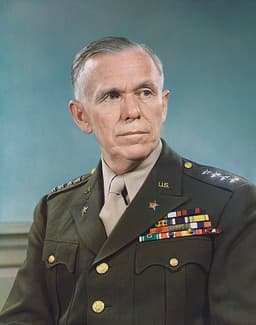
George Marshall
General · Modern
70.0Total

Kato Kiyomasa
General · Modern
54.3Total
Basic Information
Born
1880
1562
Died
1959
1611
Era
Modern
Modern
Nationality
United States
Japan
Occupation
General
General
Civilization
Western
Eastern
Score Comparison
Military (10%)
47.5
61.7
Political (20%)
86.0
39.4
Influence (20%)
65.0
61.0
Legacy (20%)
70.0
47.5
Leadership (15%)
78.0
62.0
Strategy (15%)
69.1
57.5
TOTAL
70.0
54.3
George Marshall — Complete Timeline
1939 AD
Appointed US Army Chief of StaffPolitical Action◆ Major
Marshall was appointed Chief of Staff of the United States Army, overseeing its expansion from a small peacetime force to the world's largest army. He was instrumental in preparing the US for World War II.
World War IIUS ArmyPreparation
Impact: globalconstructive
1947 AD
Developed the Marshall PlanPolitical Action
As Secretary of State, Marshall proposed the European Recovery Program, known as the Marshall Plan. The plan provided over $12 billion in economic aid to rebuild Western Europe, stabilizing economies and countering Soviet influence.
Cold WarEconomic AidEurope
Impact: globalconstructive
1953 AD
Received the Nobel Peace PrizeCultural◆ Major
Marshall was awarded the Nobel Peace Prize for his role in the Marshall Plan. He was the only professional soldier ever to receive the prize, recognizing his contribution to post-war reconstruction and peace.
Nobel PrizePeaceReconstruction
Impact: globalconstructive
Kato Kiyomasa — Complete Timeline
1592 AD
First Invasion of Korea (Imjin War)War◆ Major
Kato Kiyomasa led a Japanese division in the invasion of Korea, capturing the city of Seoul and advancing into the northeastern provinces. His forces engaged in brutal campaigns against Korean and Ming Chinese troops.
Imjin WarJapanese InvasionKorea
Impact: regionaldestructive
Tiger Hunting in KoreaOther
During the invasion of Korea, Kato Kiyomasa hunted tigers in the Korean mountains, reportedly killing several. This earned him the nickname 'Tiger Hunter' and became a celebrated aspect of his military reputation.
Tiger HuntingLegendKorea
1598 AD
Battle of UlsanWar◆ Major
Kato Kiyomasa defended the Japanese fortress at Ulsan against a siege by Ming Chinese and Korean forces. The siege lasted several months, and Kato's forces held out until reinforcements arrived, forcing the allies to withdraw.
Imjin WarSiegeDefense
Impact: regional
1600 AD
Battle of SekigaharaWar
Kato Kiyomasa fought on the Eastern Army side under Tokugawa Ieyasu at Sekigahara. His forces contributed to the defeat of the Western Army, securing Tokugawa's dominance and Kato's position as a major daimyo.
SekigaharaBattleTokugawa
Impact: nationalconstructive
Expert Analysis
Origins
George Catlett Marshall was born on December 31, 1880, in Uniontown, Pennsylvania, into a middle-class family. His father owned a coal and coke business. Marshall attended the Virginia Military Institute (VMI), graduating in 1901 as a cadet lieutenant. His early military career included staff assignments and service in the Philippines. Kato Kiyomasa was born on July 25, 1562, in Nakamura, Owari Province (modern Nagoya), the son of a blacksmith. He entered the service of Toyotomi Hideyoshi as a page and rose through the ranks. Kiyomasa was known for his martial prowess and loyalty to Hideyoshi.
Rise to Power
Marshall's rise came through staff roles and World War I. He served as chief of operations for the 1st Infantry Division in France, earning a reputation for brilliant planning. After the war, he became an aide to General John J. Pershing. In 1939, President Franklin D. Roosevelt appointed Marshall as Army Chief of Staff, bypassing more senior officers. Marshall oversaw the expansion of the US Army from 200,000 to 8 million soldiers. Kato Kiyomasa rose during Japan's unification period. He fought for Hideyoshi at the Battle of Shizugatake (1583) and the Kyushu Campaign (1587). He was granted the fief of Kumamoto (250,000 koku) in 1588. In 1592, he led the vanguard of the Japanese invasion of Korea, capturing Seoul and advancing to the Tumen River.
Leadership & Governance
Marshall's leadership was methodical and consensus-driven. He demanded precise planning and clear communication. As Secretary of State (1947-1949), he proposed the European Recovery Program (Marshall Plan), providing $12 billion in economic aid to rebuild Western Europe. His approach emphasized stability and multilateral cooperation. Kato Kiyomasa governed Kumamoto domain with a focus on military readiness and land development. He built Kumamoto Castle, one of Japan's strongest fortresses, and promoted agriculture. However, his political influence was limited after Hideyoshi's death. At Sekigahara (1600), he sided with Tokugawa Ieyasu but was not given major rewards, retaining his domain.
Triumph & Tragedy
Marshall's greatest triumph was the Marshall Plan, which revitalized European economies and contained Soviet influence. He received the Nobel Peace Prize in 1953, the only professional soldier ever to do so. His tragedy was the failure to prevent the Chinese Civil War outcome; as Truman's envoy in 1945-1946, he could not broker a coalition between Nationalists and Communists. Kato Kiyomasa's triumphs include his battlefield successes in Korea, especially the defense of Ulsan (1598) against a 60,000-strong Ming army. His tragedy was the failure of the invasion itself; the war ended in stalemate and Japanese withdrawal. He also lost political favor after Hideyoshi's death, and his influence waned.
Character & Destiny
Marshall was stoic, disciplined, and apolitical. He refused to campaign for himself and was known for his integrity. His character led to trust from presidents and allies, enabling the Marshall Plan's passage. Kato Kiyomasa was fiercely loyal, aggressive, and devoutly Buddhist. He was known for his tiger hunting in Korea, earning the nickname "Tiger Hunter." His character made him a formidable warrior but limited his political acumen. He died in 1611 at age 49, possibly from illness or assassination.
Legacy
Marshall's legacy is the Marshall Plan, which shaped post-war Europe and US foreign policy. His name is synonymous with economic reconstruction. The Marshall Foundation continues his work. Kato Kiyomasa is remembered as a symbol of samurai martial prowess. Kumamoto Castle remains a major tourist attraction. He is a figure in Japanese popular culture, but his legacy is local and martial, not global.
Conclusion
George Marshall had greater impact. His political score of 86.0 and legacy of 70.0 surpass Kiyomasa's political 39.4 and legacy 47.5. Marshall's Marshall Plan rebuilt a continent and set a precedent for international aid, while Kiyomasa's achievements were confined to feudal Japan and a failed invasion. Marshall's total score of 70.0 against Kiyomasa's 54.3 reflects this disparity. The architect of peace outweighs the warrior of war.
Rankings
🥇
George MarshallLeader
Mil: 47.5Pol: 86.0Inf: 65.0
70.0
🥈
Kato Kiyomasa
Mil: 61.7Pol: 39.4Inf: 61.0
54.3
+15.7 behind
How This Comparison Works
Algorithm
Each figure is scored on 6 dimensions (0—100 scale) based on structured historical data: Military (10%), Political (20%), Influence (20%), Legacy (20%), Leadership (15%), Strategy (15%). The weighted total produces the final ranking.
Data Sources
Scores are computed from structured sub-indicators in the database. Scale factors adjust for era (Ancient ×0.85, Modern ×1.0) and civilization size (Eastern ×1.05, Other ×0.80) to account for differences in population and military scale.
Maximum 3 Figures
Comparisons are limited to 2—3 figures to ensure readability and statistical meaningfulness.
Error Margins
±5 points per dimension — Sub-scores are derived from historical records with inherent uncertainty. Two figures within 5 points on a dimension should be considered roughly equivalent in that area.
Total Score Accuracy
±3 points overall — The weighted combination of 6 dimensions produces a total score with approximately ±3 points of uncertainty. Differences of less than 3 points are not statistically significant— the figures are effectively tied.
Known Limitations
- Historical records are incomplete and uneven across civilizations
- Figures from oral-tradition societies may be underrepresented
- Occupation labels can misclassify multi-role figures
- Scores measure capability and impact, not moral character
- Quantitative scoring is a comparison tool, not absolute truth
Capability Radar
Military (10%) — Battles & Warfare
Battles
45
70
Win Rate
60
65
Expansion
40
60
Political (20%) — Governance & Reform
Reform
95
20
Diplomacy
90
25
Economy
95
30
Influence (20%) — Cultural & Global Reach
Cultural
60
40
Global
85
35
Legacy (20%) — Historical Impact
Historical
85
45
Longevity
75
30
Leadership (15%) — Power & Stability
Tenure
70
45
Stability
85
40
Strategy (15%) — Tactics & Innovation
Strategy
85
55
Tactics
55
60
Reform
90
30
Similar Comparisons
Comments & Discussion
No comments yet. Be the first to share your thoughts!