Loading...
Georges Bidault vs William Howard Taft
William Howard Taft leads by 6.4 pts · 2 figures compared
…
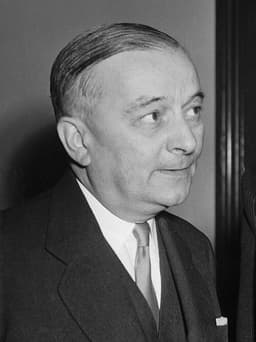
Georges Bidault
Politician · Modern
49.9Total

William Howard Taft
Politician · Modern
56.3Total
Basic Information
Born
1899
1857
Died
1983
1930
Era
Modern
Modern
Nationality
France
United States
Occupation
Politician
Politician
Civilization
Western
Western
Score Comparison
Military (10%)
39.9
50.0
Political (20%)
46.6
62.7
Influence (20%)
51.8
57.2
Legacy (20%)
43.3
50.0
Leadership (15%)
65.0
72.0
Strategy (15%)
54.3
43.2
TOTAL
49.9
56.3
Georges Bidault — Complete Timeline
1943 AD
Leadership of the French Resistance and CNRPolitical Action◆ Major
Bidault became president of the National Council of the Resistance (CNR) in 1943, unifying various resistance groups under de Gaulle's authority. He helped coordinate resistance activities and drafted the CNR's program for post-war social and economic reforms, which influenced the Fourth Republic.
French ResistanceWorld War IICNR
Impact: nationalconstructive
1946 AD
First Term as Prime Minister and Foreign PolicyPolitical Action
Bidault served as Prime Minister from June to December 1946, leading a tripartite government of Socialists, Communists, and MRP. He focused on foreign policy, including negotiations for the Marshall Plan and the establishment of the Fourth Republic's constitution, but faced internal coalition tensions.
Fourth RepublicGovernmentPost-War
Impact: nationalconstructive
1949 AD
Second Term as Prime Minister and the Indochina WarPolitical Action◆ Major
Bidault became Prime Minister again in 1949, overseeing France's involvement in the First Indochina War. He supported the creation of the Associated State of Vietnam under Emperor Bao Dai, but the war continued without resolution, and his government fell in 1950 due to economic and colonial issues.
Indochina WarColonial PolicyFourth Republic
Impact: globaldestructive
1958 AD
Opposition to de Gaulle and the Algerian WarPolitical Action◆ Major
Bidault opposed de Gaulle's return to power in 1958 and his policy of Algerian self-determination. He became a leader of the Organisation de l'arm
Algerian WarOASFifth Republic
Impact: nationaldestructive
William Howard Taft — Complete Timeline
1908 AD
Election as President of the United StatesPolitical Action◆ Major
Taft, a Republican, won the 1908 presidential election against Democrat William Jennings Bryan. Taft was handpicked by outgoing President Theodore Roosevelt as his successor, promising to continue Roosevelt's progressive policies.
Presidential ElectionRepublican Party
Impact: national
1909 AD
Signing of the Payne-Aldrich TariffPolitical Action◆ Major
Taft signed the Payne-Aldrich Tariff, which lowered some tariffs but raised others, disappointing progressives who wanted significant reductions. The tariff alienated Taft from the progressive wing of the Republican Party and contributed to the party split.
Tariff PolicyRepublican Split
Impact: national
1921 AD
Appointment as Chief Justice of the United StatesPolitical Action◆ Major
President Warren G. Harding appointed Taft as Chief Justice of the Supreme Court, a position Taft had long desired. Taft served until 1930, becoming the only person to have held both the presidency and the chief justiceship.
Supreme CourtJudicial Appointment
Impact: nationalconstructive
Expert Analysis
Origins
**Georges Bidault** (1899-1983) was born in Moulins, France, into a middle-class Catholic family. He studied history and geography, becoming a teacher and journalist. His early career was in education and politics, joining the Christian democratic Popular Democratic Party. His formative experience came during World War II when he joined the French Resistance after the 1940 armistice.
**William Howard Taft** (1857-1930) was born in Cincinnati, Ohio, into a prominent political family. His father, Alphonso Taft, served as Secretary of War and Attorney General. Taft graduated from Yale and Cincinnati Law School, becoming a lawyer and judge. His early career included service as a solicitor general and federal judge, shaping his judicial philosophy.
Rise to Power
Bidault rose to prominence through the Resistance. In 1943, he became president of the National Council of the Resistance (CNR), unifying various groups under Charles de Gaulle's authority. This role made him a key figure in the provisional government after liberation. He served as foreign minister from 1944-1946 and briefly as prime minister in 1946. His political career peaked with a second prime ministership from 1949-1950.
Taft rose through the judiciary and executive branch. After serving as a federal judge, he was appointed Governor-General of the Philippines (1901-1904) and Secretary of War (1904-1908). Handpicked by Theodore Roosevelt, he won the 1908 presidential election against William Jennings Bryan, securing 321 electoral votes to 162.
Leadership & Governance
Bidault's leadership style was shaped by his Resistance background: he favored coalition governments and consensus-building. As prime minister, he led a tripartite government of Socialists, Communists, and his own MRP party. He focused on foreign policy, supporting the formation of the European Coal and Steel Community and the Atlantic Alliance. However, his governance was marked by instability: his first term lasted only four months, and his second term was plagued by the Indochina War. He supported the creation of the Associated States of Indochina, escalating French involvement.
Taft's leadership emphasized legalism and caution. As president, he pursued antitrust prosecutions (80 cases in four years) and supported the Sixteenth Amendment (income tax). However, his signing of the Payne-Aldrich Tariff in 1909 alienated progressives, as it only modestly reduced tariffs. His governance score of 72.0 reflects his administrative competence but lack of political savvy. He later became Chief Justice (1921-1930), modernizing the Supreme Court and advocating for judicial efficiency.
Triumph & Tragedy
Bidault's greatest success was leading the CNR, which coordinated resistance networks and prepared for post-war reconstruction. His foreign policy achievements included the founding of the European Coal and Steel Community, a precursor to the EU. However, his tragic flaw was his opposition to de Gaulle's Algerian policy. In 1962, he joined the Organisation de l'armée secrète (OAS), a terrorist group opposing Algerian independence, leading to his exile and conviction for plotting against the state. This destroyed his legacy.
Taft's greatest triumph was becoming Chief Justice, a role he performed with distinction, writing 253 opinions and improving court administration. His political career, however, was marred by the 1912 election, where he won only 8 electoral votes against Woodrow Wilson and Theodore Roosevelt, splitting the Republican vote. His failure to bridge the progressive-conservative divide led to his defeat.
Character & Destiny
Bidault was principled but inflexible. His Catholic faith and anti-communism drove his politics, but his inability to adapt to decolonization led to his downfall. Historian Robert Paxton notes Bidault's 'tragic blindness' regarding Algeria. His leadership score of 65.0 reflects his wartime courage but peacetime rigidity.
Taft was genial and methodical, but lacked Roosevelt's dynamism. He preferred the judiciary to politics, famously saying, 'I don't remember that I ever was president.' His personality score is lower due to his indecisiveness on tariffs. His legacy score of 50.0 reflects the mixed assessment of his presidency versus his chief justiceship.
Legacy
Bidault's legacy is deeply contradictory: he is remembered as a Resistance hero but also as a supporter of the OAS. His role in European integration is often overlooked. In France, he is a minor figure, his political scores 46.6 political and 43.3 legacy reflect his diminished reputation. The CNR's program, however, influenced French social policy.
Taft's legacy is more positive: he is the only person to serve as both president and chief justice. His judicial reforms, including the creation of the Judicial Conference, endure. The Taft-Hartley Act (1947) was named after him, though passed after his death. His political score of 62.7 and influence score of 57.2 indicate a solid, if not transformative, impact.
Conclusion
William Howard Taft had greater overall impact than Georges Bidault. Taft's total score of 56.3 exceeds Bidault's 49.9 by 6.4 points. While Bidault's Resistance leadership was crucial, his later support for the OAS tarnished his legacy. Taft's dual service as president and chief justice left enduring institutional legacies. His governance score of 72.0 versus Bidault's 65.0 reflects his greater effectiveness in office. Taft's influence on the judiciary and antitrust enforcement outweighs Bidault's contributions to European integration, which were shared with others. Therefore, Taft is the more significant historical figure.
Rankings
🥇
William Howard TaftLeader
Mil: 50.0Pol: 62.7Inf: 57.2
56.3
🥈
Georges Bidault
Mil: 39.9Pol: 46.6Inf: 51.8
49.9
+6.4 behind
How This Comparison Works
Algorithm
Each figure is scored on 6 dimensions (0—100 scale) based on structured historical data: Military (10%), Political (20%), Influence (20%), Legacy (20%), Leadership (15%), Strategy (15%). The weighted total produces the final ranking.
Data Sources
Scores are computed from structured sub-indicators in the database. Scale factors adjust for era (Ancient ×0.85, Modern ×1.0) and civilization size (Eastern ×1.05, Other ×0.80) to account for differences in population and military scale.
Maximum 3 Figures
Comparisons are limited to 2—3 figures to ensure readability and statistical meaningfulness.
Error Margins
±5 points per dimension — Sub-scores are derived from historical records with inherent uncertainty. Two figures within 5 points on a dimension should be considered roughly equivalent in that area.
Total Score Accuracy
±3 points overall — The weighted combination of 6 dimensions produces a total score with approximately ±3 points of uncertainty. Differences of less than 3 points are not statistically significant— the figures are effectively tied.
Known Limitations
- Historical records are incomplete and uneven across civilizations
- Figures from oral-tradition societies may be underrepresented
- Occupation labels can misclassify multi-role figures
- Scores measure capability and impact, not moral character
- Quantitative scoring is a comparison tool, not absolute truth
Capability Radar
Military (10%) — Battles & Warfare
Battles
10
30
Win Rate
10
30
Expansion
5
34
Political (20%) — Governance & Reform
Reform
40
55
Diplomacy
45
60
Economy
30
55
Influence (20%) — Cultural & Global Reach
Cultural
20
40
Global
30
45
Legacy (20%) — Historical Impact
Historical
40
55
Longevity
20
50
Leadership (15%) — Power & Stability
Tenure
55
60
Stability
25
65
Strategy (15%) — Tactics & Innovation
Strategy
20
37
Tactics
20
41
Reform
5
46
Similar Comparisons
Comments & Discussion
No comments yet. Be the first to share your thoughts!