Loading...
Georgy Malenkov vs Paavo Lipponen
Paavo Lipponen leads by 9.5 pts · 2 figures compared
…

Georgy Malenkov
Politician · Modern
41.7Total
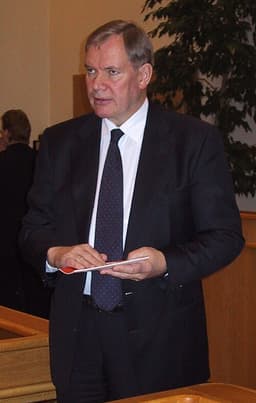
Paavo Lipponen
Politician · Modern
51.2Total
Basic Information
Born
1902
1941
Died
1988
—
Era
Modern
Modern
Nationality
Russia
Finland
Occupation
Politician
Politician
Civilization
Western
Western
Score Comparison
Military (10%)
47.4
21.2
Political (20%)
33.6
60.0
Influence (20%)
47.9
56.4
Legacy (20%)
38.3
45.0
Leadership (15%)
41.5
72.0
Strategy (15%)
41.0
38.9
TOTAL
41.7
51.2
Georgy Malenkov — Complete Timeline
1953 AD
Advocacy for Consumer Goods and Peaceful CoexistenceReform◆ Major
As Premier, Malenkov advocated for a shift in Soviet economic priorities toward consumer goods and light industry, and promoted peaceful coexistence with the West. This 'New Course' was a departure from Stalinist heavy industry focus, but was abandoned after his fall.
Economic ReformCold WarPolicy
Impact: nationalprogressive
Appointment as Premier after Stalin's DeathPolitical Action◆ Major
Following Stalin's death on March 5, 1953, Malenkov became Chairman of the Council of Ministers (Premier) of the Soviet Union. He initially held power alongside Khrushchev and Beria, but was soon outmaneuvered and forced to share leadership.
Soviet LeadershipSuccessionPower Struggle
Impact: national
1955 AD
Removal from PremiershipPolitical Action◆ Major
Malenkov was removed from the premiership in February 1955, replaced by Bulganin. He was demoted to Minister of Electric Power Stations, losing his position as the top Soviet leader after Khrushchev consolidated power and criticized his policies.
Power StruggleKhrushchevDemotion
Impact: nationaldestructive
1961 AD
Expulsion from the Communist PartyPolitical Action◆ Major
Malenkov was expelled from the Communist Party in 1961 for his involvement in the 'Anti-Party Group' that attempted to remove Khrushchev in 1957. He was sent into internal exile, ending his political career permanently.
PurgeKhrushchevExpulsion
Impact: nationaldestructive
Paavo Lipponen — Complete Timeline
1995 AD
Election as Prime Minister of FinlandPolitical Action◆ Major
Paavo Lipponen became Prime Minister of Finland, leading a broad coalition government of Social Democrats, Conservatives, and others. His tenure focused on economic recovery, EU integration, and welfare state reforms.
Finnish PoliticsSocial Democratic PartyCoalition Government
Impact: nationalconstructive
1999 AD
Finland's EU PresidencyPolitical Action◆ Major
Finland held its first rotating presidency of the Council of the European Union under Lipponen's leadership. The presidency focused on EU enlargement, the Helsinki Summit, and the development of the EU's security and defence policy.
European UnionFinnish Presidency
Impact: regionalconstructive
2002 AD
Introduction of the Euro in FinlandPolitical Action◆ Major
Under Lipponen's government, Finland adopted the euro as its official currency, replacing the Finnish markka. This was a key step in Finland's deeper integration into the European Union.
Euro AdoptionFinnish EconomyEU Integration
Impact: nationalconstructive
2003 AD
Resignation as Prime MinisterPolitical Action◆ Major
Lipponen resigned as Prime Minister after the Social Democrats lost seats in the general election. He was succeeded by Anneli J
Finnish PoliticsResignation
Impact: national
Expert Analysis
Origins
Georgy Malenkov was born in 1902 in Orenburg, Russia, into a middle-class family. He joined the Red Army in 1919 and the Communist Party in 1920, rising through administrative roles. His early career was marked by loyalty to Stalin, serving in the party's organizational department. Paavo Lipponen, born in 1941 in Turtola, Finland, grew up in a working-class family. He studied political science and journalism, becoming active in the Social Democratic Party. His formative years included work as a journalist and diplomatic advisor, shaping his later pragmatic approach.
Rise to Power
Malenkov's rise was tied to Stalin's patronage. He became a Central Committee member in 1939 and oversaw the Soviet aircraft industry during World War II. After Stalin's death in March 1953, Malenkov became Premier, initially holding supreme power alongside Beria and Khrushchev. He quickly moved to reduce military spending and promote consumer goods. Lipponen rose through Finnish politics, serving as Minister of Foreign Affairs in the 1970s and later as Speaker of Parliament. In 1995, he became Prime Minister, leading a broad coalition that pushed for EU integration. His key turning point was Finland's 1995 EU membership referendum, which he championed.
Leadership & Governance
Malenkov's leadership was short but distinct. He advocated for peaceful coexistence with the West and shifted economic priorities toward light industry and consumer goods, scoring 41.5 in leadership. However, his governance was constrained by collective leadership and the party apparatus. He lacked a power base, leading to his removal in 1955. Lipponen scored 72.0 in leadership, demonstrating steady management of Finland's EU presidency in 1999 and the euro adoption in 2002. His coalition government focused on fiscal responsibility and social welfare, contrasting with Malenkov's failed attempts to reform a totalitarian system.
Triumph & Tragedy
Malenkov's greatest triumph was his brief tenure as Stalin's successor, where he initiated a thaw in Cold War tensions. His advocacy for consumer goods was a radical departure from Stalinist heavy industry. However, his tragedy was his rapid loss of power; he was demoted in 1955, expelled from the party in 1961, and lived in obscurity. Lipponen's triumphs include successfully managing Finland's first EU presidency and integrating Finland into the eurozone. His tragedy was the 2003 election loss after a decline in Social Democratic support, though he left a legacy of stability. Lipponen's political score of 60.0 far exceeds Malenkov's 33.6.
Character & Destiny
Malenkov was cautious and bureaucratic, lacking the charisma and ruthlessness to survive Soviet politics. His decision to prioritize consumer goods alienated hardliners, leading to his downfall. Historians view him as a transitional figure unable to escape Stalin's shadow. Lipponen was pragmatic and diplomatic, embodying Finland's post-Cold War integration into Europe. His steady leadership during economic challenges earned respect. Malenkov's character sealed his fate as a footnote, while Lipponen's shaped Finland's modern identity.
Legacy
Malenkov's legacy is minimal; his reforms were reversed, and he is remembered as a failed successor. His total score of 41.7 reflects limited enduring impact. Lipponen's legacy is more substantial: he oversaw Finland's deep EU integration, including the euro, and his influence score of 56.4 reflects his role in European politics. Finland's stable governance during his tenure is often cited as a model. While Malenkov's legacy is confined to Soviet history, Lipponen's extends to contemporary European affairs.
Conclusion
Paavo Lipponen had a greater impact than Georgy Malenkov. Despite Malenkov's higher military score (47.4 vs 21.2), Lipponen's political (60.0), influence (56.4), and leadership (72.0) scores are decisively higher. Malenkov's brief rule was a failed transition, while Lipponen's decade of leadership shaped Finland's place in the EU. The total score gap of 9.5 points (51.2 vs 41.7) reflects Lipponen's lasting contributions. History remembers Malenkov as a footnote, but Lipponen as a key architect of modern Finland.
Rankings
🥇
Paavo LipponenLeader
Mil: 21.2Pol: 60.0Inf: 56.4
51.2
🥈
Georgy Malenkov
Mil: 47.4Pol: 33.6Inf: 47.9
41.7
+9.5 behind
How This Comparison Works
Algorithm
Each figure is scored on 6 dimensions (0—100 scale) based on structured historical data: Military (10%), Political (20%), Influence (20%), Legacy (20%), Leadership (15%), Strategy (15%). The weighted total produces the final ranking.
Data Sources
Scores are computed from structured sub-indicators in the database. Scale factors adjust for era (Ancient ×0.85, Modern ×1.0) and civilization size (Eastern ×1.05, Other ×0.80) to account for differences in population and military scale.
Maximum 3 Figures
Comparisons are limited to 2—3 figures to ensure readability and statistical meaningfulness.
Error Margins
±5 points per dimension — Sub-scores are derived from historical records with inherent uncertainty. Two figures within 5 points on a dimension should be considered roughly equivalent in that area.
Total Score Accuracy
±3 points overall — The weighted combination of 6 dimensions produces a total score with approximately ±3 points of uncertainty. Differences of less than 3 points are not statistically significant— the figures are effectively tied.
Known Limitations
- Historical records are incomplete and uneven across civilizations
- Figures from oral-tradition societies may be underrepresented
- Occupation labels can misclassify multi-role figures
- Scores measure capability and impact, not moral character
- Quantitative scoring is a comparison tool, not absolute truth
Capability Radar
Military (10%) — Battles & Warfare
Battles
31
24
Win Rate
33
28
Expansion
37
28
Political (20%) — Governance & Reform
Reform
15
60
Diplomacy
25
70
Economy
30
65
Influence (20%) — Cultural & Global Reach
Cultural
10
30
Global
15
50
Legacy (20%) — Historical Impact
Historical
20
40
Longevity
10
30
Leadership (15%) — Power & Stability
Tenure
20
65
Stability
10
60
Strategy (15%) — Tactics & Innovation
Strategy
38
30
Tactics
38
35
Reform
42
40
Similar Comparisons
Comments & Discussion
No comments yet. Be the first to share your thoughts!