Loading...
This comparison has not been analyzed yet.
One-time AI generation (~1 minute). Scores and timeline are already available below.
Ghezo vs Mutesa II of Buganda
Ghezo leads by 17.0 pts · 2 figures compared
…

Ghezo
Emperor · Modern
61.4Total
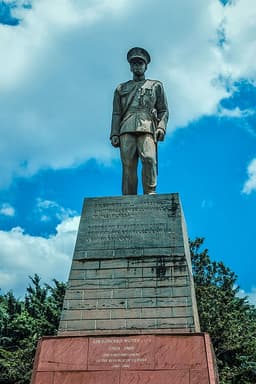
Mutesa II of Buganda
Emperor · Modern
44.4Total
Basic Information
Born
1796
1924
Died
1858
—
Era
Modern
Modern
Nationality
Dahomey
Uganda
Occupation
Emperor
Emperor
Civilization
Other
Other
Score Comparison
Military (10%)
70.0
20.0
Political (20%)
72.0
39.4
Influence (20%)
59.0
53.3
Legacy (20%)
47.5
40.0
Leadership (15%)
79.8
51.9
Strategy (15%)
50.0
54.3
TOTAL
61.4
44.4
Ghezo — Complete Timeline
1840 AD
Battle of AtakpaméWar◆ Major
Ghezo led the Dahomey army in a campaign against the Oyo Empire, culminating in the capture of the city of Atakpam
Oyo-Dahomey WarIndependenceMilitary Campaign
Impact: regional
1845 AD
Expansion of the Dahomey Amazon corpsReform
Ghezo significantly expanded and formalized the Dahomey Amazons, an all-female military regiment. He increased their numbers and integrated them more deeply into the army's structure, making them a key component of Dahomey's military strength and a symbol of the kingdom's power.
Military ReformWomen in WarfareDahomey Amazons
Impact: nationalconstructive
1852 AD
Abolition of the Dahomey slave tradeReform◆ Major
Under pressure from the British Royal Navy blockade and the threat of military action, Ghezo signed a treaty with Great Britain to end the Dahomey slave trade. This marked a major shift in Dahomey's economy, leading to the promotion of palm oil production as a replacement export.
Slave TradeBritish PressureEconomic Shift
Impact: regionalconstructive
Mutesa II of Buganda — Complete Timeline
1939 AD
Accession as Kabaka of BugandaPolitical Action◆ Major
Mutesa II became Kabaka of Buganda after the death of his father Daudi Cwa II. He inherited a kingdom that was a British protectorate, with limited autonomy under colonial rule.
SuccessionBugandaUganda
Impact: regional
1953 AD
Exiled by the British over the Kabaka crisisPolitical Action
Mutesa II was exiled by the British governor Andrew Cohen after demanding Buganda's independence from Uganda. The exile sparked widespread protests in Buganda, leading to negotiations and his eventual return in 1955.
ExileColonialismBuganda
Impact: regionaltragic
1955 AD
Returned from exile and signed the Buganda Agreement of 1955Political Action◆ Major
Mutesa II returned to Buganda after negotiations with the British. He signed a new agreement that restored his position but limited his powers, making Buganda a constitutional monarchy within Uganda.
ReturnTreatyBuganda
Impact: regional
1963 AD
Became first President of UgandaPolitical Action◆ Major
Mutesa II was elected as the first President of Uganda, a largely ceremonial role, while Milton Obote served as Prime Minister. This arrangement was part of Uganda's independence constitution.
PresidencyUgandaIndependence
Impact: national
1966 AD
Exiled by Milton ObotePolitical Action
Mutesa II was forced into exile in the United Kingdom after Prime Minister Milton Obote suspended the constitution and attacked the Lubiri (his palace). Obote abolished the kingdoms and declared himself president, ending Mutesa's political role.
ExileCoupUganda
Impact: nationaltragic
1969 AD
Death in exilePolitical Action◆ Major
Mutesa II died in exile in London under mysterious circumstances, reportedly from alcohol poisoning. His death ended the Buganda monarchy's active role in Ugandan politics, though the kingdom was later restored in 1993.
DeathExileBuganda
Impact: nationaltragic
This comparison has not been analyzed yet.
One-time AI generation (~1 minute). Scores and timeline are already available below.
Rankings
🥇
GhezoLeader
Mil: 70.0Pol: 72.0Inf: 59.0
61.4
🥈
Mutesa II of Buganda
Mil: 20.0Pol: 39.4Inf: 53.3
44.4
+17.0 behind
How This Comparison Works
Algorithm
Each figure is scored on 6 dimensions (0—100 scale) based on structured historical data: Military (10%), Political (20%), Influence (20%), Legacy (20%), Leadership (15%), Strategy (15%). The weighted total produces the final ranking.
Data Sources
Scores are computed from structured sub-indicators in the database. Scale factors adjust for era (Ancient ×0.85, Modern ×1.0) and civilization size (Eastern ×1.05, Other ×0.80) to account for differences in population and military scale.
Maximum 3 Figures
Comparisons are limited to 2—3 figures to ensure readability and statistical meaningfulness.
Error Margins
±5 points per dimension — Sub-scores are derived from historical records with inherent uncertainty. Two figures within 5 points on a dimension should be considered roughly equivalent in that area.
Total Score Accuracy
±3 points overall — The weighted combination of 6 dimensions produces a total score with approximately ±3 points of uncertainty. Differences of less than 3 points are not statistically significant— the figures are effectively tied.
Known Limitations
- Historical records are incomplete and uneven across civilizations
- Figures from oral-tradition societies may be underrepresented
- Occupation labels can misclassify multi-role figures
- Scores measure capability and impact, not moral character
- Quantitative scoring is a comparison tool, not absolute truth
Capability Radar
Military (10%) — Battles & Warfare
Battles
55
5
Win Rate
60
5
Expansion
60
5
Political (20%) — Governance & Reform
Reform
65
25
Diplomacy
70
30
Economy
75
20
Influence (20%) — Cultural & Global Reach
Cultural
50
40
Global
45
20
Legacy (20%) — Historical Impact
Historical
55
30
Longevity
40
20
Leadership (15%) — Power & Stability
Tenure
70
30
Stability
60
15
Strategy (15%) — Tactics & Innovation
Strategy
55
5
Tactics
50
5
Reform
65
5
Similar Comparisons
Comments & Discussion
No comments yet. Be the first to share your thoughts!