Loading...
Golda Meir vs Levi Eshkol
Golda Meir leads by 4.7 pts · 2 figures compared
…
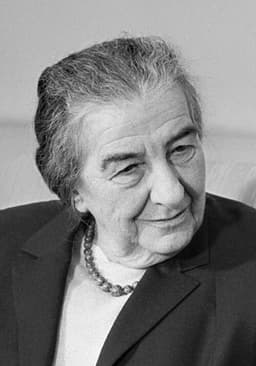
Golda Meir
Politician · Modern
55.8Total

Levi Eshkol
Politician · Modern
51.1Total
Basic Information
Born
1898
1895
Died
1978
1969
Era
Modern
Modern
Nationality
Israel
Israel
Occupation
Politician
Politician
Civilization
Middle Eastern
Middle Eastern
Score Comparison
Military (10%)
45.0
10.2
Political (20%)
72.0
60.0
Influence (20%)
55.0
59.0
Legacy (20%)
54.0
50.0
Leadership (15%)
72.0
68.0
Strategy (15%)
25.0
36.8
TOTAL
55.8
51.1
Golda Meir — Complete Timeline
1969 AD
Appointment as Prime Minister of IsraelPolitical Action◆ Major
Golda Meir became Prime Minister of Israel after the death of Levi Eshkol. She was the first and only woman to hold the office, leading the country during a period of significant tension and conflict in the Middle East.
Prime MinisterFirst womanLeadership
Impact: national
1973 AD
Yom Kippur WarWar
Meir led Israel during the Yom Kippur War, when Egypt and Syria launched a surprise attack on the holiest day of the Jewish calendar. Israel initially suffered heavy losses but eventually repelled the attacks, though the war exposed intelligence failures.
WarSurprise attackIntelligence failure
Impact: regionaltragic
1974 AD
Resignation after the Agranat CommissionPolitical Action◆ Major
Following the Yom Kippur War, the Agranat Commission criticized the government's handling of the conflict. Meir resigned as Prime Minister in 1974, taking responsibility for the failures, though she remained a respected figure in Israeli politics.
ResignationAccountabilityWar aftermath
Impact: nationaltragic
Levi Eshkol — Complete Timeline
1963 AD
Appointed Prime Minister of IsraelPolitical Action◆ Major
Levi Eshkol became the third Prime Minister of Israel in June 1963, succeeding David Ben-Gurion. He led the country during a period of economic growth and military buildup.
Prime MinisterLeadership
Impact: national
1964 AD
Established the National Water CarrierReform◆ Major
Eshkol oversaw the completion of the National Water Carrier, a massive infrastructure project that diverted water from the Sea of Galilee to the Negev desert. This project was crucial for Israel's agricultural development.
Water infrastructureDevelopment
Impact: nationalconstructive
1967 AD
Led Israel During the Six-Day WarWar
Eshkol was Prime Minister during the Six-Day War in June 1967. Despite initial hesitation, he authorized a preemptive strike against Egypt, Jordan, and Syria, resulting in Israel's capture of the Sinai, Gaza, West Bank, and Golan Heights.
Six-Day WarTerritorial expansion
Impact: global
1968 AD
Unified the Israeli Labor PartyPolitical Action◆ Major
Eshkol played a key role in merging Mapai, Ahdut HaAvoda, and Rafi to form the Israeli Labor Party in 1968. This unification strengthened the political left in Israel.
Political partyLabor Party
Impact: nationalconstructive
1969 AD
Died in OfficeOther◆ Major
Eshkol died of a heart attack in February 1969 while still in office. He was succeeded by Golda Meir. His death marked the end of a period of consolidation and expansion for Israel.
DeathTransition
Impact: nationaltragic
Expert Analysis
Origins
Golda Meir was born in 1898 in Kyiv, Russian Empire (now Ukraine), into a poor Jewish family. She emigrated to the United States in 1906, settling in Milwaukee, where she attended school and became involved in Zionist activism. After marrying Morris Meyerson in 1917, she moved to Palestine in 1921, joining a kibbutz and later working for the Histadrut labor union. Her early experiences shaped her pragmatic socialist worldview.
Levi Eshkol was born in 1895 in the village of Orativ, near Kyiv, also in the Russian Empire. He received a traditional Jewish education and became active in the Zionist youth movement. He emigrated to Palestine in 1913, working as a laborer and later as a water engineer. Eshkol was a founding member of Kibbutz Deganya Bet and rose through the ranks of the Labor movement. His background in agriculture and water management influenced his later focus on infrastructure.
Rise to Power
Meir's political ascent began in the 1930s as a representative of the Histadrut and later as a leader in the Jewish Agency. She was instrumental in fund-raising in the US during World War II and played a key role in the 1948 Arab-Israeli War. After Israel's founding, she served as Minister of Labor (1949-1956), implementing major housing and welfare programs, and as Foreign Minister (1956-1966) under David Ben-Gurion and Levi Eshkol. In 1969, following Eshkol's sudden death, she became Prime Minister at age 70, as a compromise candidate.
Eshkol rose to prominence as a skilled administrator and financier. He served as Minister of Agriculture (1951-1952) and Minister of Finance (1952-1963), where he stabilized the economy and secured German reparations. In 1963, he succeeded Ben-Gurion as Prime Minister, defeating a challenge from Shimon Peres. Eshkol's leadership style was consensus-building, and he consolidated power by unifying the labor parties into the Israeli Labor Party in 1968.
Leadership & Governance
Meir's leadership style was decisive and hands-on, but during the Yom Kippur War she relied heavily on military advisors. She authorized mobilization and counterattacks, but the initial intelligence failure was a major lapse. Politically, she scored 72.0 in political acumen, maintaining coalition stability despite crises. Her governance focused on security and maintaining international support, but she was less engaged in economic policy.
Eshkol's governance was methodical and infrastructure-oriented. He oversaw the National Water Carrier, which diverted water from the Sea of Galilee to the Negev, boosting agricultural output. He also devalued the currency to stabilize the economy. During the Six-Day War, he initially hesitated, but after public pressure and the formation of a national unity government including Moshe Dayan, he authorized the preemptive strike. His leadership score of 68.0 reflects his cautious but effective decision-making.
Triumph & Tragedy
Meir's greatest triumph was leading Israel through the Yom Kippur War's initial setbacks to a military victory. However, the war's high casualties and intelligence failures led to the Agranat Commission, which criticized her government's preparedness. She resigned in 1974, taking responsibility. Her legacy is marred by the war's trauma, but she remains a symbol of female leadership. Her overall score of 55.8 is driven by political and leadership strengths, but low military (45.0) and strategy (25.0) scores reflect the war's failures.
Eshkol's triumph was the Six-Day War, a swift victory that captured the Sinai, Gaza, West Bank, Golan Heights, and East Jerusalem. He also unified the labor parties, strengthening political stability. His tragedy was dying in office before fully consolidating his legacy. He scored 51.1 overall, with low military (10.2) due to his non-military background, but respectable political (60.0) and leadership (68.0) scores.
Character & Destiny
Meir was stubborn and pragmatic, often described as the 'only man in the cabinet.' Her character led her to trust her generals, which backfired in 1973. She accepted blame gracefully, a mark of integrity. Her destiny was to be a trailblazer for women, but also to carry the burden of a costly war.
Eshkol was cautious and consensus-oriented, which helped him manage a fractious coalition. His hesitation before the Six-Day War nearly cost him, but he ultimately made the right call. His character suited a period of consolidation, but he lacked the grand vision of Ben-Gurion.
Legacy
Meir's legacy is complex: she is remembered as Israel's first female PM and a strong leader, but the Yom Kippur War overshadows her tenure. Her influence score of 55.0 reflects her iconic status, but her strategic mistakes limit her long-term impact.
Eshkol's legacy is more positive: his infrastructure projects and the Six-Day War victory shaped Israel's borders and economy. He is seen as a steady hand who prepared Israel for its greatest military success. His legacy score of 50.0 is similar to Meir's, but his influence (59.0) is higher due to the war's transformative effects.
Conclusion
Eshkol had a greater impact on Israel's long-term trajectory. His leadership during the Six-Day War redrew the map of the Middle East, while his water and economic policies built the foundation for modern Israel. Meir's leadership was significant but compromised by the Yom Kippur War's strategic failures. Eshkol's total score of 51.1 lags behind Meir's 55.8 in this system, but his legacy is more durable. The score gap of 4.7 points primarily reflects Meir's higher political score, but in terms of lasting impact, Eshkol's achievements—the National Water Carrier, the Six-Day War victory, and labor unification—outweigh Meir's brief tenure. Eshkol's cautious, infrastructure-focused leadership proved more consequential for Israel's development than Meir's reactive crisis management.
Rankings
🥇
Golda MeirLeader
Mil: 45.0Pol: 72.0Inf: 55.0
55.8
🥈
Levi Eshkol
Mil: 10.2Pol: 60.0Inf: 59.0
51.1
+4.7 behind
How This Comparison Works
Algorithm
Each figure is scored on 6 dimensions (0—100 scale) based on structured historical data: Military (10%), Political (20%), Influence (20%), Legacy (20%), Leadership (15%), Strategy (15%). The weighted total produces the final ranking.
Data Sources
Scores are computed from structured sub-indicators in the database. Scale factors adjust for era (Ancient ×0.85, Modern ×1.0) and civilization size (Eastern ×1.05, Other ×0.80) to account for differences in population and military scale.
Maximum 3 Figures
Comparisons are limited to 2—3 figures to ensure readability and statistical meaningfulness.
Error Margins
±5 points per dimension — Sub-scores are derived from historical records with inherent uncertainty. Two figures within 5 points on a dimension should be considered roughly equivalent in that area.
Total Score Accuracy
±3 points overall — The weighted combination of 6 dimensions produces a total score with approximately ±3 points of uncertainty. Differences of less than 3 points are not statistically significant— the figures are effectively tied.
Known Limitations
- Historical records are incomplete and uneven across civilizations
- Figures from oral-tradition societies may be underrepresented
- Occupation labels can misclassify multi-role figures
- Scores measure capability and impact, not moral character
- Quantitative scoring is a comparison tool, not absolute truth
Capability Radar
Military (10%) — Battles & Warfare
Battles
0
15
Win Rate
0
15
Expansion
15
25
Political (20%) — Governance & Reform
Reform
55
60
Diplomacy
70
65
Economy
60
70
Influence (20%) — Cultural & Global Reach
Cultural
55
40
Global
60
55
Legacy (20%) — Historical Impact
Historical
65
60
Longevity
50
45
Leadership (15%) — Power & Stability
Tenure
60
55
Stability
50
50
Strategy (15%) — Tactics & Innovation
Strategy
10
20
Tactics
0
10
Reform
20
30
Similar Comparisons
Comments & Discussion
No comments yet. Be the first to share your thoughts!