Loading...
Gonzalo Fernandez de Cordoba vs John Hawkwood
Gonzalo Fernandez de Cordoba leads by 25.7 pts · 2 figures compared
…

Gonzalo Fernandez de Cordoba
General · Medieval
78.6Total
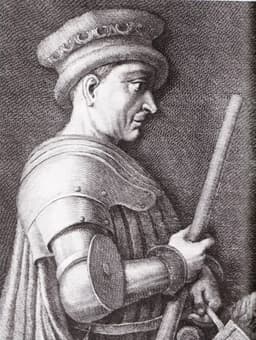
John Hawkwood
General · Medieval
52.9Total
Basic Information
Born
1453
1323
Died
1515
1394
Era
Medieval
Medieval
Nationality
Spain
Italy
Occupation
General
General
Civilization
Western
Western
Score Comparison
Military (10%)
78.5
60.0
Political (20%)
62.7
42.3
Influence (20%)
80.0
53.3
Legacy (20%)
82.0
45.0
Leadership (15%)
85.0
68.0
Strategy (15%)
80.5
58.0
TOTAL
78.6
52.9
Gonzalo Fernandez de Cordoba — Complete Timeline
1503 AD
Battle of CerignolaWar◆ Major
Cordoba's Spanish army defeated the French at Cerignola, Italy. Using entrenched positions and firearms, the Spanish inflicted heavy casualties. This was the first major battle won primarily by arquebus fire.
Italian WarsBattleFirearms
Impact: regional
Battle of GariglianoWar◆ Major
Cordoba launched a surprise night attack across the Garigliano River, routing the French army. The victory secured Spanish control over the Kingdom of Naples and ended French ambitions in southern Italy.
Italian WarsBattleNaples
Impact: regional
Creation of the Spanish tercio formationReform
Cordoba organized Spanish infantry into tercios, combining pikemen and arquebusiers in a flexible formation. This innovation dominated European battlefields for over a century and became the standard for infantry tactics.
Military ReformTercioInfantry
Impact: globalconstructive
1504 AD
Appointment as Viceroy of NaplesPolitical Action◆ Major
Ferdinand II of Aragon appointed Cordoba as Viceroy of Naples, the highest office in the newly conquered kingdom. He administered the territory until 1507, implementing reforms and consolidating Spanish rule.
AdministrationNaplesViceroyalty
Impact: regional
John Hawkwood — Complete Timeline
1363 AD
Commanded the White CompanyPolitical Action◆ Major
Hawkwood took command of the White Company, a mercenary band of English and German soldiers. He led them into Italy, where they became a major military force, selling their services to various Italian city-states.
MercenaryItalyMilitary
Impact: regional
1377 AD
Sack of CesenaWar◆ Major
Hawkwood, in the service of Cardinal Robert of Geneva, participated in the massacre of thousands of civilians in Cesena. The city was sacked after its surrender, an event that tarnished his reputation.
MassacreWar CrimeItaly
destructive
1387 AD
Battle of CastagnaroWar◆ Major
Hawkwood led the Paduan army to victory against Verona. Using a feigned retreat, he broke the Veronese lines, capturing many prisoners. This battle is considered a masterpiece of medieval tactical deception.
BattleCondottieroItaly
Impact: regional
1390 AD
Appointed Captain-General of FlorencePolitical Action◆ Major
The Republic of Florence appointed Hawkwood as its Captain-General, granting him command of its armies. This position made him the highest-ranking military officer in Florence, a role he held until his death.
AppointmentFlorenceMilitary
Impact: regionalconstructive
Expert Analysis
Origins
Gonzalo Fernández de Córdoba was born in 1453 in Montilla, Córdoba, into a noble Andalusian family. He was the second son of Pedro Fernández de Córdoba, a lord of the House of Córdoba. His early military training came from service in the War of the Castilian Succession (1475-1479) and the Granada War (1482-1492). He learned the art of war under the Catholic Monarchs, Ferdinand II of Aragon and Isabella I of Castile.
John Hawkwood was born around 1323 in Sible Hedingham, Essex, England, into a family of minor gentry. He apprenticed as a tailor in London but fled to France after killing a rival. He joined the English army in the Hundred Years' War, serving under Edward III. He fought at the Battle of Poitiers (1356) and later joined the Free Companies, mercenary bands that roamed France. In 1361, he led the White Company into Italy, where he became a leading condottiero.
Rise to Power
Córdoba rose to prominence during the Granada War, where he commanded a small force and earned a reputation for discipline and innovation. In 1495, King Ferdinand sent him to Italy to support the Neapolitan king against the French invasion. Córdoba's first Italian campaign (1495-1498) was marked by initial setbacks, but he learned from them. His decisive moment came in 1503 at the Battle of Cerignola, where he defeated the French using entrenched positions and arquebusiers. This victory established him as a master of infantry tactics. He followed up with the Battle of Garigliano later that year, a night crossing that routed the French and secured Naples for Spain. He was appointed Viceroy of Naples in 1504, the highest office in the kingdom.
Hawkwood's rise began when he took command of the White Company in 1361. He led them into Italy, where they fought for various city-states. His reputation grew after the Battle of Castagnaro in 1387, where he led the Paduan army to victory by feigning a retreat. This battle is considered a masterpiece of tactical deception. Hawkwood's political acumen, however, was limited; he remained a mercenary, selling his services to the highest bidder. His highest position came in 1390 when Florence appointed him Captain-General, but he was never a sovereign ruler.
Leadership & Governance
Córdoba's leadership style was transformative. He reorganized the Spanish army into tercios, combining pikemen and arquebusiers in flexible formations. He emphasized training, discipline, and the use of firearms. His governance as Viceroy was effective: he stabilized Naples, reformed the administration, and integrated the kingdom into the Spanish Empire. He scored 85.0 in leadership and 80.5 in strategy.
Hawkwood's leadership was more traditional for a mercenary. He commanded through personal authority and tactical skill, but he lacked a long-term vision. He never built a permanent institution; his White Company was a private enterprise. His political score of 42.3 reflects his inability to translate military success into lasting power. He was a hired sword, not a state-builder.
Triumph & Tragedy
Córdoba's greatest triumph was the creation of the tercio, which dominated European battlefields for over a century. His victories at Cerignola and Garigliano were decisive in establishing Spanish hegemony in Italy. His tragedy came later: King Ferdinand, suspicious of his popularity, recalled him from Naples in 1507 and sidelined him. Córdoba died in 1515 in relative obscurity, his reforms unacknowledged by the crown.
Hawkwood's triumph was the Battle of Castagnaro, a textbook example of tactical deception. He also successfully led the White Company for decades, amassing wealth. His tragedy was the Sack of Cesena in 1377, where he participated in the massacre of thousands of civilians. This event tarnished his reputation and highlighted the moral ambiguities of mercenary warfare. He died in 1394 in Florence, honored with a fresco in the Duomo.
Character & Destiny
Córdoba was methodical, innovative, and disciplined. He learned from his early defeats and adapted his tactics. His character shaped his destiny: his success in Italy made him a threat to Ferdinand, who feared his power. Córdoba's loyalty to the crown was absolute, but he was unable to navigate court politics. His total score of 78.6 reflects his balanced abilities.
Hawkwood was pragmatic, ruthless, and adaptable. He was a survivor, switching sides as needed. His character made him a successful mercenary but limited his legacy. He was a tool of others, not a creator of systems. His total score of 52.9 places him in a lower tier of historical impact.
Legacy
Córdoba's legacy is immense: the tercio formation influenced military organization for centuries. His emphasis on firearms and combined arms foreshadowed modern infantry tactics. He is remembered as the "Great Captain" and a founder of the Spanish Empire. His influence score of 80.0 and legacy score of 82.0 reflect his enduring impact.
Hawkwood's legacy is more modest. He is remembered as the archetypal condottiero, but his tactical innovations were not lasting. The White Company dissolved after his death. His influence score of 53.3 and legacy score of 45.0 indicate his limited reach. He is a footnote in military history, while Córdoba is a major figure.
Conclusion
Gonzalo Fernández de Córdoba had a greater impact than John Hawkwood. Córdoba's total score is 78.6 to Hawkwood's 52.9, a gap of 25.7 points. Córdoba created a military system that dominated Europe, while Hawkwood was a skilled mercenary who left no lasting institution. Córdoba's innovations in infantry tactics and firearm use changed warfare; Hawkwood's feigned retreat was a clever trick but not a revolution. In the long term, Córdoba's tercio shaped the Spanish Empire, while Hawkwood's White Company was a temporary enterprise. The clear position is that Córdoba was the more significant figure by a wide margin.
Rankings
🥇
Gonzalo Fernandez de CordobaLeader
Mil: 78.5Pol: 62.7Inf: 80.0
78.6
🥈
John Hawkwood
Mil: 60.0Pol: 42.3Inf: 53.3
52.9
+25.7 behind
How This Comparison Works
Algorithm
Each figure is scored on 6 dimensions (0—100 scale) based on structured historical data: Military (10%), Political (20%), Influence (20%), Legacy (20%), Leadership (15%), Strategy (15%). The weighted total produces the final ranking.
Data Sources
Scores are computed from structured sub-indicators in the database. Scale factors adjust for era (Ancient ×0.85, Modern ×1.0) and civilization size (Eastern ×1.05, Other ×0.80) to account for differences in population and military scale.
Maximum 3 Figures
Comparisons are limited to 2—3 figures to ensure readability and statistical meaningfulness.
Error Margins
±5 points per dimension — Sub-scores are derived from historical records with inherent uncertainty. Two figures within 5 points on a dimension should be considered roughly equivalent in that area.
Total Score Accuracy
±3 points overall — The weighted combination of 6 dimensions produces a total score with approximately ±3 points of uncertainty. Differences of less than 3 points are not statistically significant— the figures are effectively tied.
Known Limitations
- Historical records are incomplete and uneven across civilizations
- Figures from oral-tradition societies may be underrepresented
- Occupation labels can misclassify multi-role figures
- Scores measure capability and impact, not moral character
- Quantitative scoring is a comparison tool, not absolute truth
Capability Radar
Military (10%) — Battles & Warfare
Battles
85
65
Win Rate
90
60
Expansion
80
55
Political (20%) — Governance & Reform
Reform
75
20
Diplomacy
80
70
Economy
65
40
Influence (20%) — Cultural & Global Reach
Cultural
75
45
Global
75
35
Legacy (20%) — Historical Impact
Historical
85
50
Longevity
80
40
Leadership (15%) — Power & Stability
Tenure
70
50
Stability
70
45
Strategy (15%) — Tactics & Innovation
Strategy
88
65
Tactics
95
70
Reform
95
30
Similar Comparisons
Comments & Discussion
No comments yet. Be the first to share your thoughts!