Loading...
Guadalupe Victoria vs Janio Quadros
Guadalupe Victoria leads by 11.0 pts · 2 figures compared
…
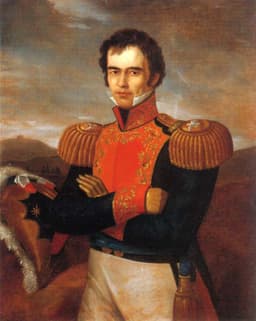
Guadalupe Victoria
Politician · Modern
53.3Total

Janio Quadros
Politician · Modern
42.3Total
Basic Information
Born
1786
1917
Died
1843
1992
Era
Modern
Modern
Nationality
Mexico
Brazil
Occupation
Politician
Politician
Civilization
Western
Western
Score Comparison
Military (10%)
25.9
50.0
Political (20%)
68.0
39.4
Influence (20%)
56.4
51.0
Legacy (20%)
49.2
39.2
Leadership (15%)
74.0
31.2
Strategy (15%)
30.3
41.3
TOTAL
53.3
42.3
Guadalupe Victoria — Complete Timeline
1812 AD
Victoria's role in the Mexican War of IndependenceWar◆ Major
Guadalupe Victoria joined the insurgent forces under Jos
War of IndependenceGuerrilla WarfareInsurgency
Impact: national
1824 AD
Guadalupe Victoria becomes first President of MexicoPolitical Action◆ Major
Guadalupe Victoria was elected as the first president of the newly established Federal Republic of Mexico. His presidency (1824-1829) marked the consolidation of Mexican independence and the establishment of republican institutions.
Mexican IndependenceFirst PresidentRepublic
Impact: nationalconstructive
1827 AD
Victoria's presidency and the expulsion of the SpanishPolitical Action◆ Major
During Victoria's presidency, the Mexican government ordered the expulsion of all Spanish residents from Mexico. This action aimed to remove remaining colonial influence but caused economic disruption and social tension.
ExpulsionAnti-SpanishNationalism
Impact: nationaldestructive
1829 AD
Victoria's peaceful transfer of powerPolitical Action◆ Major
Guadalupe Victoria completed his four-year term and peacefully handed over the presidency to Vicente Guerrero. This was the first peaceful transfer of executive power in Mexican history, setting a precedent for republican governance.
Peaceful TransitionDemocracyPresidency
Impact: nationalconstructive
Janio Quadros — Complete Timeline
1960 AD
Elected President of BrazilPolitical Action◆ Major
Jânio Quadros was elected president of Brazil in 1960 as the candidate of the National Democratic Union (UDN) and the Christian Democratic Party (PDC). He assumed office on January 31, 1961, with a mandate to combat corruption and inflation.
Brazilian PresidencyElectionAnti-corruption
Impact: nationalconstructive
1961 AD
Implemented Anti-Corruption MeasuresReform
Quadros launched a campaign against corruption and bureaucracy, including banning the use of official cars for personal purposes and reducing government spending. These measures were popular but faced resistance from political elites.
Anti-corruptionReformBrazil
Impact: nationalconstructive
Resigned the PresidencyPolitical Action
Quadros resigned from the presidency on August 25, 1961, after only seven months in office. He claimed he was forced out by 'occult forces' and hoped to return with greater powers, but his resignation was accepted by Congress, leading to a political crisis.
ResignationPolitical CrisisBrazil
Impact: nationaldestructive
Awarded the Order of the Southern Cross to Che GuevaraPolitical Action
Quadros awarded the Order of the Southern Cross, Brazil's highest honor, to Argentine revolutionary Che Guevara in August 1961. This act angered conservative sectors and the military, contributing to the political tensions that led to his resignation.
DiplomacyControversyBrazil
Impact: national
Expert Analysis
Origins
Guadalupe Victoria was born José Miguel Ramón Adaucto Fernández y Félix on September 29, 1786, in Tamazula, New Spain (now Mexico). He studied at the Colegio de San Ildefonso in Mexico City, where he was exposed to Enlightenment ideas. His family was of modest means, and he initially pursued a career in law before joining the independence movement in 1811.
Jânio Quadros was born on January 25, 1917, in Campo Grande, Mato Grosso do Sul, Brazil. He came from a middle-class family; his father was a pharmacist. Quadros studied law at the University of São Paulo and began his political career as a city councilman in São Paulo in 1947. He later served as governor of São Paulo from 1955 to 1959, where he gained a reputation for anti-corruption campaigns.
Rise to Power
Victoria joined the insurgent forces under José María Morelos in 1811. He adopted the name Guadalupe Victoria, symbolizing his commitment to Mexico's independence and the Virgin of Guadalupe. He became a key guerrilla leader in the region of Veracruz, fighting Spanish royalist forces from 1812 to 1821. After independence, he served in the provisional government and was elected the first president of the Federal Republic of Mexico in 1824, taking office on October 10, 1824.
Quadros rose to prominence as a reformist governor of São Paulo. He was elected president of Brazil in 1960 as the candidate of the National Democratic Union (UDN) and the Christian Democratic Party (PDC), winning by a landslide. He took office on January 31, 1961, with a mandate to fight corruption and stabilize the economy.
Leadership & Governance
Victoria's leadership focused on consolidating the new republic. He presided over the adoption of the 1824 Constitution, which established a federal system. He enforced the expulsion of Spanish residents from Mexico in 1827-1829, aiming to remove colonial influence. His governance was marked by efforts to maintain national unity amid factional conflicts between federalists and centralists. Victoria's political score of 68.0 reflects his ability to navigate early republican politics.
Quadros launched an anti-corruption campaign, banning the use of official cars for personal purposes and reducing government spending. He sought an independent foreign policy, including reestablishing relations with the Soviet Union and awarding the Order of the Southern Cross to Che Guevara in August 1961. However, his erratic style and lack of congressional support hampered his agenda. His leadership score of 31.2 is low, reflecting his inability to govern effectively.
Triumph & Tragedy
Victoria's greatest triumph was completing his four-year term and peacefully transferring power to Vicente Guerrero in 1829, establishing a precedent for democratic transition. He also successfully defended Mexico's sovereignty against Spanish reconquest attempts. His tragedy was the economic stagnation and political instability that persisted after his presidency; he left office with a depleted treasury and rising factionalism.
Quadros's triumph was his anti-corruption measures, which enjoyed popular support. However, his tragedy was his abrupt resignation on August 25, 1961, after only seven months, claiming he was forced out by 'occult forces.' This plunged Brazil into a constitutional crisis and ultimately contributed to the military coup in 1964. Quadros's legacy score of 39.2 reflects the negative impact of his short tenure.
Character & Destiny
Victoria was known for his integrity and dedication to republican principles. He avoided personal enrichment and remained committed to constitutional rule. His character shaped his destiny as a stabilizing figure, but his moderate approach could not prevent the eventual rise of authoritarianism under Santa Anna.
Quadros was charismatic but impulsive and unpredictable. His decision to resign was seen as a political miscalculation; he hoped to return with greater powers, but Congress refused. His character of defiance and poor judgment led to his downfall. Quadros's total score of 42.3 is significantly lower than Victoria's 53.3.
Legacy
Victoria is remembered as a founding father of Mexico. His peaceful transfer of power set a standard for future presidents. The federal system he helped establish endured, though with modifications. He is honored with a state named after him (Victoria) and his image on Mexican currency.
Quadros's legacy is mixed. He is remembered for his anti-corruption efforts but also for the instability caused by his resignation. His foreign policy initiatives were controversial, and his short tenure prevented lasting reforms. He is often cited as a cautionary tale of political recklessness.
Conclusion
Guadalupe Victoria had a greater impact than Jânio Quadros. Victoria scored 53.3 overall versus Quadros's 42.3. Victoria successfully established the Mexican republic and ensured a peaceful transition of power, laying the foundation for decades of constitutional governance. Quadros, despite initial promise, failed to complete his term and left Brazil in crisis. While both faced challenges, Victoria's enduring contributions to Mexican statehood outweigh Quadros's brief and destabilizing presidency.
Rankings
🥇
Guadalupe VictoriaLeader
Mil: 25.9Pol: 68.0Inf: 56.4
53.3
🥈
Janio Quadros
Mil: 50.0Pol: 39.4Inf: 51.0
42.3
+11.0 behind
How This Comparison Works
Algorithm
Each figure is scored on 6 dimensions (0—100 scale) based on structured historical data: Military (10%), Political (20%), Influence (20%), Legacy (20%), Leadership (15%), Strategy (15%). The weighted total produces the final ranking.
Data Sources
Scores are computed from structured sub-indicators in the database. Scale factors adjust for era (Ancient ×0.85, Modern ×1.0) and civilization size (Eastern ×1.05, Other ×0.80) to account for differences in population and military scale.
Maximum 3 Figures
Comparisons are limited to 2—3 figures to ensure readability and statistical meaningfulness.
Error Margins
±5 points per dimension — Sub-scores are derived from historical records with inherent uncertainty. Two figures within 5 points on a dimension should be considered roughly equivalent in that area.
Total Score Accuracy
±3 points overall — The weighted combination of 6 dimensions produces a total score with approximately ±3 points of uncertainty. Differences of less than 3 points are not statistically significant— the figures are effectively tied.
Known Limitations
- Historical records are incomplete and uneven across civilizations
- Figures from oral-tradition societies may be underrepresented
- Occupation labels can misclassify multi-role figures
- Scores measure capability and impact, not moral character
- Quantitative scoring is a comparison tool, not absolute truth
Capability Radar
Military (10%) — Battles & Warfare
Battles
35
31
Win Rate
40
30
Expansion
15
33
Political (20%) — Governance & Reform
Reform
50
30
Diplomacy
45
40
Economy
40
20
Influence (20%) — Cultural & Global Reach
Cultural
40
20
Global
30
15
Legacy (20%) — Historical Impact
Historical
50
25
Longevity
45
10
Leadership (15%) — Power & Stability
Tenure
55
10
Stability
35
5
Strategy (15%) — Tactics & Innovation
Strategy
35
36
Tactics
30
39
Reform
20
44
Similar Comparisons
Comments & Discussion
No comments yet. Be the first to share your thoughts!