Loading...
This comparison has not been analyzed yet.
One-time AI generation (~1 minute). Scores and timeline are already available below.
Guido Westerwelle vs Khaw Boon Wan
Guido Westerwelle leads by 1.8 pts · 2 figures compared
…
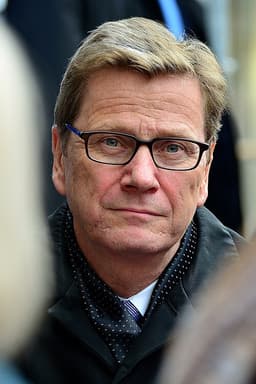
Guido Westerwelle
Politician · Modern
51.0Total

Khaw Boon Wan
Politician · Modern
49.2Total
Basic Information
Born
1961
1952
Died
—
—
Era
Modern
Modern
Nationality
Germany
Singapore
Occupation
Politician
Politician
Civilization
Western
Eastern
Score Comparison
Military (10%)
49.0
14.5
Political (20%)
68.0
68.0
Influence (20%)
52.5
51.8
Legacy (20%)
42.5
40.8
Leadership (15%)
53.2
72.0
Strategy (15%)
41.9
36.2
TOTAL
51.0
49.2
Guido Westerwelle — Complete Timeline
2004 AD
Came Out as Gay PubliclyCultural
Westerwelle publicly came out as gay, becoming one of the first high-profile German politicians to do so. He brought his partner to official events, increasing visibility for LGBTQ+ people in German politics.
LGBTQ+Coming OutVisibility
Impact: nationalconstructive
2009 AD
Appointed Vice Chancellor and Foreign MinisterPolitical Action◆ Major
Guido Westerwelle was appointed Vice Chancellor and Foreign Minister in the coalition government of Chancellor Angela Merkel. He served from 2009 to 2013, becoming the first openly gay person to hold these offices in Germany.
Vice ChancellorForeign MinisterLGBTQ+
Impact: nationalconstructive
Led FDP to Best Election ResultPolitical Action◆ Major
Westerwelle led the Free Democratic Party (FDP) to 14.6% of the vote in the 2009 federal election, the party's best result ever. This success allowed the FDP to form a coalition with the CDU/CSU.
ElectionFDPCoalition
Impact: nationalconstructive
2013 AD
Resigned as FDP Leader after Election DefeatPolitical Action◆ Major
After the FDP failed to reach the 5% threshold in the 2013 federal election and lost all its seats, Westerwelle resigned as party leader. The defeat marked a dramatic fall from the party's 2009 high.
ResignationElection DefeatFDP
Impact: nationaldestructive
Khaw Boon Wan — Complete Timeline
2004 AD
Appointed Minister for HealthPolitical Action◆ Major
Khaw was appointed Minister for Health, overseeing healthcare reforms and the expansion of public healthcare facilities. He introduced the Community Health Assist Scheme (CHAS).
Cabinet AppointmentHealthcare Policy
Impact: nationalconstructive
2011 AD
Appointed Minister for TransportPolitical Action◆ Major
Khaw Boon Wan was appointed Minister for Transport, tasked with improving the reliability of Singapore's MRT system. He oversaw major upgrades and maintenance programs.
Cabinet AppointmentTransport Policy
Impact: nationalconstructive
2012 AD
Launched the MRT Reliability Improvement ProgramReform◆ Major
Khaw launched a multi-year program to improve MRT reliability, including replacing aging tracks and signaling systems. The program aimed to reduce breakdowns and improve commuter experience.
InfrastructureTransport Reform
Impact: nationalconstructive
2014 AD
Introduced the Pioneer Generation PackageReform◆ Major
As Health Minister, Khaw introduced the Pioneer Generation Package, providing healthcare subsidies and benefits to Singaporeans aged 65 and older in 2014. The package aimed to honor the contributions of the pioneer generation.
Healthcare ReformSocial Policy
Impact: nationalconstructive
This comparison has not been analyzed yet.
One-time AI generation (~1 minute). Scores and timeline are already available below.
Rankings
🥇
Guido WesterwelleLeader
Mil: 49.0Pol: 68.0Inf: 52.5
51.0
🥈
Khaw Boon Wan
Mil: 14.5Pol: 68.0Inf: 51.8
49.2
+1.8 behind
How This Comparison Works
Algorithm
Each figure is scored on 6 dimensions (0—100 scale) based on structured historical data: Military (10%), Political (20%), Influence (20%), Legacy (20%), Leadership (15%), Strategy (15%). The weighted total produces the final ranking.
Data Sources
Scores are computed from structured sub-indicators in the database. Scale factors adjust for era (Ancient ×0.85, Modern ×1.0) and civilization size (Eastern ×1.05, Other ×0.80) to account for differences in population and military scale.
Maximum 3 Figures
Comparisons are limited to 2—3 figures to ensure readability and statistical meaningfulness.
Error Margins
±5 points per dimension — Sub-scores are derived from historical records with inherent uncertainty. Two figures within 5 points on a dimension should be considered roughly equivalent in that area.
Total Score Accuracy
±3 points overall — The weighted combination of 6 dimensions produces a total score with approximately ±3 points of uncertainty. Differences of less than 3 points are not statistically significant— the figures are effectively tied.
Known Limitations
- Historical records are incomplete and uneven across civilizations
- Figures from oral-tradition societies may be underrepresented
- Occupation labels can misclassify multi-role figures
- Scores measure capability and impact, not moral character
- Quantitative scoring is a comparison tool, not absolute truth
Capability Radar
Military (10%) — Battles & Warfare
Battles
32
14
Win Rate
34
16
Expansion
32
20
Political (20%) — Governance & Reform
Reform
45
55
Diplomacy
55
50
Economy
50
55
Influence (20%) — Cultural & Global Reach
Cultural
30
20
Global
25
20
Legacy (20%) — Historical Impact
Historical
35
25
Longevity
20
20
Leadership (15%) — Power & Stability
Tenure
60
60
Stability
40
60
Strategy (15%) — Tactics & Innovation
Strategy
35
24
Tactics
42
25
Reform
44
28
Similar Comparisons
Comments & Discussion
No comments yet. Be the first to share your thoughts!