Loading...
This comparison has not been analyzed yet.
One-time AI generation (~1 minute). Scores and timeline are already available below.
Gunthamund vs Tushratta
Gunthamund leads by 2.1 pts · 2 figures compared
…
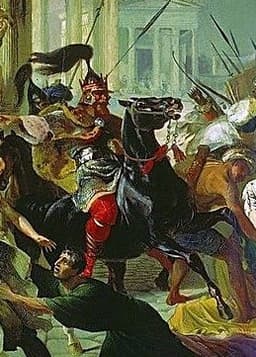
Gunthamund
Emperor · Ancient
40.8Total

Tushratta
Emperor · Ancient
38.7Total
Basic Information
Born
450
-1380
Died
496
-1340
Era
Ancient
Ancient
Nationality
Vandals
Mitanni
Occupation
Emperor
Emperor
Civilization
Western
Middle Eastern
Score Comparison
Military (10%)
22.6
50.0
Political (20%)
39.4
29.3
Influence (20%)
45.5
45.5
Legacy (20%)
35.8
36.7
Leadership (15%)
55.3
38.1
Strategy (15%)
39.6
30.3
TOTAL
40.8
38.7
Gunthamund — Complete Timeline
484 AD
Easing of Catholic PersecutionCultural◆ Major
Gunthamund reversed the harsh anti-Catholic policies of his predecessor Huneric. He allowed Catholic worship to resume, returned confiscated churches, and released imprisoned clergy. This eased religious tensions in the Vandal Kingdom.
Religious ToleranceCatholic ChurchVandal Kingdom
Impact: regionalconstructive
Accession to the Vandal ThronePolitical Action
Gunthamund became king of the Vandals after the death of his uncle Huneric. His reign focused on internal consolidation and rebuilding the kingdom's economy after years of persecution.
KingshipSuccessionVandal Kingdom
Impact: national
490 AD
Defense Against Moorish RaidsWar
Gunthamund led campaigns against Moorish tribes in the interior of North Africa, securing Vandal control over key trade routes. These raids threatened the kingdom's stability, and his efforts provided temporary relief.
Military CampaignMoorish ConflictVandal Kingdom
Impact: regionalconstructive
Tushratta — Complete Timeline
1350 BC
Correspondence with Egyptian Pharaohs via Amarna LettersPolitical Action◆ Major
Tushratta exchanged diplomatic letters with Pharaohs Amenhotep III and Akhenaten, recorded in the Amarna archive. These letters document Mitanni's alliance with Egypt against the Hittites, including requests for gold and a royal marriage. The correspondence reveals the diplomatic network of the Late Bronze Age.
DiplomacyAmarna LettersMitanni-Egypt Alliance
Impact: regional
1340 BC
Defeat by Suppiluliuma I of the HittitesWar
Hittite king Suppiluliuma I launched a military campaign against Mitanni, defeating Tushratta's forces. This defeat led to the collapse of Mitanni's power and the eventual fragmentation of the kingdom into rival factions, including the rise of Artatama II.
Hittite ConquestMitanni DeclineSuppiluliuma
Impact: regionaldestructive
Assassination by His Own SonPolitical Action◆ Major
Tushratta was assassinated in a palace coup led by his son, possibly with support from rival factions. This event plunged Mitanni into a civil war, with Artatama II seizing power in the west and Shattiwaza fleeing to the Hittites.
AssassinationCivil WarDynastic Struggle
Impact: nationaltragic
This comparison has not been analyzed yet.
One-time AI generation (~1 minute). Scores and timeline are already available below.
Rankings
🥇
GunthamundLeader
Mil: 22.6Pol: 39.4Inf: 45.5
40.8
🥈
Tushratta
Mil: 50.0Pol: 29.3Inf: 45.5
38.7
+2.1 behind
How This Comparison Works
Algorithm
Each figure is scored on 6 dimensions (0—100 scale) based on structured historical data: Military (10%), Political (20%), Influence (20%), Legacy (20%), Leadership (15%), Strategy (15%). The weighted total produces the final ranking.
Data Sources
Scores are computed from structured sub-indicators in the database. Scale factors adjust for era (Ancient ×0.85, Modern ×1.0) and civilization size (Eastern ×1.05, Other ×0.80) to account for differences in population and military scale.
Maximum 3 Figures
Comparisons are limited to 2—3 figures to ensure readability and statistical meaningfulness.
Error Margins
±5 points per dimension — Sub-scores are derived from historical records with inherent uncertainty. Two figures within 5 points on a dimension should be considered roughly equivalent in that area.
Total Score Accuracy
±3 points overall — The weighted combination of 6 dimensions produces a total score with approximately ±3 points of uncertainty. Differences of less than 3 points are not statistically significant— the figures are effectively tied.
Known Limitations
- Historical records are incomplete and uneven across civilizations
- Figures from oral-tradition societies may be underrepresented
- Occupation labels can misclassify multi-role figures
- Scores measure capability and impact, not moral character
- Quantitative scoring is a comparison tool, not absolute truth
Capability Radar
Military (10%) — Battles & Warfare
Battles
10
15
Win Rate
10
10
Expansion
5
10
Political (20%) — Governance & Reform
Reform
40
10
Diplomacy
35
40
Economy
30
20
Influence (20%) — Cultural & Global Reach
Cultural
20
20
Global
10
10
Legacy (20%) — Historical Impact
Historical
20
25
Longevity
15
15
Leadership (15%) — Power & Stability
Tenure
30
30
Stability
40
15
Strategy (15%) — Tactics & Innovation
Strategy
10
15
Tactics
10
20
Reform
5
5
Similar Comparisons
Comments & Discussion
No comments yet. Be the first to share your thoughts!