Loading...
Analysis will be generated on first visit.
Scores and timeline are available below. The page will refresh automatically when ready.
Haile Selassie vs Napoleon Bonaparte
Napoleon Bonaparte leads by 19.0 pts · 2 figures compared
…

Haile Selassie
Emperor · Modern
63.4Total
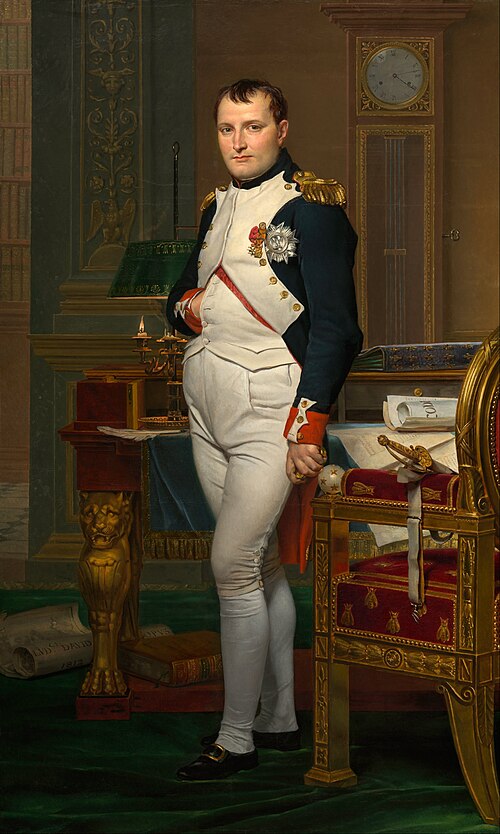
Napoleon Bonaparte
General · Modern
82.4Total
Basic Information
Born
1892
1769
Died
1975
1821
Era
Modern
Modern
Nationality
Ethiopia
France
Occupation
Emperor
General
Civilization
Other
Western
Score Comparison
Military (10%)
31.1
94.0
Political (20%)
65.8
75.0
Influence (20%)
66.7
82.0
Legacy (20%)
65.3
78.0
Leadership (15%)
80.0
80.0
Strategy (15%)
58.5
93.0
TOTAL
63.4
82.4
Rankings
🥇
Napoleon BonaparteLeader
Mil: 94.0Pol: 75.0Inf: 82.0
82.4
🥈
Haile Selassie
Mil: 31.1Pol: 65.8Inf: 66.7
63.4
+19.0 behind
How This Comparison Works
Algorithm
Each figure is scored on 6 dimensions (0—100 scale) based on structured historical data: Military (10%), Political (20%), Influence (20%), Legacy (20%), Leadership (15%), Strategy (15%). The weighted total produces the final ranking.
Data Sources
Scores are computed from structured sub-indicators in the database. Scale factors adjust for era (Ancient ×0.85, Modern ×1.0) and civilization size (Eastern ×1.05, Other ×0.80) to account for differences in population and military scale.
Maximum 3 Figures
Comparisons are limited to 2—3 figures to ensure readability and statistical meaningfulness.
Error Margins
±5 points per dimension — Sub-scores are derived from historical records with inherent uncertainty. Two figures within 5 points on a dimension should be considered roughly equivalent in that area.
Total Score Accuracy
±3 points overall — The weighted combination of 6 dimensions produces a total score with approximately ±3 points of uncertainty. Differences of less than 3 points are not statistically significant— the figures are effectively tied.
Known Limitations
- Historical records are incomplete and uneven across civilizations
- Figures from oral-tradition societies may be underrepresented
- Occupation labels can misclassify multi-role figures
- Scores measure capability and impact, not moral character
- Quantitative scoring is a comparison tool, not absolute truth
Capability Radar
Military (10%) — Battles & Warfare
Battles
45
95
Win Rate
40
90
Expansion
30
95
Political (20%) — Governance & Reform
Reform
60
95
Diplomacy
75
80
Economy
50
85
Influence (20%) — Cultural & Global Reach
Cultural
70
85
Global
70
90
Legacy (20%) — Historical Impact
Historical
75
95
Longevity
65
90
Leadership (15%) — Power & Stability
Tenure
85
85
Stability
40
70
Strategy (15%) — Tactics & Innovation
Strategy
50
95
Tactics
35
98
Reform
55
92
Analysis will be generated on first visit.
Scores and timeline are available below. The page will refresh automatically when ready.
Haile Selassie — Complete Timeline
1930 AD
Coronation as EmperorPolitical Action◆ Major
Haile Selassie was crowned Emperor of Ethiopia at Addis Ababa, taking the throne name Haile Selassie I. The coronation was a grand ceremony attended by foreign dignitaries, symbolizing Ethiopia's sovereignty.
CoronationEmperorSovereignty
Impact: nationalconstructive
1936 AD
Italian Invasion and ExileWar
Italy invaded Ethiopia, and Haile Selassie's forces were defeated. He fled into exile in England, where he appealed to the League of Nations for help, famously denouncing the invasion and the failure of collective security.
InvasionExileLeague of Nations
Impact: globaltragic
Address to the League of NationsPolitical Action◆ Major
Haile Selassie addressed the League of Nations in Geneva, condemning Italy's use of chemical weapons and the League's failure to protect Ethiopia. His speech became a symbol of African resistance and international justice.
SpeechLeague of NationsChemical Weapons
Impact: global
1941 AD
Return to Ethiopia and RestorationWar◆ Major
Haile Selassie returned to Ethiopia with British forces, leading a campaign to liberate the country from Italian occupation. He was restored to the throne, reestablishing Ethiopian independence.
LiberationRestorationBritish Alliance
Impact: nationalconstructive
1955 AD
Constitution of 1955Reform◆ Major
Haile Selassie promulgated a new constitution that established a bicameral parliament and limited civil rights. While it allowed for some representation, it maintained imperial authority and did not create a fully democratic system.
ConstitutionParliamentReform
Impact: national
1974 AD
Overthrow and DeathPolitical Action
Haile Selassie was overthrown by the Derg, a Marxist military junta, after a period of famine and unrest. He was placed under house arrest and died in 1975 under disputed circumstances, ending the Solomonic dynasty.
CoupDergEnd of Dynasty
Impact: nationaltragic
Similar Comparisons
Comments & Discussion
No comments yet. Be the first to share your thoughts!