Loading...
This comparison has not been analyzed yet.
One-time AI generation (~1 minute). Scores and timeline are already available below.
Ho Chi Minh vs Imam Shamil
Ho Chi Minh leads by 2.8 pts · 2 figures compared
…
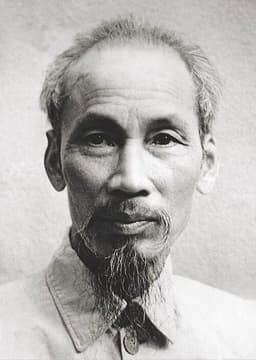
Ho Chi Minh
Revolutionary · Modern
62.9Total

Imam Shamil
Revolutionary · Modern
60.1Total
Basic Information
Born
1890
1797
Died
1969
1871
Era
Modern
Modern
Nationality
Vietnam
Dagestan
Occupation
Revolutionary
Revolutionary
Civilization
Eastern
Middle Eastern
Score Comparison
Military (10%)
55.0
72.5
Political (20%)
72.0
68.0
Influence (20%)
62.0
61.0
Legacy (20%)
58.0
56.0
Leadership (15%)
72.0
48.8
Strategy (15%)
58.0
61.2
TOTAL
62.9
60.1
Ho Chi Minh — Complete Timeline
1941 AD
Establishment of the Viet MinhPolitical Action◆ Major
Ho Chi Minh founded the Viet Minh (League for the Independence of Vietnam) in southern China. This coalition of nationalist and communist groups became the primary force for Vietnamese independence, fighting both Japanese occupation and French colonialism.
Viet MinhIndependence MovementWorld War II
Impact: nationalconstructive
1945 AD
Declaration of Independence of VietnamPolitical Action
Ho Chi Minh proclaimed the Democratic Republic of Vietnam in Hanoi's Ba Dinh Square, citing the US Declaration of Independence. This established the Viet Minh government and began the struggle for independence from French colonial rule.
IndependenceVietnamDecolonization
Impact: nationalconstructive
1954 AD
Battle of Dien Bien PhuWar
Ho Chi Minh's Viet Minh forces, under General Giap, defeated the French garrison at Dien Bien Phu. This victory ended French colonial rule in Indochina and led to the Geneva Accords dividing Vietnam at the 17th parallel.
Vietnam WarDecolonizationFrench Indochina
Impact: regional
Geneva AccordsPolitical Action◆ Major
Ho Chi Minh's delegation signed the Geneva Accords, temporarily dividing Vietnam at the 17th parallel. The agreement promised nationwide elections in 1956, which were never held, leading to the permanent division of Vietnam.
Geneva ConferenceDivision of VietnamDiplomacy
Impact: regional
1959 AD
Start of the Vietnam WarWar
Ho Chi Minh's government in North Vietnam authorized armed struggle against the US-backed South Vietnamese regime. This escalated into the Vietnam War, a prolonged conflict that resulted in millions of deaths and US withdrawal in 1973.
Vietnam WarCold WarCommunism
Impact: globaldestructive
Imam Shamil — Complete Timeline
1834 AD
Proclaimed Imam of DagestanPolitical Action
Following the deaths of Ghazi Muhammad and Hamzat Bek, Shamil was elected as the third imam of the Caucasian Imamate. He united the mountain tribes of Dagestan and Chechnya under a theocratic state to continue resistance against Russian imperial expansion.
Caucasian WarLeadershipResistance
Impact: regionalconstructive
1839 AD
Battle of AkhulgoWar◆ Major
Russian forces under General Grabbe besieged Shamil's stronghold at Akhulgo. After a three-month siege, Shamil escaped with his family but suffered heavy losses. The battle demonstrated Russian military superiority but failed to end the rebellion.
Caucasian WarSiegeRussian Empire
Impact: regionaltragic
1843 AD
Capture of GergebilWar◆ Major
Shamil's forces captured the Russian fortress of Gergebil in Dagestan. This victory marked the peak of his military power, allowing him to control much of the Caucasus interior and threaten Russian supply lines.
Caucasian WarVictoryFortress
Impact: regionalconstructive
1859 AD
Surrender to Russian ForcesWar
After the fall of his last stronghold at Gunib, Shamil surrendered to Prince Baryatinsky. He was taken to Russia as a prisoner, ending the 25-year Caucasian War. The surrender marked the final Russian conquest of the North Caucasus.
Caucasian WarSurrenderRussian Empire
Impact: regionaltragic
Exile to KalugaPolitical Action
Shamil was exiled to Kaluga, Russia, where he lived under house arrest. He was treated with respect by Tsar Alexander II and allowed to perform religious duties. This exile ended his active role in the Caucasus.
ExileRussian EmpirePrisoner
Impact: national
1870 AD
Pilgrimage to MeccaCultural
Shamil received permission to perform the Hajj to Mecca. He traveled via Istanbul and Medina, meeting with Ottoman Sultan Abdulaziz. This pilgrimage fulfilled his religious duty and marked his final journey before death.
HajjReligiousOttoman Empire
Impact: regionalconstructive
This comparison has not been analyzed yet.
One-time AI generation (~1 minute). Scores and timeline are already available below.
Rankings
🥇
Ho Chi MinhLeader
Mil: 55.0Pol: 72.0Inf: 62.0
62.9
🥈
Imam Shamil
Mil: 72.5Pol: 68.0Inf: 61.0
60.1
+2.8 behind
How This Comparison Works
Algorithm
Each figure is scored on 6 dimensions (0—100 scale) based on structured historical data: Military (10%), Political (20%), Influence (20%), Legacy (20%), Leadership (15%), Strategy (15%). The weighted total produces the final ranking.
Data Sources
Scores are computed from structured sub-indicators in the database. Scale factors adjust for era (Ancient ×0.85, Modern ×1.0) and civilization size (Eastern ×1.05, Other ×0.80) to account for differences in population and military scale.
Maximum 3 Figures
Comparisons are limited to 2—3 figures to ensure readability and statistical meaningfulness.
Error Margins
±5 points per dimension — Sub-scores are derived from historical records with inherent uncertainty. Two figures within 5 points on a dimension should be considered roughly equivalent in that area.
Total Score Accuracy
±3 points overall — The weighted combination of 6 dimensions produces a total score with approximately ±3 points of uncertainty. Differences of less than 3 points are not statistically significant— the figures are effectively tied.
Known Limitations
- Historical records are incomplete and uneven across civilizations
- Figures from oral-tradition societies may be underrepresented
- Occupation labels can misclassify multi-role figures
- Scores measure capability and impact, not moral character
- Quantitative scoring is a comparison tool, not absolute truth
Capability Radar
Military (10%) — Battles & Warfare
Battles
65
75
Win Rate
60
60
Expansion
55
65
Political (20%) — Governance & Reform
Reform
85
65
Diplomacy
90
60
Economy
40
40
Influence (20%) — Cultural & Global Reach
Cultural
75
70
Global
75
55
Legacy (20%) — Historical Impact
Historical
85
75
Longevity
70
65
Leadership (15%) — Power & Stability
Tenure
70
70
Stability
50
55
Strategy (15%) — Tactics & Innovation
Strategy
80
80
Tactics
70
85
Reform
75
70
Similar Comparisons
Comments & Discussion
No comments yet. Be the first to share your thoughts!